Showing posts with label Airstream Basecamp. Show all posts

Friday, August 16, 2024

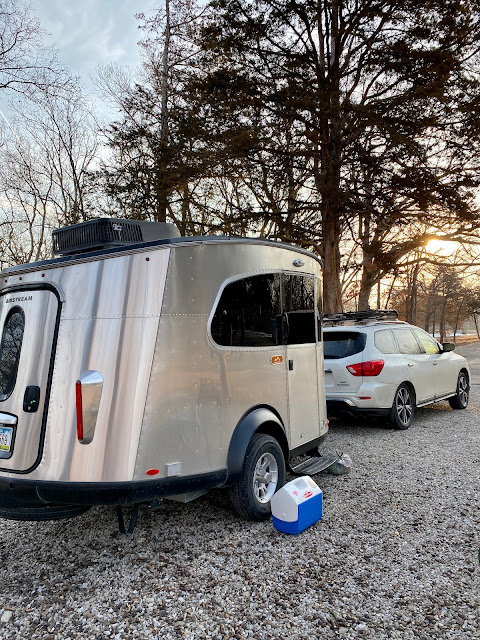
Airstream Basecamp 16-Foot Review, a 4-Year Owner's Review

2024 Memorial Day Weekend
Having just finished a full-time year of teaching 4th Grade after ten years of retirement, I'm now retiring . . . again. Oh, I'll probably be doing a little substitute teaching next year, but working 1-2 days a week and taking off 5-6 days a week--that's retired, isn't it?

I am, therefore, beginning my re-retirement with a review of our 2021 16-foot Airstream Basecamp. First, though, there should be some discussion about the subject this blog has been focused on during the years--tiny trailers, trailers that provide an inside living space, keep you comfortable during inclement weather, and provide a safe, secure place to sleep. Some tiny trailers are little more than "hard-sided tents" (which isn't necessarily a bad thing), and some tiny trailers are touted as self-sufficient living spaces. Most tiny trailers are truly tiny, providing a space for sleep and for sitting with legs crossed. 

My 16-foot Airstream Basecamp resides at the opposite side of the tiny trailer spectrum; I actually feel more comfortable labeling it a little or small trailer, one having enough room for a bed/dining table, a bathroom, and a kitchen. There are other little trailers that are slightly smaller which provide a self-sufficient living space, the Tab 320 being a notable example. However, with Airstream's years of experience building travel trailers and its innovative Basecamp design, the Airstream Basecamp 16-footer is right up there at the top of little trailers that, as my wife's son recently said after camping in the Basecamp for a week and a half, "provide everything you need and nothing you don't."

It should be noted that the tiny trailers camping philosophy is that choosing a small camping space inside means that one spends more time outside. Minimalism is the key word for tiny trailer camping, and minimalism begins with towing a very small living space which can generate descriptors all the way from "cozy" to "cramped," depending on the campers and weather. Our Basecamp is no exception to the dilemma of "How big is too big? How small is too small?" We still debate the trade-offs, sometimes with our individual selves! I have previously written about tiny trailers trade-offs in the article "The Airstream Basecamp Is a Little Camper--and We're Glad."

Positive Qualities

The current Basecamp is an innovative new iteration of an older idea, with the camper resurfacing in 2018 onto the market with a similar but upbeat design. Here are the features my wife and I like.
  • At six and a half feet wide, the trailer is easily pulled by my Nissan Pathfinder SUV. Although not absolutely necessary, I've added inexpensive extension mirrors which lessen the blind spot behind the camper when towing. 
  • The kitchen provides ample space for cooking equipment and supplies. The roof-level netting storage areas work well for us. We use REI storage bags for clothes and have found that the front net storage holds light food items well even without storage bags. We still cook quite a bit outside, but having an indoor space is a real treat when the weather is bad or buggy.
  • We still use campground facilities a lot but have found the indoor toilet convenient for nighttime and inclement weather.
  • Like all small trailers, there is quite a bit of setting up and breaking down the bed/dining area, but the Basecamp's configuration has been good for us. 
  • The air conditioner and Truma  heating system work well; sometimes I use a space heater for a more "fireplace effect."
We've found the Basecamp to be solid and dependable. Our warranty issues were centered around three weaknesses that were identified during the first years of the trailer's reiteration: the air conditioner securing screws working loose (company fix with Loctite), the door window becoming unglued (re-sealed by the company), and door locks not strong enough in windy conditions (longer screws added by the company), As we turned the Basecamp in just now, we are having the visor over the rear door re-caulked because a leak during rain. We were told this is a known problem, that the caulk dries out and needs to be renewed. Other than those issues, we've found the unit delivers.

Design Issues

The quality of the materials used in the Basecamp we've found excellent, and the set-up of the unit is thoughtful and utilitarian yet still elegant. However, there are a few issues in the design that cause occasional consternation. 
  • The overhead fan is noisy even at its lowest setting. There are quieter fans out there.
  • The venting side "van" windows are classy to look at and really add to the unit's beauty; however, they provide less air circulation than some other options. This especially becomes a problem if the front door is closed at night for security. Adding windows with low air circulation with a noisy fan has caused some frustration. Why not use the air conditioner, you might ask? The ac is a solution but is more noisy than windows open and a quiet ceiling fan would be.
  • The back door can provide nice ventilation if the area is secure. However, the snap netting, although it works well for mosquitoes isn't much of a barrier for crawling bugs, such as stink bugs that we once battled. Also, I use a swimming noodle and bungee cord to secure the back door to eliminate strain on the manufacturer's standard hooks.
  • My wife and I eventually bought two-inch latex foam pads for sleeping to augment the standard Basecamp cushions. The factory cushions were minimally acceptable for me but a definite no-go for my wife. I later succumbed to the allure of greater sleeping softness and have never felt any guilt. 
  • I've added a roof vent cover for the fan so that I can open the vent during rain. The cover definitely disrupts the sleek design of the roof, but having the fresh-air option during rain is too practical for me to take a "pass" on.
  • The Basecamp design puts its electronic controls next to the door on the wall, a place that can attract excessive condensation inside the shell, which has shorted out some models. An after-market #D-printer spacer is available for the Truma control panel, discussed on a Facebook owners' group. This link should be available if you belong to the group Airstream Basecamp Owners. The spacer has venting on three sides. I also use a little dehumidifier when there's a lot of condensation. It provides some relief, taking out about a cup of water a day when I'm camping alone.
I've tried to discuss issues specific to the Basecamp and not pro and con issues that are common to all tiny trailers owners. My wife and I realize that buying a larger camper would create a new challenge for every challenge the larger camper would solve. Likewise, buying a tinier trailer would also both solve and create problems. Times change, needs change, but the Airstream Basecamp 16 is a pretty sweet rig, compared to any other camper its size. 

We do think fondly of our first camper, a little standy we called the Green Goddess, a Rustic Trail camper, Polar Bear model. Also, Rustic Trail is now manufacturing some new, innovative models. We've even talked some about someday owning both the Airstream and a Rustic Trail camper! Those are fun conversations, but the main reason I'm writing this review now is that my wife and I have just traded our Basecamp in at Blue Compass RV in Des Moines, Iowa, (where we bought the Basecamp, formerly RV One) and have bought a  16-foot Airstream Bambi. 


It wasn't that we were dissatisfied with the Basecamp, not in any fundamental way; our decision was based on our lifestyle. Right now I am retired and my wife is still busy with her consulting business. With the Basecamp, if she were working and I was resting, we were both together in the back of the Basecamp with either the bed half-made and one table set up, or with both tables set up and with me resting on one of the benches. With the Bambi, there is a permanent bed in the back and the dinette table (which can convert to a bed) up front, which provides separate spaces for each activity. The main reason this is possible is that the Bambi is wider than the Basecamp, eight feet wider rather than six and a half feet.

We know we'll miss the Basecamp with its unique design. I describe the Basecamp as having a modern aesthetic design, whereas the Bambi has the iconic, retro Airstream silver bullet look. Both looks are beautiful, but we'll have to get used to owning an iconic aluminum classic travel trailer rather than owning a spaceship cleverly disguised as an Airstream travel trailer. We look forward to new adventures, though, and will share our stories with you.


Subscribe--Follow by Email

* indicates required

Saturday, July 6, 2024

A Beginner's Experience of Camping in a Little Trailer

Rainy Day Getaway
"Look at this!" my wife's son says on Facetime from his campsite an hour's drive from our home. What we see is a plastic storage bin at the rear door of our Airstream Basecamp travel trailer, water dripping steadily from the top of the door seal. That drip-drip-drip is one more lesson in a beginning camper's experience of being on the road alone--in this case during a driving rainstorm. 

My reply via Facetime was to say, "Yes, that happened to me once. How's the bin catching the drip?" Since it was raining hard but the plastic bin was catching the drips, that was the end to my part of the crisis. The next morning I called Thomas and suggested that he should check the rubber seal. Sometimes in the heat it pulls loose when the door is opened. After checking the seal, the evidence was that there was a wrinkle in the seal, and Thomas said he would readjust the seal and wipe down the closure area. Problem solved . . . we hope.

For anyone who has gone camping, we know that things come up--and that there is a learning curve. Experience and knowledge are good things and can ease the bite when chance reaches out and nips us. I've been enjoying teaching Thomas and helping him enter his first year of small trailer camping. He's doing a great job, and interacting with him during this camping season has been a great walk down memory lane plus a good venue for us to get to know one another better.

The first step in teaching Thomas how to tiny trailer camp was towing. I already had a hitch and ball, so we mounted that on his Tacoma pick-up and then had the electric brake controller installed. In order to learn how to back the trailer, Thomas followed the same steps I had used: hitching up from my driveway and then rounding the block and backing in; then pulling out in the opposite direction, rounding the block, and backing in again, thus backing in from both directions. After about three mornings of practice, I told Thomas he was ready to hit the road. To be perfectly honest, he was a much faster learner than I was. 

Memorial Day Campsite
His first camping experience in the Basecamp was at our local county park, about five miles from our house. Thomas didn't have towing set up on his Tacoma yet, so since he was going to camp with his sister and her family, they towed his trailer out to the campground after setting theirs up. It was a great experience for Thomas, seeing how the campground is peaceful on weekdays and more lively on the weekends. He also learned a bit about planning--packing bread and mustard for sandwiches, but forgetting the other ingredients! We've all done that, right? On his current trip, he came back to visit us the next day because he had forgotten something vital--coffee! And so the beginner's experience of camping grows, becoming more adept and rich. We dream, then plan, and then learn through trial and error. 

Belva Deer Campground
On his second camping experience towing, Thomas was a little late getting ready, and his sister and company showed up early for their trip to Lake Belva Deer Park campground. They caravaned together to the campground, and the early departure meant a few items were left behind; however, he was more philosophical about his lapses, realizing that he had the basics--a place to stay, food, clothing, and good company. 

At an Older "Retro" Campground
On Thomas's current trip, he has towed the camper himself for the second time, set it up, and is enjoying his first solo camping experience. Yes, he burned his leg on our Solo stove, but he is happy, taking 45-minute walks around the lake, riding his bike, or just lying back in the chaise lounge at camp and reading. The Basecamp provides him with a self-sufficient, safe haven, a true "basecamp" for him to explore and relax. 

I am reminded of my little learning lessons, such as when a raccoon opened my ice box and stole a baked potato I was going to cook as home fries the next morning. Or the time during a big rainstorm when a limb fell and bashed a hole in my first trailer, the Green Goddess (link to article). I also remember the time my wife and I traveled to Carlsbad, California, to visit her parents. When backing the trailer into their driveway, having to be very precise so there was room for the parents' car to still get into the garage, I had to finally tell everyone, "I can get the trailer exactly where we want it. Just be patient and let me do it with twenty tries instead of two." My retired major Marine Recon father-in-law graciously listened to me, and by-golly I finally got the rig where we wanted it! I could go on and on, and I know that many reading this article could add their own stories, ones we fondly look back on now but which were a bit tense at the time they were happening. 

We learn as we go, and it has been my joy to see Thomas successfully negotiate his learning curve from beginning camper to Old Man on the Mountain. Even though there are no real mountains in Iowa, you get the idea: one more experienced camper is now enjoying the great outdoors. 

Bambi, the Apache, Mickey, Minnie, and their pet Godzilla
You may ask, What about my camping? What about our camping, my wife and I? The short answer to that is that after coming out of retirement and teaching full-time for one year, it's just plain nice to kick back at home and to spend time together with Sandy. Also, Sandy and I have a little visual aid in the house to keep our dreams alive and our curiosity lively!

Subscribe--Follow by Email

* indicates required

Saturday, November 19, 2022

A Basecamp Country Mouse


The winds were from the north when we buttoned up our Airstream Basecamp 16 and left for home, thirty-nine miles away. Yes, it was cold, but we had some chores and appointments in town, so a couple of nights off our land was the best solution. I felt a bit strange leaving the trailer because usually we're either camping in it or it's parked in our driveway where we can keep an eye on it. Owning land has changed our habits, though, and in many ways our Basecamp has become our country cabin--a place to stay and also a place ready for us to stay. We're getting used to leaving our little travel trailer, and at least it has the company of our storage shed that we also have established as part of our country basecamp--a Basecamp at our basecamp!

One task on my to-do list for the Basecamp has been to set a drop light one night on the ground beneath the trailer, and then to go inside and open benches and cabinets to look for light and, therefore, small open spaces that could provide access to the trailer for bugs and critters. Those spaces I can stuff with steel wool. Well, I've never gotten around to it, and I'm sorry that I've put that task off. On returning to our trailer two days later, the trailer winterized and the electric Truma furnace set at 47 degrees, I discovered evidence that a mouse had taken up residence. On the kitchen counter I had left three acorns from one of our mother oaks on the property. Upon my return, two had disappeared except for some remains of chewed shell. Yikes!

I don't mind mice; in fact, I think they're cute--in their own environment. What I've found, though, is that mice aren't fun if they are in my environment--chewing on this and that, and the scat and urine. I had no traps, though, so dealing with the situation had to be left till we returned home. The mouse was remarkably neat and hadn't chewed into any food, not into the protein bars or the ramen noodles. We have most of our food stored in hard plastic containers, so that did limit the critter's access to our food. However, there was no doubt that the mouse had taken up residence in our trailer and was somewhere nesting.

That night, the motion sensor for our cabinet light flashed on even though the door was closed and my wife Sandy and I were in bed--corroboration that the mouse had not just visited, eaten a couple of acorns, and then vamoosed. The next morning, Sandy was drinking tea when she saw motion through the smoke-colored plastic cupboard door, and there was the mouse, happily checking out our food yet not chewing on anything. Very cold weather, north winds, and snow were arriving in a couple of days, so Sandy and I decided to pack up and head for home with the travel trailer, a good decision since the little Basecamp can be a tight space when we have to stay inside for longer periods due to more extreme weather.

When arriving home, I unpacked and then found a mousetrap in the garage. Setting it with sharp cheddar cheese, I was both hoping and dreading catching the mouse. I have as much right as any other critter to maintain my home, yet those traps are pretty brutal. For two days I played the game of baiting the trap with cheese and having the mouse eat it. I think the cheddar was a bit hard and flaky, so it fell from the trigger more easily than soft cheese. I changed out traps, and on the third day caught the mouse. Sad, yet happy that I didn't have to worry about chewed wires or insulation (or soiled cabinet and living space), I reset the trap just in case I was dealing with a family.

I've always felt okay with trapping mice that have invaded my living space, but I think I'm going to research humane traps and maybe try them. For our health and the integrity of our home (whether camping or permanent residence), I intend to keep our home critterless, but I hope a humane trap will work next time. I hope that's possible. If necessary, I'll send a mouse into its next cycle of evolution, into its next incarnation, playing the same role as a hunting hawk or a fox; it's part of the structure of the world. However, as a human, I have a choice, and I think I'll try a catch-and-release system next time. So if you discover a new mouse has arrived in your area, unless you have video . . . it wasn't me.

Subscribe--Follow by Email

* indicates required

Wednesday, August 17, 2022

From State Park to Private Camping on Our Own Land

It's not exactly boondocking, but it is camping with privacy--on thirty-five acres of property my wife and I just bought in rural southeast Iowa. We've been preoccupied with getting the land ready for camping, land that had been neglected--both a good and bad thing--good because the property hasn't been messed with and so is pretty wild, and bad because multiflora rose grows abundantly, along with poison ivy. 

Trails have been cut on the property which allow us to hike the perimeter of the land, which includes a higher ridge hill and also a lowering to the north where our land's boundary includes a creek. The land includes at least four large white oaks, hickory, honey locust, and other varieties that I still have to identify. Much of our initial work will be thinning the forest of saplings so we will be able to mow and open up the space. We're even researching the possibility of bringing in goats to clear out the bush!


Our first action on the land was to have the trails opened up, the second and third actions to activate electrical power and to gravel a driveway and camping area. We need to have a spigot installed to our water access. Having purchased a few mowing and work-related tools, we now will just begin exploring and improving. Even though the creek is mostly dry now, and even though during the rainy season it will be mostly muddy, the combination of hill and bottom land provides a diversity that we like. 

Camping in August on our over-grown land was enjoyable--despite the humidity, sweat flies, and chiggers and ticks. We plan, though, to be easy with the camping until the weather cools. It's then that we'll jump in more with the mowing and thinning. I did buy a second MoonShade awning, though, to help with the sun for the four nights I've camped on the land so far.

We've also discovered that our new Starlink communications connection works well. Eventually we hope for Sandy to be able to work on the land so that we can stay there for longer periods of time. Will we still travel and camp, though? Yes! I hope this late summer to camp at Backbone State Park again and to wade the Upper Iowa River. In the same area, I hope this fall to primitive camp (no electricity or water) in the Yellow River State Forest. 

Mostly, we intend to enjoy this new experience of camping and working on the land rather than just hiking for recreation. It's a new kind of interaction with nature, one of stewardship. I have no doubt there will be lots of hard work, but there will also be joy in especially helping the trees on the land to grow without too much crowding, and to help the land be freed of the invasive multiflora rose. 

I plan to write more about my experiences with our new land on my writing blog, Tom Kepler Writing (https://www.tomkeplerswritingblog.com). Go to that blog and subscribe for updates . . . or subscribe to this blog because I intend to provide links on our work on the land to Green Goddess Glamping subscribers, too. The form for subscribing to this blog is below.

Subscribe--Follow by Email

* indicates required

Sunday, June 19, 2022

A New Hitch for My Airstream Basecamp 16

Blue Ox Weight Distribution, Anti-sway Hitch
When I initially purchased my 2021 Basecamp in June of 2020 (six-month wait till delivery), the salesperson added a weight-distribution, anti-sway hitch for free. Picking up the Basecamp in December of 2020, I was told that my Nissan Pathfinder didn't need the hitch: it wasn't a big enough trailer. RV One in Des Moines, Iowa, talked me into substituting the hitch for a free electric jack. 

Fast forward to May of 2022 when I took the trailer in to RV One in Des Moines, Iowa, for some warranty work. "Look," the service agent said, "see how the rear of your Pathfinder is sagging? You need a weight-distribution hitch!" This, of course, is what I had felt all along and was actually going to bring up the topic during the visit. 

I told my story, and the agent said, "They didn't have an Airstream Basecamp/SUV solution back in 2020. Airstream has partnered with the company Blue Ox, and now we have a hitch for you." You see, the original RV One salesperson hadn't been the regular Airstream individual, so she didn't know that there wasn't a good Basecamp/SUV hitch solution available back then. I think maybe there was some fancy footwork back then to cover the sales department's lack of knowledge, but after telling the story and asking, I received a ten percent discount on the hitch.

The Blue Ox TrackPro owner's manual states: "The TrackPro is a revolutionary hitch that not only handles weight distribution but sway prevention as well by using the combination of loaded spring bars, friction L brackets and an integrated hitch head. As the trailer tries to sway it puts a heavier load on one side of the bars, as this happens the spring bars will pivot on the hitch head and balance load working with the friction L brackets to prevent and control trailer sway. The TrackPro will also conquer weight distribution at the same time, putting more weight on the towing vehicles front tires which increases steering control and braking giving you a safer and easier driving experience."

I think probably this description of the TrackPro's functioning also describes what all weight-distribution, anti-sway hitch arrangements do, but I can say that the Blue Ox hitch does a great job. Having just returned from a trip from Iowa to California and back without the new hitch, I can really tell the difference. The new hitch provides more stability and control while towing. Now, as a retired English teacher, I can also say the owner's manual needs a bit more proofreading attention, but since I'm retired, I'll give the company a pass. My attention is on safe towing, and this hitch provides much more stability when turning; the feel of centrifugal force is much less pronounced with the wider hitch base.

I've summarized some of the drama and jiving that took place regarding RV One and my finally acquiring the new hitch. The service agent said, though, that there had been a reorganization of the service department, with all Airstream service flowing across her desk. Things did seem more orderly during this visit, compared with my purchase and pick-up experiences. I enjoyed working with Jill Holland, the service agent; and the Certified Airstream Technician, Marvin Sorber, was also easy to work with. He explained the hitch's set-up to me and let me do the hook-up work, providing information and suggestions as I proceeded. He also did the warranty work needed, which got me on the camping road again.

I'm writing this blog post now while camping in Backbone State Park, the oldest state park in Iowa. It's good to be back on the road, and I'm glad I chose to buy the Airstream Basecamp. Although having the Airstream dealership two and a half hours away is a bit of a trip, it's certainly less than the two-day drive that would be necessary for a Canadian travel trailer my wife and I had considered buying. I'll stop now and take a few minutes to gaze out my front-window perspective at the rising sun. Hmmm--what's for breakfast? French toast, I think!

Subscribe--Follow by Email

* indicates required

Sunday, May 22, 2022

Vent Hood or No Vent Hood? My Experience and Choice

Dometic Ultra Breeze
I associate the roar of my little travel trailer's air conditioner with "coolth," a bit of blessed relief from summer heat and humidity. Merriam-Webster's definition of the word coolth is "the state or occasion of being cool," exactly what I want if I must camp when the heat is excessive. However, air conditioners in a tiny or little camper are loud. At least, that's my experience. When possible, I prefer to open my ceiling vent to bring in a little cool air, even though my ceiling fan is also loud, albeit not as loud as the ac. Having the vent open when possible during the night is especially preferable over the air conditioner. "When possible" are the key words, though. Having a hole in the camper's ceiling when it's raining is not a good idea. Believe me, I've tried it. Having a hood for the ceiling vent fan dramatically extends my ability to have the vent open, even when it's raining. 

MaxxAir Fanmate
Both of the travel trailers I've owned, a Polar Bear "standy" from Rustic Trail Teardrop Campers and an Airstream Basecamp both were purchased without vent hoods, but I added them to both following the experience of having to choose ac noise, stuffiness, or a wet floor during rain storms. With both trailers, the experience of having to shut the vent during rain storms was the ultimate determiner for opting for the vent hood. My experience with the vent hood for my Basecamp occurred just two days after installing the hood. I was at Saylorville Lake in Iowa, and it began to rain. The hood allowed me to keep the vent open even during the rain. Prior to buying the hood, I was concerned that the hood would interrupt the sleek lines of the Basecamp, but now that I've added the hood, I'm already used to it. 

The Facebook group Airstream Basecamp provided me with all the information that I needed to purchase and install the hood. Thanks, Todd! The smoke-colored Dometic U1500GR Ultra Breeze Vent was easy to install, the instructions clear and straightforward--essentially removing screws, adding caulk sealant, placing mounting brackets, screwing slightly longer screws into the original holes, and then adding sealant onto the screw location. I did find that using my extension ladder, leaned against the trailer, was more stable than using my folding ladder. 

The Dometic vent fan is louder than the MaxxAir Fanmate cover that I bought for the RTTC Polar Bear. That, of course, has nothing to do with the vent hood; however, they were both easy to install. I also plan to camp more off the grid this season, so having more options for "coolth" besides turning on the air conditioner is important, since the air conditioner is only an option for me if I have shore power. 

Now when it's too rainy to have the doors or windows open, I will have the option of keeping the vent open, thanks to my vent hood. Using the fan option on the air conditioner is possible, but only if I don't mind the noise and if I'm hooked up to electricity. Since the hood can be removed with four clips, I can always remove the hood if I want to "style" my way along in a parade or something. I don't mind the utilitarian and practical look, though, if that's what it takes to keep me dry when out and camping.

Subscribe--Follow by Email

* indicates required

Friday, April 29, 2022

From Airstream Driveway Mooching to Beach at Carlsbad, California

Driveway Mooching at Carlsbad, California
Two weeks of driveway mooching--quiet and private
This was my last bicycle ride along the Pacific Ocean, so I made sure I would savor the experience. Six days of traveling in our 16-foot Airstream Basecamp (five overnighters) landed my wife and me in Carlsbad, California, for thirteen nights of driveway mooching at her parents' cul-de-sac, quiet residence. We've planned for another five overnighters at different RV parks to get home, but first while my wife was gone for the day at a business meeting, I wanted one more day of riding the five and a half mile route along the ocean to Carlsbad State Park Campground. Since it was my last day ride this trip, I wanted to stop for every whim and gaze at every vista.

The morning began with the lightest misting rain, but that burned off before my departure. It was just part and parcel of the Carlsbad experience, walking out in the morning to a gray, overcast sky, the lightest mist of precipitation cool to the skin, the faint smell of the briny ocean perfuming the breeze off the ocean. I rode at a steady but easy clip, enjoying the sights, especially once I dropped off the hills above the ocean and reached the beach area. Carlsbad has a long paved sidewalk that skirts the beach, and the road along the ocean includes well-planned bicycle lanes for each direction, north and south, miles and miles of bicycling and walking opportunities. 

I headed south toward my destination of Carlsbad State Park. Although there are hills, none are excessive and the ride is easy. At several points there are long stretches of parallel parking available for beach goers, a bike lane next to the parked cars, but with a safe zone between so bicyclists don't get "doored." Along this stretch, I saw a tiny, homemade "standy" trailer parked, a "for sale" sign on its side. I rode by, admiring the craftsmanship, but then turned back to ask for a photo and maybe to ask a few questions. 

Tiny trailer at Carlsbad, California
Homemade tiny trailer/toy hauler
Warren Jackson, from Virginia, had bought himself an EZ Hauler trailer and then built his custom dream trailer inside the aluminum shell. What he ended up with was a tiny toy hauler with the rear tailgate door dropping down to make a deck for his lawnchair. The inside included a bed, TV and electronics up front, and a sink, portable toilet, and space for a portable stove. He also had installed 640 watts of solar power on the roof so that he could run his little air conditioner. The strength of the exterior aluminum shell and the exquisite custom interior woodwork were certainly pluses. He was moving to Europe, which was why the trailer and his F-150 Ford truck were for sale. 

Tiny trailer at Carlsbad, California
A toy hauler capacity with a back deck
Tiny trailer at Carlsbad, California
Beautifully finished interior
We chatted for a while, talking construction and pricing. Since I write this blog about tiny and little trailers, he was curious about pricing, saying he was asking $27,000 for the trailer. I told him that since the trailer was a bit larger than many tiny trailers, especially with the flat roof which enabled standing its entire length and with the big solar kit, the price wasn't unreasonable. I felt the bed set-up, which was twin size, would certainly be limited for a traveling couple. That could be worked around, though. I wished Warren well and continued on my way. 

After a bit more riding, passing beach volleyballers stretching and warming up and surfers out beyond the swells sitting their boards, I crested the next hill and stopped at a traffic light. A young man at a commuter bus stop asked me a question, rapidly speaking Spanish. I responded, ¿Que? He asked if I spoke Spanish. Un poquito, I said. ¿Inglés? he asked. When I nodded, the young man said he was up from Mexico, meeting friends, but his cellphone was dead and he needed to find out where the McDonalds was where he was to meet them. We searched on my phone and found the McDonalds he needed was just three tenths of a mile away, across the ocean highway and over an overpass to cross the freeway. He gave me a "Thank you, sir," and I was on my way.

This bicycle ride today was much easier for me because I knew my route, having traveled it several times already. Carlsbad State Park is dominated by the Pacific Ocean, the campground on the bluffs above the ocean. The campground is also close to the four-lane ocean frontage road, but even that manmade reality does not overshadow the ocean. I meandered along the camping strip this trip, and snapped a few photos of interesting rigs after chatting with owners. Quite a variety of rigs were showcased at the campground, which has almost completely primitive sites, without water or electricity. The campground does have modern restrooms, available spigots, and dump stations, though. A few solar arrays were in view, and the sound of a few generators also filled the air as the campers got on with their day. 

CampInn at Carlsbad State Park
A nice CampInn
Airstream at Carlsbad State Park
A classic Airstream at Carlsbad SP
Rooftop tent at Carlsbad State Park
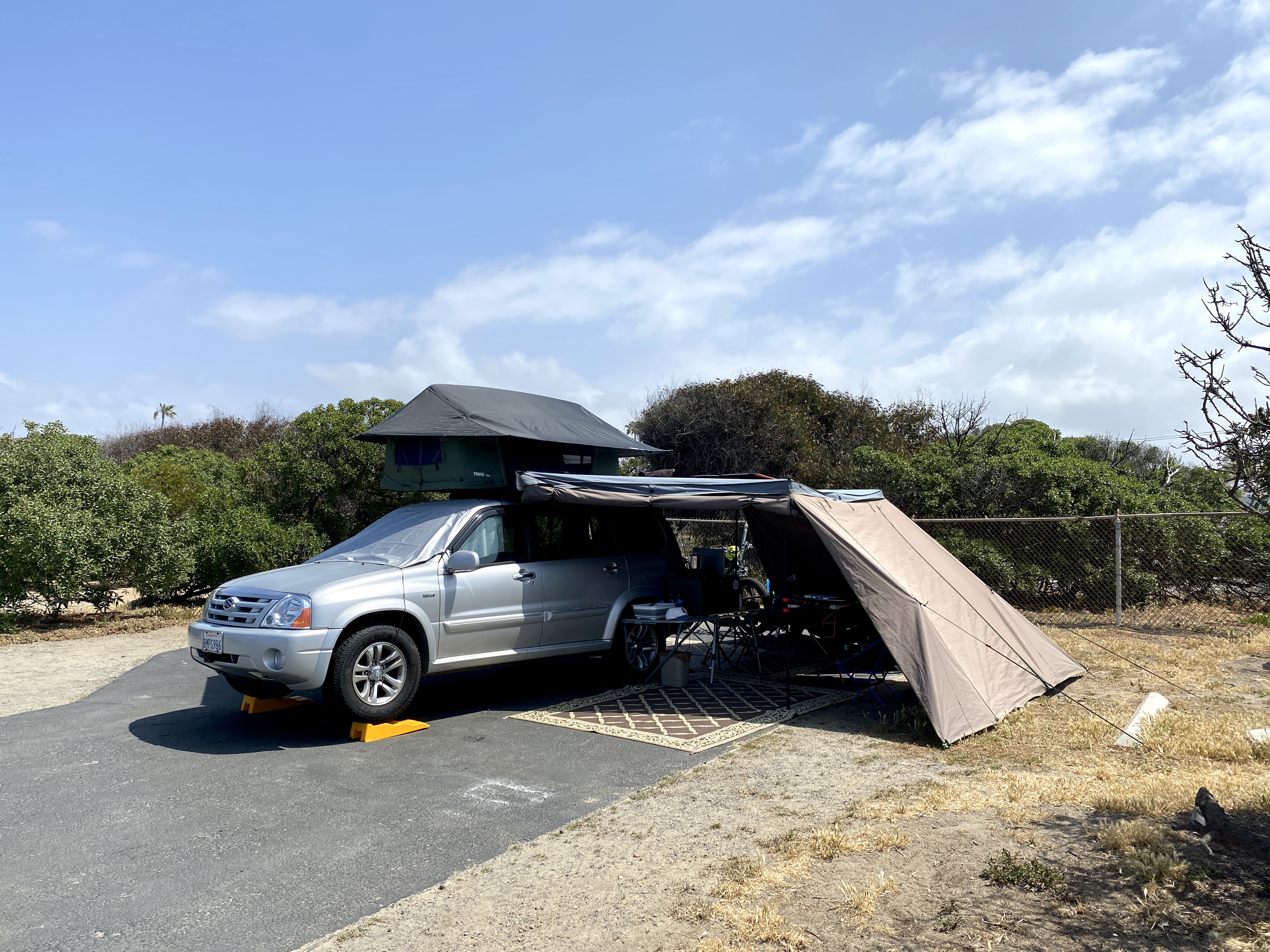
A Thule rooftop and a 3/4 surround shade tent
Retro brand tiny trailer at Carlsbad State Park
The Retro trailers: as the owner said, "Everything you need in a small space."
Although it would be hard to beat my driveway mooching camp spot at my in-laws, I have to admit the camping right on the ocean would be special. With the Basecamp, I could back in and then open up the rear door for a spectacular "backyard" experience of the ocean. My solar panels would keep me in energy, although if we came in the winter and it were foggy or rainy, then a portable generator would certainly be handy. 

Heading back home, since my wife Sandy was at a business meeting for the day, I stopped at the Harbor Fish Cafe in Carlsbad for lunch, sitting on a cement bench on the bluff above the ocean, eating my fish and chips (a unique meal for my primarily vegetarian self), enjoying the slight breeze off the sea, the pelicans flying by in stately formation, and me humorously keeping an eye out for hungry seagulls swooping down. It was a grand last day on my bike, one in which I had finally felt more comfortably at home in the town, freeway driving aside. 

Pacific Ocean, Carlsbad Beach, California
What greater views for a bicycle day ride?
Yes, I could get used to this--bike rides with ocean views, walks on the beach with my sweet wife, the perfect camping spot to driveway mooch, and a state park for camping on the bluffs above the ocean (as long as you reserve six months in advance). Now that we've driven the 1,800+ miles, maybe it will be easier to do again. Logistically speaking, the Nissan Pathfinder and the Airstream Basecamp performed like champs, and speaking of champs, Sandy took to driving the trailer like a trooper. 

Like all good trips, there is the joy of taking off and also the joy of arriving back home. We'll get back home in time to enjoy our asparagus season and spring garden planting. The world is a rich and varied treasure trove of beauty and wonder. Carlsbad, California, and the Pacific Ocean, in the spring, morning light burning through the faint ocean misting fog, this has been a special trip and a special time. I can truthfully say this trip has not only been a vacation experience; it has been a spiritual experience, recreation in the deepest sense of the word.

Subscribe--Follow by Email

* indicates required

Friday, February 18, 2022

One Warm Day for Camping Is All (or the Least) You Need

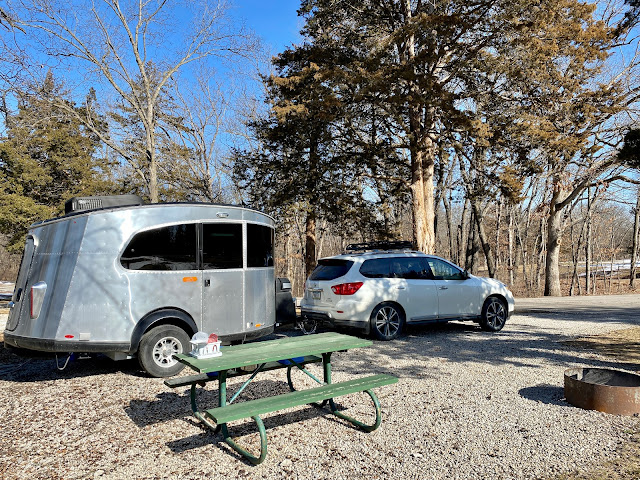
Airstream Basecamp at Lacey Keosauqua State Park
Using the word "warm-up" in February in Iowa is probably the most scandalous word choice one can make as winter continues to dump its frigid bounty upon the Midwest. However, there was one day this week when the temperatures rose to near fifty degrees, and there was one afternoon when the sun was shining and the wind had not yet begun to howl. I chose to hitch up and make my way to Lacey Keosauqua State Park, arriving at about noon on a Monday and leaving at around noon the next day--thereby missing wind, rain, freezing rain, sleet, and snow. I'm pretty proud of my timing and also glad for another chance to check out the rig and get everything ready for when better weather arrives. This trip continues my plan to take advantage of winter getaways and to also use them as shakedown excursions, providing an opportunity for both some recreation and also gearing up.

Lacey Keosauqua State Park is the second-oldest state park in Iowa. It's twenty-five miles from my home, and it's also located right next to the little town of Keosauqua, the Van Buren County seat and also where I was a junior-senior high school teacher for twenty-one years. Van Buren County is rural, known for its villages, rolling hills, and the Des Moines River. Keosauqua is the county's largest town with a population of around a thousand. I have many good memories of this area and its families, and with the recent years, I also have many good memories of camping and hiking in the region. Twenty-four hours of hiking the area pushed away the winter doldrums and provided a glimpse of better weather that will eventually arrive--even if it arrives in fits of wind, freezing rain, and mud. 

Lacey Keosauqua State Park
Although there were several campsites available with the warmer weather, I chose one near the front of the campground that was snow-free and level, allowing me to hook up to electricity, to be near the central water faucet, and to not have to level and unhook my Airstream Basecamp from my Nissan Pathfinder. Because little camp set-up was required, I was able to take a couple of hikes that afternoon, a quick one prior to lunch and then a longer hike after lunch. For this trip, I continued my overnighter practice of not using the 12-volt refrigerator but just using a small ice chest cooled by a couple of reuseable freezer blocks. My main meals? Leftover lasagna!

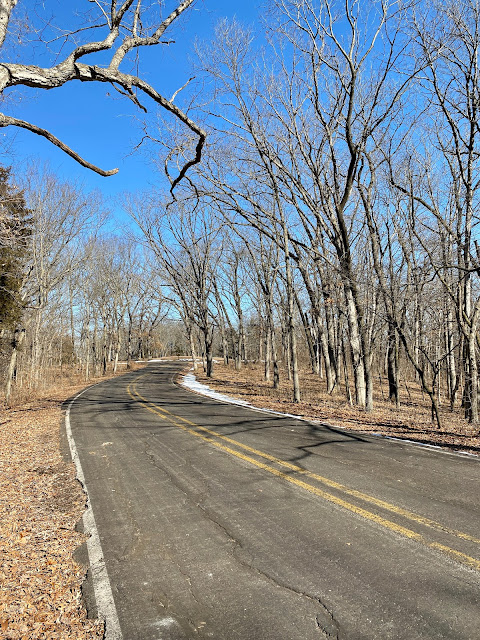
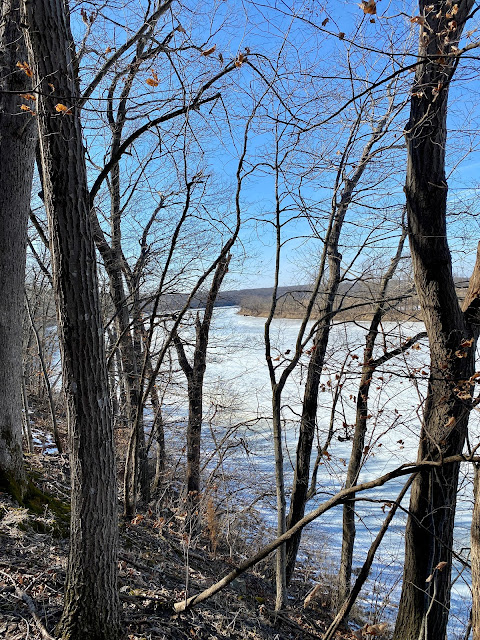
Hiking mostly on paved roads was okay for this trip, allowing me to avoid mud. About a quarter mile down the main road through the park is a paved road to one of the park's shelters. Since it's not a through road, I was able to walk down the center of the roadway, at times my face turned upward to the sun and my eyes closed. I was able to sit on a limestone wall at the shelter's loop-around and enjoy the silence of the still-sleeping forest trees. I did wander down one trail, though, that was covered with fallen leaves and not muddy, walking a couple of hundred yards to a bluff where I could see the frozen Des Moines River below, a sheet of unmoving ice not anywhere near the spring thaw. A bit of silence, a bit of exercise, and a bit of sunshine without much wind were my rewards for the day and this overnight camp trip. Well worth the effort!

Lacey Keosauqua State Park, Des Moines River
The night's temperatures dropped down to twelve degrees Fahrenheit, but the Basecamp's Truma heating system worked well. I slept warm, enjoying the luxury of the camping trailer and looking forward to another hike the next day. Since the weather was still somewhat uncertain and the wind was picking up, even though it would be a warm day--up to 50 degrees--I decided to head home instead of dealing with wind and with the possible early arrival of rain. I did take a morning hike, though, checking out the other spots in the campground that I could have claimed if I'd been willing to deal with a bit more snow and ice. I was happy with the spot I'd chosen, though, because the site allowed me south and east sunlight for the camper. In cold weather, I like to be able to exit the camper to sunlight, not freezing shadow. 

I enjoyed the drive home on Highway 1, the state highway that I had commuted for twenty-one years as a teacher. A few views have changed with buildings new or buildings demolished; however, for the most part the unfolding vistas were the same, evoking memories and also providing ever-present perspectives of rural beauty--sleeping fields awaiting the spring and strings of trees that followed the creeks. My greatest joy was in getting out even for a short while to enjoy the beauty of the natural world and to engage in those eternal rhythms governed by the laws of nature, the hand of humankind less heavy upon the land. One warm day was all I needed for camping, and I'm glad I took advantage of the opportunity to head out. We should all enjoy those moments of joy that come our way, and we shouldn't feel shy to contrive them when necessary. Being the only camper in the campground and seeing the sun rise in the eastern sky, the bare limbs of dormant trees silhouetted by the pristine light, that was an experience worth the effort--another small excursion in this new camping season, another joyful moment to commune with the great outdoors.

Subscribe--Follow by Email

* indicates required

Thursday, November 4, 2021

Winterized Camping Is Old-school Camping

Last night before bed, I brushed my teeth and then went outside my Airstream Basecamp to rinse my mouth and my toothbrush. It was an old-school camping routine, one that I had adopted when camping with my standy tiny trailer that had no plumbing. Spit outside after brushing my teeth. Wake up in the morning and crack the ice in the water bucket outside, then rinse my face. Sit by the fire in the evening and read with a headlamp. Those are good memories, and my last three days of camping at Lake Darling State Park just reinforced those good memories and the practical, simple camping practices I learned while tiny trailer camping. 

This week brought the first frosts of the year with temperatures in the mid-20s, so prior to this trip I winterized the Basecamp, draining tanks and flushing water lines with RV anti-freeze. It was my first time winterizing the Basecamp (or any RV), so I suppose I'll have to wait till next spring to find out if I did everything correctly. However, now that the rig is winterized, it has become in a way a larger, more grand version of my little RTTC Polar Bear--a small trailer that required many camping necessities to be done outside or, if inside, in a modified manner. Winter temperatures also necessitate some acknowledgement of condensation factors, which especially means being careful with cooking. I enjoyed my old-school camping trip, though, and appreciated how the little Airstream Basecamp (as opposed to a tiny trailer) was easily adapted to a simpler style of winterized camping. The transformation can be described with just a few significant points of change.

  • No running water. Flush toilet, shower, and kitchen sink are all now shut down. Our toilet is now a form of military, dry-bag toilet, such as I reviewed with the Cleanwaste Portable Toilet in an earlier article. When camping, my wife and I bring our own filtered drinking water from home, so that hasn't changed. As for water for bathing and dishwashing, we have a bucket and make use of the faucts at campgrounds.
  • Heating. Winterizing had no effect on the Basecamp's efficient Truma furnace, other than the fact that the water heater is drained and isolated from anti-freeze. There still is that winter camping experience of finding that magic balance point between too hot and too cold, especially with sleeping. Also, the Basecamp's thermostat on the wall near the door is significantly at variance with the actual temperature in the camper. I usually have to set it somewhere between 10-15 degrees cooler than the actual temperature I want. Last night, for instance, I slept with the thermostat set at 45 degrees.
  • Propane cook stove. The Dometic propane gas stove works just fine; however, I am aware that burning propane creates moisture as a by-product, which makes me sometimes choose to cook outside. Also, since the camper in more buttoned up in colder weather, smells tend to linger longer. 
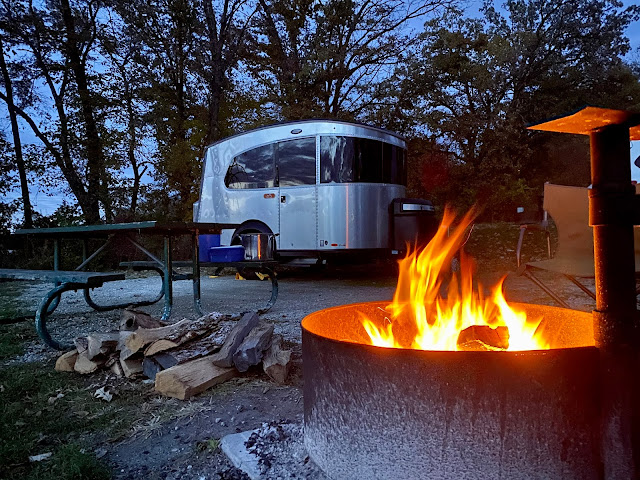
  • A cozy campfire. Summer campfires, at least in Iowa, are often just symbolic and something I skip. When it's in the 80s and it's humid, I don't need a campfire unless it's a smoky one that keeps away the mosquitoes. Cold-weather camping, though, really warms the heart regarding the idea of having a campfire--and that's probably because a winter campfire literally warms the heart! The campfire becomes a place to enjoy the heat of the burning wood while also enjoying the beauty of the cold weather. Sometimes that a bit of a paradox because the side toward the fire is a bit too hot and the side away from the fire is a bit too cold. A fire keeps us outside for a longer time when the weather has turned cold. 
Winterized camping in my modern Airstream Basecamp has that old school vibe--more outside time for camp chores and routines, but with the inside of the camper available when I just need a break and a little comfortable time. As for when I winterize, I chose to do so early. Forecasts indicate I probably could have waited until late November this year if I were willing to turn on tank heaters and to keep the camper warm inside, even when parked at home. That's why I recently had a 30-amp RV outlet wired for my garage and driveway area. However, a lot of campers who don't winterize early are traveling south, and the cold weather is a temporary inconvenience. For me here in Iowa, the certainty is that it's now frosting, then it's going to get cold--and then it's going to get damn cold and stay that way for several months. Rather than play freeze-the-pipes roulette, I just winterized and got it over with. What I've lost in convenience, I've gained by skipping the worry.

At this point, I can camp for as long as the roads are safe, as long as I'm careful about managing condensation in the cold weather. (See the article "Minimizing Condensation in a Teardrop or Tiny Trailer") What I've learned from reading online posts from other small trailer owners is that your trailer doesn't have to be tiny to have a condensation issue. Fortunately, condensation remedies are science-based and fairly straightforward. Usually sometime in the winter, though, we have an Iowa combination ice-and-snow storm which dumps its slippery precipitation and then keeps it frozen for weeks to months. After such a storm, even if the roads are cleared, campsites are locked up with the snow and ice, last year for at least a couple of months.

Until then, my little trailer is a tiny trailer mansion--with its own room for the toilet, with a kitchen, and with a built-in furnace. Sometimes I just walk around in my trailer, thinking to myself, "Look, I can walk around, not just one step forward and one step back!" This will be our first fall and winter season of camping with the Basecamp, and I'm looking forward to it.

Subscribe--Follow by Email

* indicates required