Showing posts with label Basecamp Expeditions. Show all posts

Sunday, June 26, 2022

Basecamping Backbone State Park--Iowa's Oldest

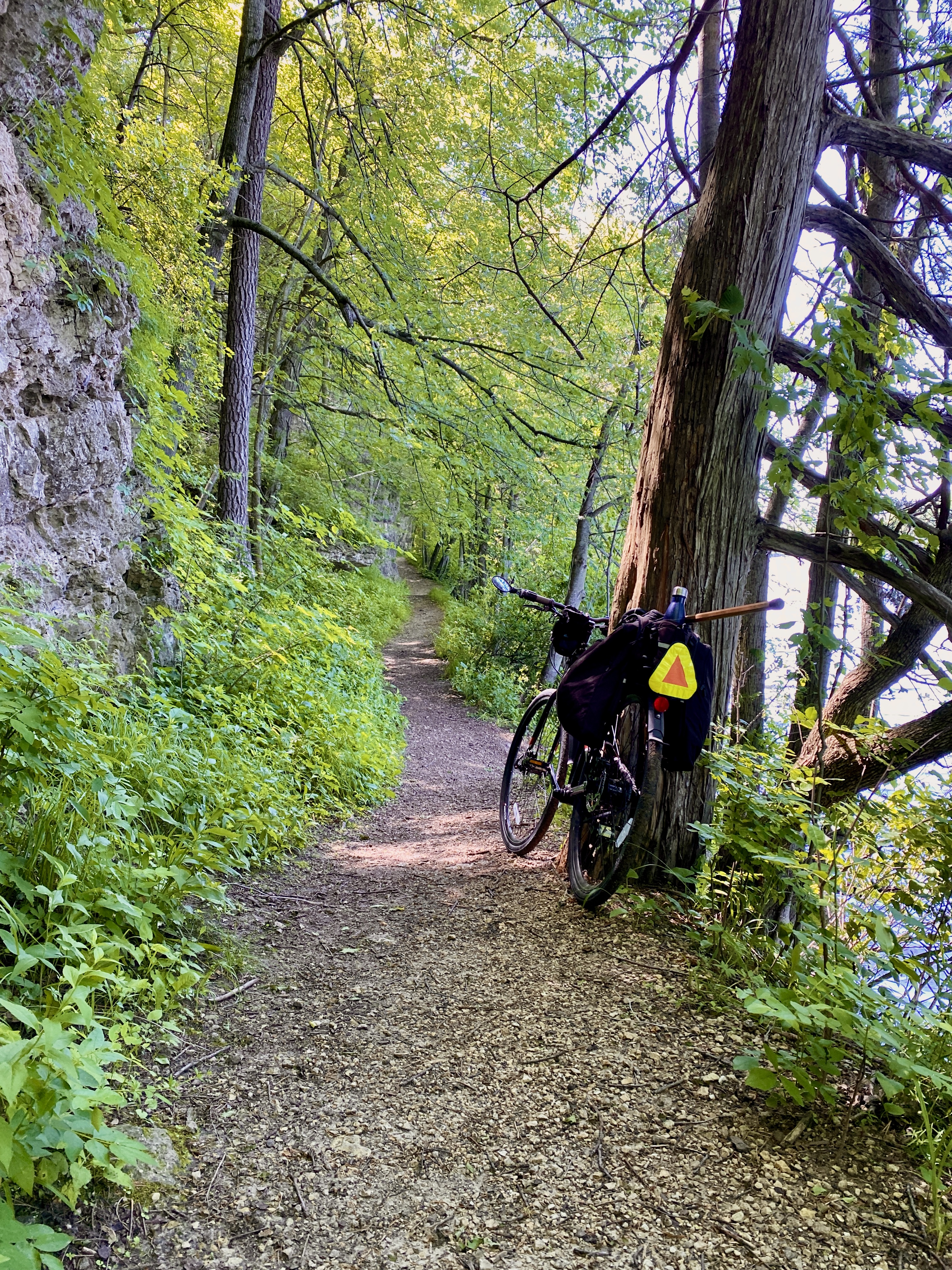
Backbone East Lake Trail
I remember wading a pebble-bottomed stream, ankle deep and crystal clear, and I remember hiking the "backbone" ridge with my son's schoolmates on a classroom campout, raccoons in the night and owls . . . and rain. Those are good memories, and I wanted to return to Backbone State Park, Iowa's first state park, and explore and experience more deeply this sanctuary in NE Iowa's Driftless Area. Missed by the glaciers of the last ice age, this part of Iowa has a geography much different than the rest of Iowa.

I opted to camp at Backbone for only four days, not really enough, but another heat wave was sweeping the Midwest, and a humid 97 degrees was a good reason to head home and water the garden. Four days of exploring wasn't quite enough to hit all the sites in this 2,001-acre state park, especially with Backbone State Forest adding an additional 186 acres of recreation opportunity at the NE corner of the park. The park, according to the DNR website, has something for everyone, from bold climbs to relaxed outings.

"Dedicated in 1920 as Iowa’s first state park, Backbone State Park is one of the most geographically unique locations in Iowa. The steep and narrow ridge of bedrock from the Maquoketa River forms the highest point in northeast Iowa - The Devil’s Backbone - giving the park its legendary name. Take a walk through history by checking out the Civilian Conservation Corps (CCC) museum, explore the rugged 21-mile multi-use trail system or fish in some of Iowa’s best trout streams. Whether you’re an adrenaline seeker or just wanting to get outdoors for the day, Backbone State Park has something for everyone."

 Arriving on a Thursday morning without a reservation, I felt confident that I'd be able to land a non-reserved site for my stay. I was correct in that assumption--but there is a story attached to that choice. I arrived and walked through the lower park of the modern South Campground, the 30-amp section, and found a non-reserved site with an old tag still attached to the site-numbered post. I added mine and then spent some time erecting two awnings to help with the sun and heat after the usual leveling and unhitching routine. By late afternoon I was able to enjoy my Airstream Basecamp's air conditioning, reading and relaxing. 

Interrupted by a firm knock on the camper's door, I looked out to see a park ranger waiting outside. I got up, and after a moment opened the door, saying, "Sorry it took a bit. I had to put my pants on." The ranger's response was, "And I appreciate that." It turned out that the site was already reserved. The rain-bedraggled reservation slip had indicated a reservation from June 10 for four days--except that it was actually from June 15 for four days . . . and I had arrived on the sixteenth. I had to break camp and leave; however, the ranger had kindly found another two non-reservable sites that weren't taken. 

"I thought you couldn't reserve a site and not set up camp. There was nothing at this site indicating anyone was here," but evidently, Iowa allows for someone to arrive at a campground and reserve a site, leaving only the reservation tag. So, okay then, I'll remember that. "Happens all the time," the ranger said. A group of several travel trailers showed up on Friday for the weekend, with my walk-in site spot having been reserved on Wednesday to ensure a spot for the weekend--two days reserved and empty, but the DNR still got their money.

At Backbone with two awnings to help keep the camper cooler
Deciding not to let the situation ruin my mood, I packed up and moved, following the ranger's advice of first picking one of the two sites and then adding my already-filled-out tag, having changed the campsite number. After that little blip, now I was ready to enjoy my four days, and I'd actually enjoyed the practice of speedily breaking and setting up camp. I'm getting pretty doggone fast! 

I had arrived at Backbone to stay for four nights. Obviously, Thursday was mostly driving and setting up camp (twice!), but I still managed to walk the upper and lower sections of South Campground, scouting out the general lay of the land. I discovered a trailhead for the West Lake Trail while taking a small, relaxing walk around the campground before bed. I also met one of the campground hosts, Thad, who let me photo a map of the park so that I'd have a better understanding of the trails.

Backbone Lake from the lower end of the West Lake Trail
The next day I was off hiking, a bit late in the morning, but I did manage to walk about half of the West Lake Trail, first heading south to the end of the lake and then turning around and hiking north of the trail. I managed a little more than half the trail, turning around at 11:30 so that I'd get back to camp in time for lunch and before it got too hot. Talking later with Thad and nearby campers, I was told that I could walk the West Lake Trail, follow the park's central road around the north end of the lake, and then take the East Lake Trail to complete the lake trail loop. I was told by a ranger I talked to that the loop trail route was okay to complete on a bicycle. That was my challenge for Saturday. The weather forecast was predicted to be cooler, and I assembled my folding bicycle, a Montague Allston, Friday evening. 

Instead of beginning my lake bike ride later in the morning, I headed out at 8:30, catching the cool air. There was a bit of a breeze, enough to hassle the humidity but not enough to hassle my trek. The West Lake Trail was described as having steeper hills than the East Lake Trail. I had hiked a couple of pretty steep pitches on Friday, so I knew that I'd be pushing the bike. That's okay with me, though, because ultimately the route is faster on a bicycle, even with a little riding and a lot of pushing. If I were pushing a fully-loaded touring bike, then that would be unnecessary work, but a lightly loaded bike isn't a problem; the bike can even function as a "walker" or wheeled "trekking pole" on steep parts of the trail. The West Lake Trail was uniformly about four to six feet wide, with mostly graveled sedimentary stone chips. 

In the end, I walked about forty percent of the West Lake Trail and bicycled the other sixty percent. There are many large, mature trees in this section of the park, many of them oak and hickory. Having attended an introductory lecture about the park by camp host Thad, I had learned that originally the park had much more open prairie, that the area had been a mixture of copses of forest and prairie. With the establishment of the state park, many more trees were planted so that now much of the park is unbroken forest. Some of the trail skirts private farm land, but most of the trail is deep enough in the park that the feel of forest silence is available. The west lake side of the hike spends some time near the lake and then moves away. 

A wider, smoother park of the East Lake Trail
I don't mind walking my bicycle, even when on highways. We can go for a Sunday drive and enjoy the scenes, but our interaction with the environment isn't nearly as immersed as when on a bicycle. Take that one step further; hiking immerses me in my surroundings even more than when riding a bike. On a road, that may not be so obvious: we can cruise along and still gawk. However, when riding on gravel or on a path with upthrust stone and exposed tree roots, a lot of the attention has to be on the path just in front of the bike. Believe me, I know because I've fallen a couple of times when the front tire has slipped out from beneath me. I wasn't hurt because I was essentially standing still, balanced on the bicycle when the tire slipped away, but nonetheless, there I was, on the ground. 

Therefore, I wasn't upset when I ended up riding about fifteen percent of the East Lake Trail and hiking the other eighty-five percent. It was a beautiful journey, even while packing the bike up or down steep, rocky trail across the "backbone" of the park and around or over trees fallen across the path. In a later conversation with the camp host and the park ranger, the ranger decided he'd have to hike the trail and open up a few spots that were sketchy.

My last full day at Backbone was a hot one, so I spent the morning checking out campsites for sun and shade orientation. I also enjoyed checking out some of the smaller trailers in the campground--quite a variety!

Rpod with a rear kitchen and quite a lot of room inside
A happy couple downsizing to an Aliner after their children have grown up
A classic (and well-used) Aristocrat trailer
Although I enjoyed my four days at Backbone State Park, there are several area features that I missed: I didn't get to the ice caves (at Bixby State Preserve), didn't get to hike the Backbone Trail, and missed wading up the river from the North Flats Shelter. The last two were activities I enjoyed with my son over twenty-five years ago, and it would have been nice to revisit both those places and those memories. However, 97-degree days were coming, so I kept my stay to four nights. I plan to visit Backbone again and to explore those areas of the park that I missed, especially the north end of the park. It was a good trip, one that made me look forward to another visit. Maybe those are the best camping trips of all!

Subscribe--Follow by Email

* indicates required

Tuesday, June 21, 2022

Camping the Iowa Driftless Region in My Airstream Basecamp

Pulpit Rock Campground, Decorah, Iowa; Airstream Basecamp
Arriving at Pulpit Rock Campground
With the windshield wipers futilely slapping at the deluge of rain, I'm driving at 25 miles per hour on a country road to visit a city campground at Kendalville, near Decorah, Iowa. The storm was so severe that I was truly having trouble seeing my path, yet the county road fell off on both sides without a chance to pull off. Welcome to the Driftless Region, I told myself, and was at least happy that my Airstream Basecamp was safely back at Pulpit Rock Campground in Decorah, and that I wasn't towing the narrow road, pulling the travel trailer, imagining myself Noah with his ark.

The Driftless Area in northeast Iowa was missed by the last glaciers, so the area is more hilly than much of the Midwest. The entire Driftless Area extends beyond Iowa, capturing parts of Wisconsin, Minnesota, and a bit of Illinois. Wikepedia describes the area as follows: "Never covered by ice during the last ice age, the area lacks the characteristic glacial deposits known as drift. Its landscape is characterized by steep hills, forested ridges, deeply carved river valleys, and karst geology with spring-fed waterfalls and cold-water trout streams. Ecologically, the Driftless Area's flora and fauna are more closely related to those of the Great Lakes region and New England than those of the broader Midwest and central Plains regions."

Bluffton Road, near Decorah, Iowa
Bluffton Road

Bluffton Road, near Decorah, Iowa
My eight days of camping in the Driftless certainly highlighted the unique beauty of this area. I did finally make it to Kendalville Park and Campground, the rain slackening enough so that I could make a quick walk around the campground and providing a chance for the rain-drenched ground to soak my sneakers. On the way back to camp, the rain stopped so I turned onto Bluffton Road, which eventually narrowed to gravel and even a one-lane bridge. It was a great drive, and I saw several private campgrounds along the road that I would have checked out except for the continuing possibility of more rain. 

Pulpit Rock Campground
Trout Run creek at Pulpit Rock Campground
Pulpit Rock Campground
Pulpit Rock, a short hike from the campground

Pulpit Rock Campground
Camping at Pulpit Rock Campground in Decorah was enjoyable. I would call it more of an urbanright at the edge of Decorah, campground, even though the area is rural. The campground is skirted by US Highway 52, right at the western edge of town, so road noise is a reality. It's a busy city park and campground with a trout stream running through. I chose the park to be my basecamp for four days, and from there I'd take day trips in my car to see more of the area. I wasn't disappointed; the campground provided me with exactly what I needed. Decorah is a town of over seven thousand people and hosts Luther College. It has a progressive vibe, and there's quite a bit of refurbishing going on in the downtown area. During my four nights there, I was able to familiarize myself with the campground, hike a bit to Pulpit Rock, which is just beside the campground, and to set up my folding Montague Allston bicycle and ride about half of the 10.5-mile paved bike trail that circles the town. If I owned a kayak or canoe, I could have navigated the Upper Iowa River that runs through the town. It's a beautiful town and area, with many recreational opportunities, including a Farmers' Market, which I didn't get the opportunity to visit.

Yellow River State Forest, Little Paint Campground
At Little Paint Campground

Yellow River State Forest, Little Paint Campground
One day trip that I was eager to take was a long-awaited trip to Yellow River State Forest. A forest in the Driftless Area with only primitive camping, I wanted to camp for at least a couple of nights there, enjoying one of the greatest forested areas in Iowa. The Iowa DNR website describes the forest as "home to stunning views, beautiful woodlands and meandering trout streams." Irresistible! However, with heavy rains followed closely by a heat wave, I chose after all to resist the lure of the forest. The humidity would have been extreme, and the primitive, non-electric campsites would have disallowed the use of air conditioning. I'm either getting too civilized with my Airstream Basecamp or getting too old--or both! At any rate, I plan to visit again in the early fall. I'm sure the colors will be spectacular then. I found Little Paint Campground to be especially beautiful, with its trout stream and two shallow fords to get to some sites.

The sculpture "Walking with Birds" on the Trout Run Trail in Decorah, Iowa
"Walking with Birds" sculpture on Trout Run Trail

Pulpit Rock Campground, Decorah, Iowa; Trout Run Trail
Upper Iowa River, with the ribbon of bike trail
Pulpit Rock Campground, Decorah, Iowa
Downtown Decorah, Iowa
"That camper of yours has been causing a lot of talk," the camp attendant told me as he and a co-worker cruised by in their John Deere Gator. Explaining the history of the unit, I asked about Trout Run Trail that crosses the park, and the attendant mentioned that I should get going to beat the rain. I headed out on my bike ride in the morning because rain was expected that afternoon. The trail is pavement or blacktop and is well maintained. It was a beautiful ride with just a cooling breeze and enough clouds to keep the day cool. Quite a bit of the part of the trail I road skirts the Upper Iowa River, so lush trees were on one side and the sparkling river of the other. One characteristic of the Driftless Area is that the creeks and rivers are not muddy, the bottoms gravel and sand. Of course, after heavy rain, the water flow did become murky. As I traveled along, I noticed the build-up of dark, roiling clouds, so the last twenty minutes of my ride was a "cardio" experience as I spun back to camp to miss the rain. I arrived before the rain, put the bike away, and took a nap, waking up to heavy winds and rain. Later I found out that there was a tornado watch, but Decorah just received strong gusts of wind. I was glad that I'd taken down my awning, though. 

Pulpit Rock Campground, Decorah, Iowa; Airstream Basecamp
At Pulpit Rock during a heat wave, awning up for some shade
I stayed at Pulpit Rock on Sunday through Wednesday nights, but the campground was still busy even though it wasn't the weekend. With no reservation, my arrival on Sunday afternoon still allowed me to capture a campsite; however, that may not have been the case on a weekend. Decorah was a perfect place for me to situate myself for exploring the local Driftless Area. I could have spent more time and discovered more, but after four nights, I packed up and moved south a bit to Backbone State Park--but that will be another post!

Subscribe--Follow by Email

* indicates required

Friday, May 13, 2022

RV Parks *Exist* -- What Does That Mean for Camping Travelers? A Personal Experiennce Narrative

Airstream Basecamp at Oasis RV Park at Aztec Hills
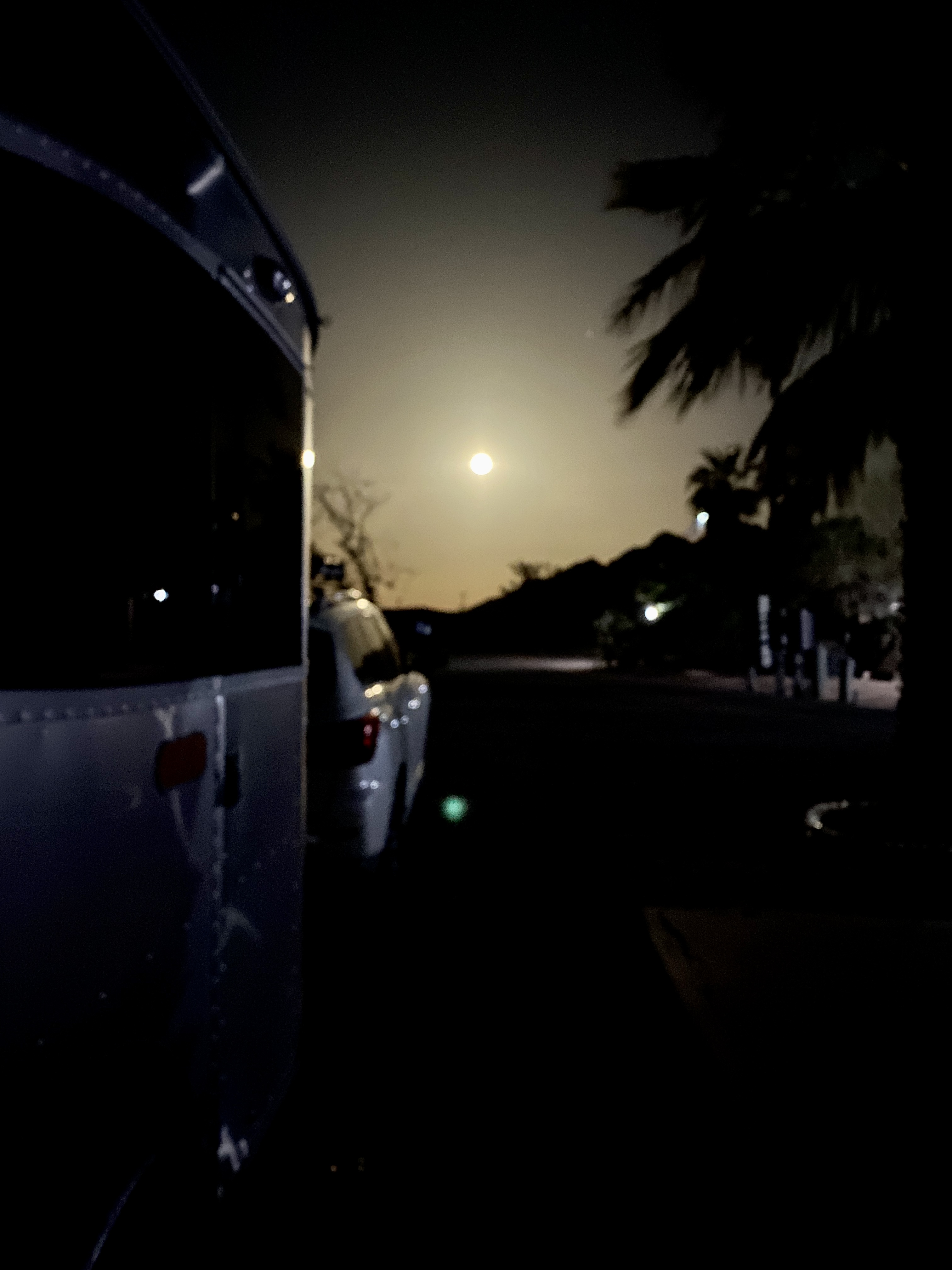
Full Moon at Oasis RV Park at Aztec Hills, Arizona, the Sonoran Desert
I enter the restroom-shower building in a small RV park. It's a blue building, the paint not new but still solid, unpeeling even if a bit faded. The roadways in the park are a reddish gravel and sand mixture, the edgings a countrified uneven scraggle of grass and weeds, mown at least once this spring yet now sporting a few leggy yellow spring flowers. A young boy about nine years old with a newly trimmed blond mohawk haircut is looping the park on his bicycle. A mother with an infant in a baby chest carrier is at the swing set with her lanky early-teenage daughter, pushing while her daughter pumps, both of them chatting and laughing. 

Inside the restroom-shower facility, the continuous sound of trickling water attracts my attention. One cracked toilet commode has a leaky trap; however, the toilet even though cracked is not leaking onto the floor. The next commode is uncracked and silent, but the seat is bandaged with white duct tape. The room is clean, worn, and waiting. The RV park likewise--worn, casually lived in, and friendly--as is the manager (and perhaps owner), a later-middle aged, gray-haired, energetic woman whom I had to telephone when we arrived because the office was closed. "I live in town," the manager's voice had said. "I'll be there in seven minutes."

Arriving in no more than seven minutes, my wife and I were efficiently processed, the lady pointing out several sites available and asking us which one we wanted. "Are you leaving early tomorrow, and which way will you be heading?" she asked. When we said we'd be driving east to Iowa, she provided directions and then said the accommodations building was always open. Guiding me to the pull-through, she gestured me to stop when the trailer was properly aligned with the hookups. Registration was completed from a clipboard, outside and covid-safe, and a quick run-through of hookup procedures were provided as she pointed out the specifics of the space we chose. We were home for the night.

On my wife and my recent trip from southeastern Iowa to the city of Carlsbad in southern California's San Diego County, we spent five overnighters each way in our sixteen-foot Airstream Basecamp. Out of those ten overnighters, one was in an Iowa state park, one in a federal national forest campground, two in Kampgrounds of America facilities, and six stays were in private RV parks. Only one camping spot was used both out and back. Our routes out and back shared some of the same roads but also were each unique in both stops and travel, especially in our Midwest and High Plains sections. The states we crossed were Iowa, Missouri, Kansas, Oklahoma, Texas, New Mexico, Arizona, and California. Some of the states, such as Missouri, Oklahoma, and Texas, we just nipped a corner. My favorite joke of the trip was my wife's as we passed through Texhoma, Oklahoma, which is right on the border of Texas and Oklahoma. "Because they're right of the border, they took half of each state's name to make their town's name--TEXas and OklaHOMA," I said. "That's better than OKLA-ASS," my wife said. That gave us a good laugh as we traversed the city both on the trip out and back. We spent thirteen days driveway mooching at my wife's parents' house, plugged into their home 110 system to keep our 12v refrigerator running and our batteries charged.
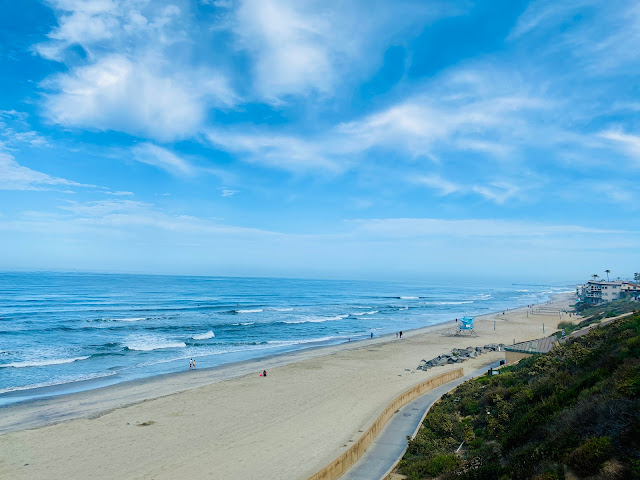
Pacific Ocean, Carlsbad, California
The view from Ocean St., Carlsbad, California
Pacific Ocean, Carlsbad State Park, California, CampInn
A CampInn at Carlsbad State Park Campground (with a 6-month in advance reservation)
With the recent upswing in camper sales, due in large part to the desire for people to travel safely during the pandemic, there has also been an increase in the move to create more RV parks. (Quickly, what is the difference between a campground and an RV park? A campground is primarily for recreational use for up to two weeks. An RV park, almost always privately owned, caters to both travelers and to permanent residents. Often permanent residents will build decks or porches next to their RVs. Skirting or small flower gardens may trick out the RV, making the "mobile" recreational vehicle facility appear much more like the mobile home parks that have become so common in the last seventy years or so. Even though RV parks are being built, there is opposition and fear expressed from many communities. "Opponents to new RV parks roll out the traditional boogeyman fears of higher crime, increased road traffic, and the large numbers of “undesirable” transients in their rolling ghetto-mobiles invading their peaceful streets," was one articulation. It's okay to build more RV parks, just not in our backyard is another sentiment. Some RV parks enforce the "ten-year rule" to try to maintain a more upbeat look--not renting spaces to RVs that are over ten years old. (There is some controversy regarding this "resort RV park" policy. Follow this link to read more.) One full-time RVing couple with a blog wrote an article about RV parks: "5 Reasons We Avoid RV Parks (And Where To Camp Instead!)." Reasons for avoiding RV parks, according to the article, include crowding, distractions, expense, noise, and "consumerist culture." 
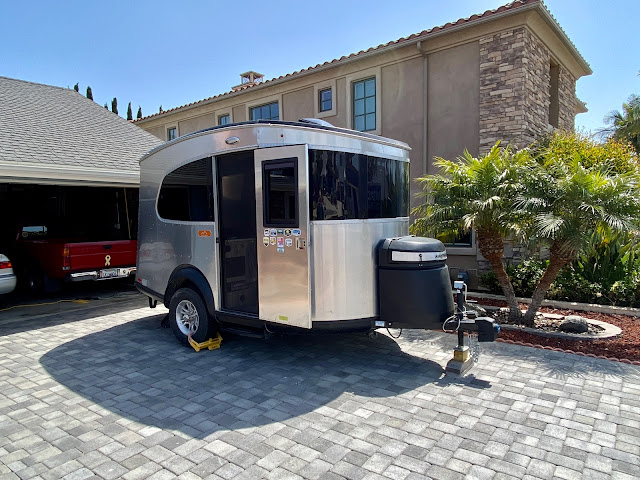
Driveway mooching; Airstream Basecamp
Driveway mooching for thirteen nights in Carlsbad, California
Although in general I agree with the "avoidance" article because my main reason for camping is to get out in nature and relax, I have to say that for our trip to the Pacific Ocean and back, RV parks provided a safe and quick option for a good night's sleep and a chance to shower, cook a meal, and stretch the legs. We even met and chatted with a few people and discovered some interesting facts. There are a lot of "mom and pop" RV parks. They may be a bit run down, but they are friendly spaces that provide a wayside stop for travelers or a longer, more permanent stay for workers, families, or retirees who live full-time in their RVs, vans, or travel trailers. My wife and I liked some of our camping spots more than others, but for all of them we appreciated the opportunity to roll in, hook up, and to use the showers. In order to save time, we used shower-toilet facilities when easy, minimizing our hookups to just the 30 amp plug-in. This saved us time when leaving and also allowed us to only use dump stations twice during the trip--one the night before arriving at our Carlsbad location and once the night before getting back home to Iowa. (When staying in Carlsbad, except for two nights, for most nights we stayed in our parents' house.) 

I researched our routes out and back, using Google Maps. First I found the quickest route, and then I began modifying that route; for instance, I didn't want to drive through Kansas City, Missouri, and re-routed north and west through the Topeka and Wichita, Kansas, area. We decided in Arizona to skip the elevation climb through Flagstaff and to take the Phoenix route. That ended up taking in some 6,000-foot elevations on the Mongollon Rim anyway, but on the route out we weren't sure how our Nissan Pathfinder would pull the trailer. (We are happy to report that the rig worked quite well.) On the way back, we kept to our lower Arizona route to avoid wildfires. We also routed a Phoenix pathway to avoid construction shutdowns on Interstate Highway 10. What we discovered is that there are many small, older RV parks around, many of them near small, rural towns, and that these small RV parks are friendly places that meet a variety of patron needs. They may not be the best locations to commune with the great outdoors, they may not be the poshest spots to camp, and some may be more cramped than you like. However, we were able to enjoy our cruise across America, having a specific destination each day after driving usually six to eight hours each day. 

When finalizing our destinations, I'd look carefully at the Google Map photos and read reviews. Our daily distance traveled was between two hundred and four hundred miles, the usual being closer to three hundred. Using the three hundred mile gauge, I'd find a town on or near the quickest route and then search for "RV parks near" and then type in the town. I also would google "campgrounds near" a town but sometimes the campgrounds would be further off the travel route, more in the boonies. These sites, I'm sure, were probably more scenic, but our main focus was getting down the road. RV parks seemed to be nearer the main roads. 

Below is a list and brief description of the campgrounds and RV parks we stayed at during our there-and-back-again journey. For travelers wondering about travel opportunities, these descriptions may provide a sampling of the possibilities out there.

Nine Eagles State Park, Lamoni, Iowa


Leaving on a Tuesday afternoon, we decided for a short first day of travel. We chose to camp our first night at Nine Eagles State Park, a bit over 125 miles from home. The shower/toilet facility was still closed, but we easily got through the night, even though it was windy and rainy. This was our first time at Nine Eagles, and we found the lake not accessible from the campground--we couldn't find it anyway. We also discovered in this first stop that if we're interested in putting in the miles, not to choose a campground too far from the route. Nine Eagles was about ten miles of narrow country road from our main route, which lost us time. RV Parks are usually closer to main routes of travel. However, we were on the road!

All Seasons RV Park, Wichita (Goddard), Kansas


A little over a mile from our route, All Seasons RV Park consisted of primarily permanent residents, and by that I mean folks who have built wooden decks and porches for their RVs. A couple of empty spaces for overnighters were kept open, however, right next to the shower house. We were quickly checked in, given the shower house combinations for the door locks, and left alone. The RV park set our expectations and general experience of RV parks for the trip--a clean, older facility with no picnic table and little space between rigs. It was a quick and easy pull-through, though, with a nearby gas station, and we were quickly on the road the next morning.
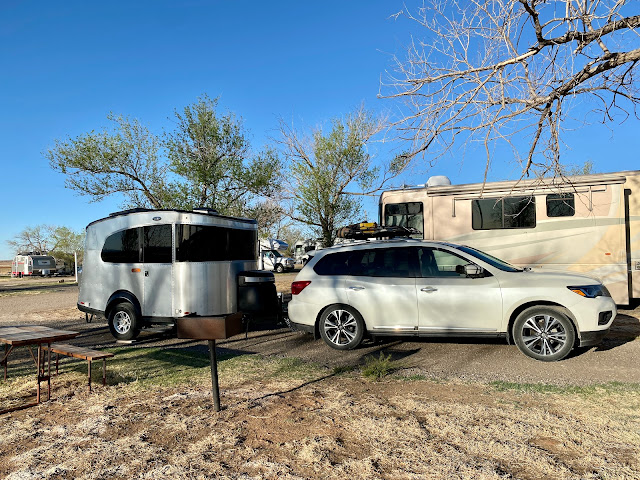
Kampgrounds of America, Tucumcari, New Mexico, Airstream Basecamp
Tucumcari KOA, New Mexico

Tucumcari KOA Journey, NM; Holbrook/Petrified Forest KOA Journey, AZ


I've written about Kampgrounds of America before ("First Impressions"), and my Southwest experience with KOAs remains the same--consistently predictable with upkeep and cleanliness . . . and predictably not a "woodsy" experience. For the trip out, we stayed in two, and I had to look at my phone's photos to remember their distinguishing features. They were pleasant, though, and the pull-throughs were flat and accessible. We did get to see our first Airstream Basecamp in Holbrook, even though we didn't get an opportunity to chat. On our trip back to Iowa, we didn't stay in any KOAs, yet that wasn't intentional. For a roadside park that keeps its standards consistent, KOAs are a good bet. We hit a couple two nights in a road, and they put us up for the night and got us down the road.
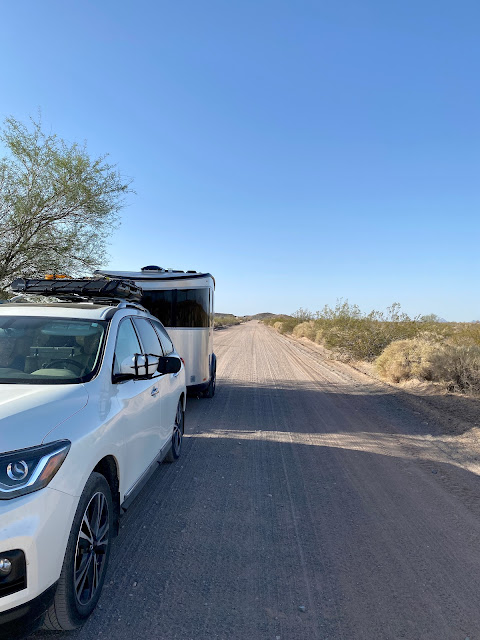
Airstream Basecamp, Sonoran Desert, Nissan Pathfinder
Oasis RV Park at Aztec Hills

Oasis RV Park at Aztec Hills, Dateland, Arizona


Oasis RV Park was our last stop before arriving at Carlsbad, California, and our first overnight stay after leaving Carlsbad. It's in the middle of the desert, and I wrote an article about our first stay upon reaching Carlsbad. ("Arizona Desert Basecamp Overnighter") This RV park certainly is in the desert in the middle of nowhere, yet there were a surprising number of folks staying there long term. Our first arrival was quite an unexpected event, as chronicled in the first article, linked above. Our return stay was hotter, yet at least we knew this little oasis really did exist as we headed down that gravel and dirt road into the desert. The owner and his wife kept the park clean, and it was interesting to see how their work routine began at dawn, when the day was coolest. 
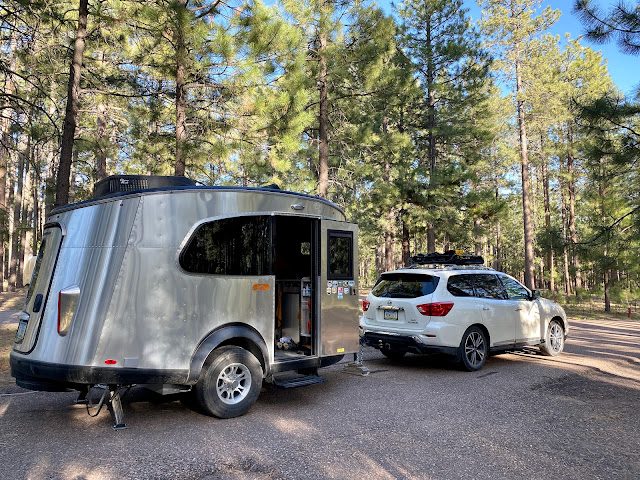
Mongollon Rim, Arizona, Canyon Point Campground, Airstream Basecamp
Safely nestled in for the night at Canyon Point
Mongollon Rim, Canyon Point Campground
Canyon Point Campground

Canyon Point Campground, Forest Lakes Estates, Arizona


After our first night on our return trip at Oasis RV Park, we decided to camp in the forest on the Mongollon Rim in Arizona at six thousand feet in elevation--a big change from the desert sojourn the night before! Canyon Point Campground is a federal campground in the Apache-Sitgreaves National Forest. The campground was closed on our way out but opened its season on May 1. We arrived on May 2, so there were a few minor glitches in our registration, but nothing noteworthy. (Believe it or not, we had trouble giving our camp fee to the staff. I finally told my wife Sandy, "I'm tired and don't want to wait around to pay. I'll just take a nap in the road, and they can wake me up when they want their money!" Luckily, someone showed up to collect.) It was windy, but we enjoyed the Ponderosa pines and the cool air after the desert. We could see that if we had more time on our trip how we could locate more scenic campgrounds. We were lucky Canyon Point was just off the road.

Hidden Valley Mountain Park, Tijeras, New Mexico


In several ways this was our least favorite park on the trip. It met the basic requirements of close to our route and clean, with an easy pull-through. However, the park didn't tell us when we registered that the nearby shower house was out of commission because of sewage repairs. We had to hike a long distance to an upper shower house, which they didn't even tell us about. We learned that the park had just been sold to a larger company. The park is laid out with the chevron pattern for RVs, so this park had many of the disadvantages of tight spacing and little landscaping without the amenities or sense of personal commitment that other small RV parks had. My main memory of this park (other than a friendly cat) was seeing in the hills above large, expensive homes with decks overlooking the valley below . . . which was stacked with RVs, ours among them. The irony of that contrast made me a bit sad--beautiful hilltop homes, a beautiful valley below, and a sardine scrunch of RVs "nestled" among the junipers growing in the dry, red soil. We were off early the next morning, though, no harm done.

Seven Winds RV Park, Liberal, Kansas


This is the RV park that I described at the beginning of this article, the one with the duct-taped toilet seat. Liberal, Kansas, is in southwest Kansas, where Kansas, Texas, Oklahoma, New Mexico, and Colorado are all in close proximity. In many ways Seven Winds was the most worn of the RV parks we stayed at on this trip, but in many ways it was also the sweetest experience. The manager was efficient, friendly, and helpful; the park was clean and peaceful; and with this park and the next night's (also in Kansas), we were given a look at how many Americans have found a home with "Mom and Pop" in these little, rural RV parks. The woman who checked us in was both professional and personal in her interactions. The southwest Kansas spring weather was hospitable, although the manager did tell us that we had "just missed some wind," which reminds me that the local town did have some tourist stop about Dorothy and Oz. Hmmmm. It was heartening, though, to see that some folks have found an economical way to live--most likely out of necessity--that includes a full-time residence in recreational vehicles (including 5th-wheelers and travel trailers) that are built more for shorter-term use. 

Mill Creek Campground, Paxico, Kansas


Our last stop on our trip home, Mill Creek Campground is about ninety miles west of Kansas City (either one, Kansas or Missouri). It reminded us of Seven Winds, perhaps a bit more renovated but both still next to the railroad tracks. Perhaps it was because of all those miles of driving, but we were never bothered by passing trains in any of the parks we stayed at. Railroad noises and road traffic noises are not uncommon in RV parks. Mill Creek and Seven Winds were both rural parks in rural communities. We found them quieter because they weren't near the interstate highways. Like most of the parks we stayed in, the pull-through was a composite of gravel, sand, and dirt--not bad except when it rained (as it did here), and then the it was easy to track in reddish footprints. Here at Mill Creek, we met a nice young maintenance man who asked us if we needed any help.  "We've got on-demand hot water," he said, "so don't worry about running out when you shower." The owner, who lived on his farm on the hill above the park, said to call if there were any problems. We cooked dinner and then went to bed early, since it had begun to rain. Up early the next morning to try to beat the rain, we still spent much of the trip home with light fog and misting rain. 
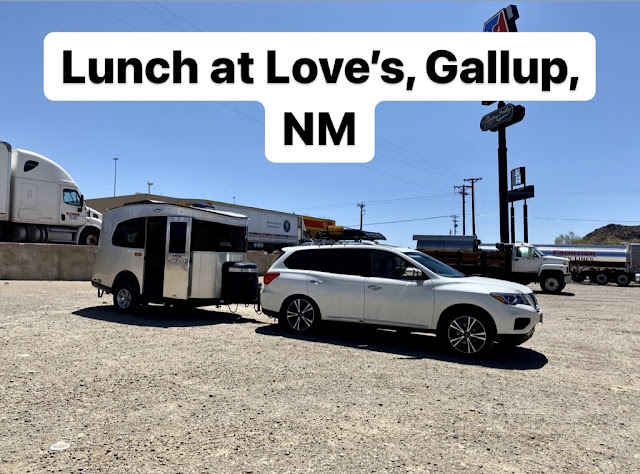
Love's Travel Stops, Gallup, New Mexico, Airstream Basecamp
A convenient gravel overspill truck lot on the other side of Love's
RV parks definitely have a place in the camping world, both for travelers and for full-time camping. If my wife didn't have her consulting business, we could have taken more time for the trip across the country. We wouldn't have had to pay so much attention to cellphone signal strength and internet receptivity. We could have set our destinations for scenic camping spots and traveled with the 2-2-2 travel model in mind (two hours of driving, arrive by 2 P.M., and stay two days). Because our destination travel was solely our final destination in Carlsbad, California, we spent longer hours traveling (but not very long hours), and it was a delight to discover little privately owned RV parks all across our nation. That made our trip easier, and we didn't have to spend our nights in Walmart parking lots or Love's Travel Stops with the big rigs. No, I didn't get a photo of every place we stopped--in part because arrival at some of the Mom and Pops gave us a chance to just let go, to drop our on-the-road vigilance. If kids are playing on the swings and dogs are lying in the middle of the street, it's okay to relax, right?

After this trip, we feel more comfortable with our traveling routine and with our new Airstream Basecamp 16, which we bought in 2021. We now know that the larger campgrounds, such as KOAs or "resort RV parks" have spaces for overnight travelers. We also know that there is a bit of adventure in discovering small, private RV parks to stay in for the night. We might expand our travel options by trying out some overnighters at truck stops or other parking lot options. It's nice to have opportunities and options when traveling down the road. Those worn yet clean RV parks tucked away across America? Perhaps that's what tried and true service experience looks like. Sometimes it's just plain nice to be mollycoddled.

Subscribe--Follow by Email

* indicates required

Friday, April 29, 2022

From Airstream Driveway Mooching to Beach at Carlsbad, California

Driveway Mooching at Carlsbad, California
Two weeks of driveway mooching--quiet and private
This was my last bicycle ride along the Pacific Ocean, so I made sure I would savor the experience. Six days of traveling in our 16-foot Airstream Basecamp (five overnighters) landed my wife and me in Carlsbad, California, for thirteen nights of driveway mooching at her parents' cul-de-sac, quiet residence. We've planned for another five overnighters at different RV parks to get home, but first while my wife was gone for the day at a business meeting, I wanted one more day of riding the five and a half mile route along the ocean to Carlsbad State Park Campground. Since it was my last day ride this trip, I wanted to stop for every whim and gaze at every vista.

The morning began with the lightest misting rain, but that burned off before my departure. It was just part and parcel of the Carlsbad experience, walking out in the morning to a gray, overcast sky, the lightest mist of precipitation cool to the skin, the faint smell of the briny ocean perfuming the breeze off the ocean. I rode at a steady but easy clip, enjoying the sights, especially once I dropped off the hills above the ocean and reached the beach area. Carlsbad has a long paved sidewalk that skirts the beach, and the road along the ocean includes well-planned bicycle lanes for each direction, north and south, miles and miles of bicycling and walking opportunities. 

I headed south toward my destination of Carlsbad State Park. Although there are hills, none are excessive and the ride is easy. At several points there are long stretches of parallel parking available for beach goers, a bike lane next to the parked cars, but with a safe zone between so bicyclists don't get "doored." Along this stretch, I saw a tiny, homemade "standy" trailer parked, a "for sale" sign on its side. I rode by, admiring the craftsmanship, but then turned back to ask for a photo and maybe to ask a few questions. 

Tiny trailer at Carlsbad, California
Homemade tiny trailer/toy hauler
Warren Jackson, from Virginia, had bought himself an EZ Hauler trailer and then built his custom dream trailer inside the aluminum shell. What he ended up with was a tiny toy hauler with the rear tailgate door dropping down to make a deck for his lawnchair. The inside included a bed, TV and electronics up front, and a sink, portable toilet, and space for a portable stove. He also had installed 640 watts of solar power on the roof so that he could run his little air conditioner. The strength of the exterior aluminum shell and the exquisite custom interior woodwork were certainly pluses. He was moving to Europe, which was why the trailer and his F-150 Ford truck were for sale. 

Tiny trailer at Carlsbad, California
A toy hauler capacity with a back deck
Tiny trailer at Carlsbad, California
Beautifully finished interior
We chatted for a while, talking construction and pricing. Since I write this blog about tiny and little trailers, he was curious about pricing, saying he was asking $27,000 for the trailer. I told him that since the trailer was a bit larger than many tiny trailers, especially with the flat roof which enabled standing its entire length and with the big solar kit, the price wasn't unreasonable. I felt the bed set-up, which was twin size, would certainly be limited for a traveling couple. That could be worked around, though. I wished Warren well and continued on my way. 

After a bit more riding, passing beach volleyballers stretching and warming up and surfers out beyond the swells sitting their boards, I crested the next hill and stopped at a traffic light. A young man at a commuter bus stop asked me a question, rapidly speaking Spanish. I responded, ¿Que? He asked if I spoke Spanish. Un poquito, I said. ¿Inglés? he asked. When I nodded, the young man said he was up from Mexico, meeting friends, but his cellphone was dead and he needed to find out where the McDonalds was where he was to meet them. We searched on my phone and found the McDonalds he needed was just three tenths of a mile away, across the ocean highway and over an overpass to cross the freeway. He gave me a "Thank you, sir," and I was on my way.

This bicycle ride today was much easier for me because I knew my route, having traveled it several times already. Carlsbad State Park is dominated by the Pacific Ocean, the campground on the bluffs above the ocean. The campground is also close to the four-lane ocean frontage road, but even that manmade reality does not overshadow the ocean. I meandered along the camping strip this trip, and snapped a few photos of interesting rigs after chatting with owners. Quite a variety of rigs were showcased at the campground, which has almost completely primitive sites, without water or electricity. The campground does have modern restrooms, available spigots, and dump stations, though. A few solar arrays were in view, and the sound of a few generators also filled the air as the campers got on with their day. 

CampInn at Carlsbad State Park
A nice CampInn
Airstream at Carlsbad State Park
A classic Airstream at Carlsbad SP
Rooftop tent at Carlsbad State Park
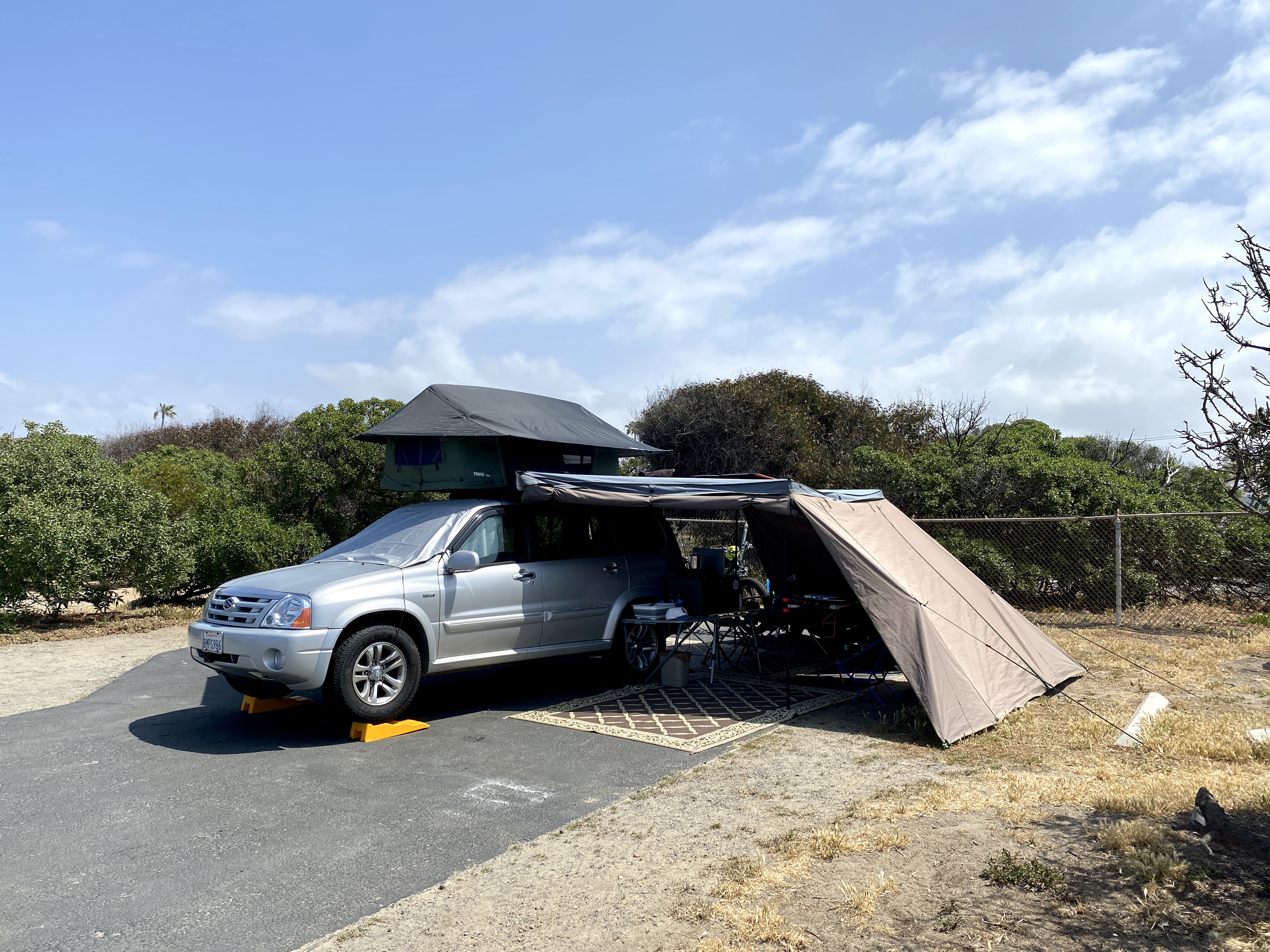
A Thule rooftop and a 3/4 surround shade tent
Retro brand tiny trailer at Carlsbad State Park
The Retro trailers: as the owner said, "Everything you need in a small space."
Although it would be hard to beat my driveway mooching camp spot at my in-laws, I have to admit the camping right on the ocean would be special. With the Basecamp, I could back in and then open up the rear door for a spectacular "backyard" experience of the ocean. My solar panels would keep me in energy, although if we came in the winter and it were foggy or rainy, then a portable generator would certainly be handy. 

Heading back home, since my wife Sandy was at a business meeting for the day, I stopped at the Harbor Fish Cafe in Carlsbad for lunch, sitting on a cement bench on the bluff above the ocean, eating my fish and chips (a unique meal for my primarily vegetarian self), enjoying the slight breeze off the sea, the pelicans flying by in stately formation, and me humorously keeping an eye out for hungry seagulls swooping down. It was a grand last day on my bike, one in which I had finally felt more comfortably at home in the town, freeway driving aside. 

Pacific Ocean, Carlsbad Beach, California
What greater views for a bicycle day ride?
Yes, I could get used to this--bike rides with ocean views, walks on the beach with my sweet wife, the perfect camping spot to driveway mooch, and a state park for camping on the bluffs above the ocean (as long as you reserve six months in advance). Now that we've driven the 1,800+ miles, maybe it will be easier to do again. Logistically speaking, the Nissan Pathfinder and the Airstream Basecamp performed like champs, and speaking of champs, Sandy took to driving the trailer like a trooper. 

Like all good trips, there is the joy of taking off and also the joy of arriving back home. We'll get back home in time to enjoy our asparagus season and spring garden planting. The world is a rich and varied treasure trove of beauty and wonder. Carlsbad, California, and the Pacific Ocean, in the spring, morning light burning through the faint ocean misting fog, this has been a special trip and a special time. I can truthfully say this trip has not only been a vacation experience; it has been a spiritual experience, recreation in the deepest sense of the word.

Subscribe--Follow by Email

* indicates required

Monday, April 18, 2022

Arizona Desert Basecamp Overnighter

April full moon at Aztec Hills
As we pulled off US Interstate Highway 8 to our evening camp stop, it was somewhat intimidating because we were in the middle of the desert. The exit road was not signed, so it was just a small, paved frontage road surrounded by the pale sandy beige shades of desert sands. My wife Sandy was driving, so we left the freeway, crossed railroad tracks, and then stopped at a tee intersection. Right across the road was a large confined cattle feedlot. OK, we thought, we're camping next to thousands of confined cattle? We traveled several miles down the old highway, though, leaving the cattle operation behind. 
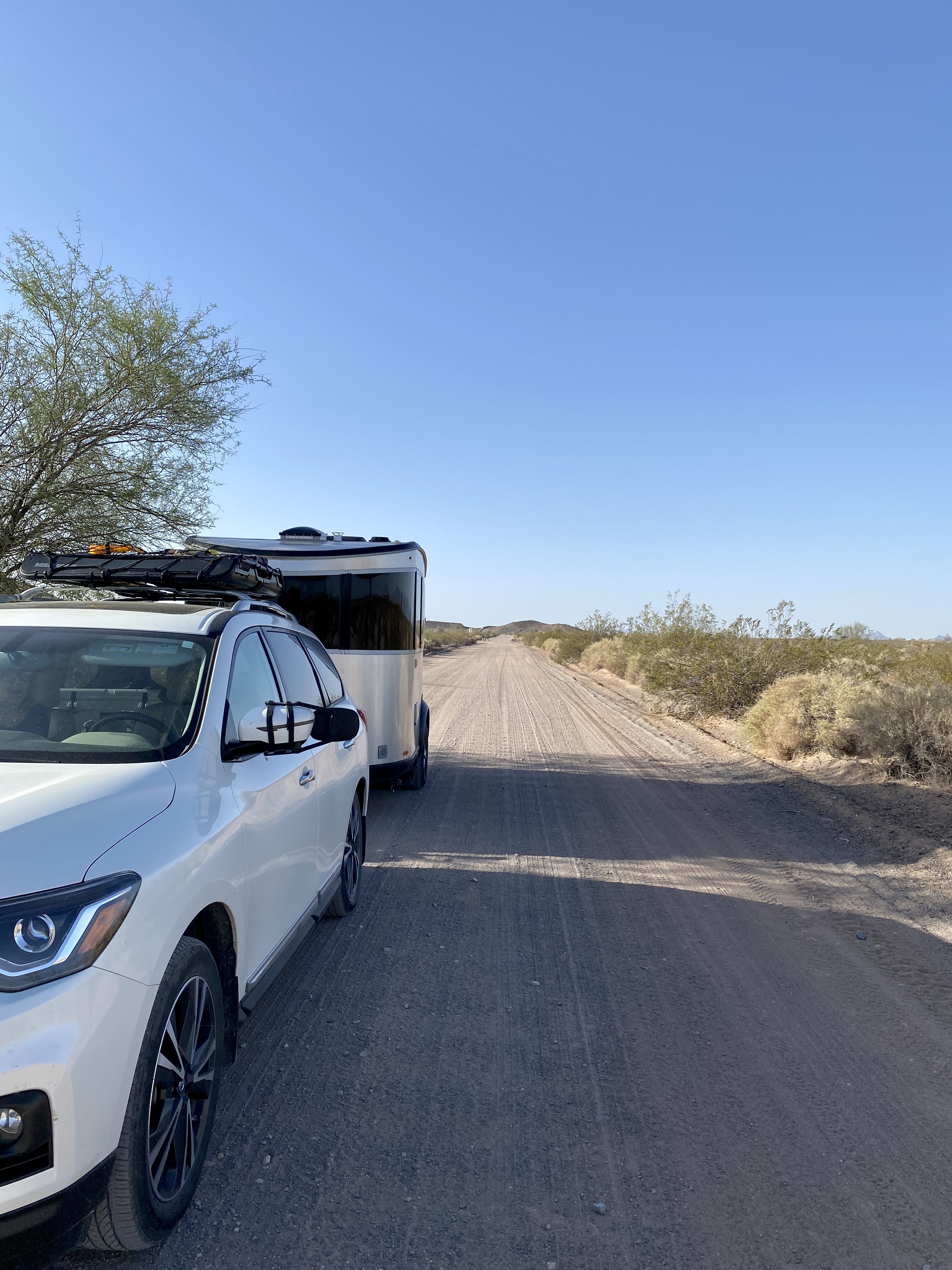
Then we were directed by our GPS navigator to turn left on an unmarked gravel road. Two lizards ran across the road on tiptoe in the afternoon heat. There was no sign indicating an RV park was anywhere in the area, but we could see a green spot about a half mile away--palm trees and perhaps the flash of some RV bling. We decided to continue on, the gravel being dry and the road wide and obviously in use. After about a half mile of gravel, the navigator indicated another left-hand turn, heading toward the green patch. Again, there was no sign indicating the existence of the campground, but we could now see a number of trailers at the little oasis. Sandy drove on, and we had arrived at Oasis RV Park at Aztec Hills. I had called and made a reservation in advance but payment was on arrival, cash or check. 

Everywhere and nowhere to walk
The wind swept across the desert and through the campground, but the April ninety degree heat was dry and not oppressive. We did turn on our air conditioner in our 16-foot Airstream Basecamp and were happy to find that the unit kept our aluminum "tin" can cool and comfortable. After setting up our minimal overnight camp--pretty much dropping the stabilizer jacks to keep my wife from getting motion sickness--we decided to take a walk and stretch our legs. We walked around the park and then wandered into the desert a ways. If we were staying longer, a desert walk early in the morning would be on the itinerary, assuming the wind was not too oppressive. And I'd bring along a trekking pole to rattle bushes to keep away the rattlesnakes.

Settling into the quiet night
As the sun set and the full moon rose, the temperature dropped so we could open windows and shut down the AC. It was quiet at this little oasis and we slept well in the quiet, moonlit moonscape. We found the park's one bathroom (and commode) and one shower was less than optimal for the number of camping spots, but we managed, even though Sandy had to wait before bathing because a couple decided to "shower" together. There were no shelves in the shower, so soaps and shampoos had to be placed on the floor. Not optimal, but we got by easily. 

This was the campground where I showed Sandy how to empty the black water tank and fill the freshwater tank. I really know how to show a gal a good time! Sandy wanted to learn, though, and she had been a trooper on our 1,800-mile trip to California, driving about half the way. Since this was our fifth night on the road, our routine of setting up the bed was efficient and easy. The Basecamp has been easy to live in. It's also been easy to pull, and our Nissan Pathfinder has done a good job of pulling the trailer, handling the six percent grades, both ascents and descents well. A lot of people mean-mouth the Pathfinder's CVT gearing (and 2022 models have a 9-speed transmission), but we've found it works well. We've used the cruise control a lot. On ascents in the mountains, though, we flick it off and figure our progress by RPMs rather than MPH, usually keeping the RPMs to between 2,000 and 3,000. That worked well. On descents, the transmission (with the "tow" option on) seemed to determine descent grade and the speed we wanted (via braking) so that the down-shifting allowed for minimal braking. 

A last "good-bye" photo
The next morning, we left at about seven o'clock, our path not crossed by coyote, lizard, gila monster, scorpion, or tarantula. We had an open road to ourselves, and I just had to take a photo of our unmarked road access to the park. It was a pleasant stop for the night, and the park was clean and the owners friendly and accommodating. A couple of signs along the entry route would be great, though! In many ways, the two KOAs we stayed at were more convenient, but this park was cleaner, quieter, and had a lot more personality. We will certainly stay here again if our stops match up. It ain't Iowa, but seeing those lizards skitter across the road while we were stopped, trying to figure out if we were on the right road or if our GPS was taking us into the bush--that is a memory we will never forget!

Subscribe--Follow by Email

* indicates required