Tiny trailer camping is great for one or two people, but what about family camping? What about two kids that are in their active years and big enough to take up a fair amount of space? Ashley and Nick Smolak, based in northern Pennsylvania, are living that dream with their classic fiberglass tiny trailer . . . along with their young daughter and son.
When it comes to tiny trailer camping, the Smolaks decided to go classic with a 1979 Trillium travel trailer. "We bought it in January 2020, right before Covid hit. We were SO so lucky. We had been looking for about a year for a fiberglass camper. We wanted something light that we could tow with our Outback and didn’t require much maintenance or difficulty in upkeep with a bathroom or extras."
1979 Trillium and Subaru Outback
They feel that the Subaru Outback makes a good match with their tiny trailer. Nick attached the hitch to the Subaru, which Ashley said wasn't a problem for him because he's handy. "Towing has been no problem at all. The weight of our camper is about 1,200 pounds when loaded. My husband does the driving. It took some practice when backing into a spot, but he’s got the hang of it! AND the benefit of a fiberglass, lightweight trailer is that my husband can pick it up himself by the tongue and swivel and move the camper by hand. It gets us into some great spots and allows us to turn the camper a certain way when we camp with friends."
The Smolaks tent camped since they had first met in 2006. "We always loved tent camping, and it allowed us to travel without the crazy cost of a hotel." Having their first child seven years ago didn’t slow them down, either. "Our kids love it and still ask to tent camp! However, camping with kids is a lot of work." After years of practice, Ashley knew she wanted a sink with a water tank. That was her only request when they began their search for a camper. "I knew it would make life easier to be able to wash dishes and babies and have water right there and ready."
Added shelves for storage
Not many renovations were required to get the Trillium ready for the road. "The only true renovations we have done are the added shelves in the vertical closet to utilize that space better for clothing storage. And the other being replacing and painting new birch plywood cabinet doors over the sink, the closet and the lower cabinets under the bench seat. The previous owner resealed the windows, replaced the linoleum floor, and put new cushion covers on."
Other additions are more for swank and comfort. "The newest addition is a three-inch bamboo and charcoal memory foam bed topper. What luxury! Sleeping on forty-year-old dinette cushions wasn’t cutting it anymore! I decorated with inspirational prayer flags in the back window, a national park scratch off picture inside a cabinet door, and a vintage poster of Acadia National Park hangs on the outside wall of the tall cabinet."
The Trillium's set-up works well for the family. "We sleep snug as a bug. The dinette folds down to a full size bed. There is also a bunk situation. The bench seat at the door converts. The back of the bench flips up to become the top bunk, with a spring rod attachment to prevent our kiddo from rolling out. Then my youngest, four, sleeps on the bottom. The dogs are cozy on the floor on a dog bed."
Efficient use of space
The camper has a two-burner gas stove that works well, just like a gas range at home. Ashley feels it is much easier than the old Coleman camp stove they previously used. There is an original Dometic refrigerator in place, but it has never been used as a refrigerator, but rather as a pantry. "It's so tiny that it would be useless to hook up and cool. We use a big cooler to store our refrigerated goods."
All of the family's clothing and hats and coats fit into the vertical closet. "We built four shelves and pack efficiently. I roll our clothing and have drawer organizers on each shelf. We use coats that pack down also. Our shoes fit under the bench seat in the cabinet. I use a big laundry bag for dirty clothes and keep that in the back of the car."
A camp bath!
Although their camper came pretty well laid out for their needs, Ashley and Nick also decided to just jump into camping with their kids and to learn by doing. They say to just get outside and use the camper. "Don’t make any changes, or buy anything special for it until you are using it and know what you truly need while camping. There are a lot of beautiful images of white, squeaky clean, minimal vintage campers, and that is just unrealistic." As a family of four with two dogs, they needed to make their sixty square feet of living space as functional as possible, and that came with practice and finding out what they needed and what was "just fluff."
"Camping with kids is great," Ashley says. "They are so much more likely to entertain themselves when we are out in nature. I do keep a basket of small toys, bubbles, coloring books, and a board game in the camper, but my kids are happier exploring outside with sticks. We do a lot of hiking. Most campgrounds have a playground too which is a highlight for them. And if there’s a creek nearby--big bonus!"
At home on country roads
Camping doesn't always have to be with the kids, though. The camper can be a little getaway for mom and dad. "We’ve experienced so much in a little over a year of having it, but I can say my favorite part about having the camper is the ability to pick up and go with ease. My husband and I were able to do date nights where we went away just the two of us for a night. Camping date nights are so fun!"
The Smolak family have camped with their trailer about twenty times in the short amount of time they've had it. They feel they are lucky to live in an area with great sights to see and a lot of camping options. Although they have mostly stayed in state parks or the Allegheny National Forest, they would like to explore more off-grid or boondock camping. They mostly travel to mountain areas with water access in northern Pennsylvania, with fall being their favorite time to camp. "Cooler temps and fall foliage is heaven to me!" says Ashely. "We’ve also winter camped three times with snow on the ground and night temps in the 20s, and it has its perks. Way less people out and solitude. We also enjoy the snow."
Classic comfort
Although most of the family's travels have been fairly local for them, they also would like to try some longer trips, having plans to do Mt. Washington and Maine this summer; Watkins Glenn, New York, for a race; and Knoebels Amusement park for an annual trip with Ashley's parents and their 5th-wheel camper. They had plans for Rocky Mountain National Park last summer, "but Covid ruined that, so we are hoping for a trip out West in summer 2022! I can’t wait to take my kids to the Rockies and Yellowstone and experience that with them, like I did as a kid with my parents in our camper." The Pacific West Coast has been a dream of Nick and Ashley's for many years. A trip to Olympic and Yosemite is on their bucket list, and "dreams of retiring and hitting the road one day are talked about a lot."
Ashley and Nick are fortunate to have found a camper that fits them so well. They are also wise campers to have realized that learning to adapt is important for happy camping. Their dreams of ranging farther north and west on their travels are grand, but what is really inspiring is that they are living the dream now, living outdoors and enjoying that fleeting, beautiful time when their children are growing up, stars gleaming bright and shiny in the summer sky. The Trillium is a flower "found in the southern Appalachian Mountains in the southeastern United States." There are about fifty species of this genus. This is such a wonderful symmetry: a beautiful Trillium trailer, a beautiful genus of flowers, and a beautiful family--all out and part of the beauty of nature. May all of Green Goddess Glamping's articles end so auspiciously!
Computer stand over stove, the day after the snowstorm
It's not so much the snow or even the cold that's keeping me from camping--most of the lows have been in the teens here in SE Iowa. It's the ice that's keeping my brand new Airstream Basecamp in the driveway. Yes, we had a big snow and freezing rain storm, and the temperatures have stayed low enough to keep that ice on the ground, and not only in my yard but also in the campgrounds. About half of the ice melted, but that has been on traveled highways. In the campgrounds, that ice has been staying. And now we're in the middle of another blizzard!
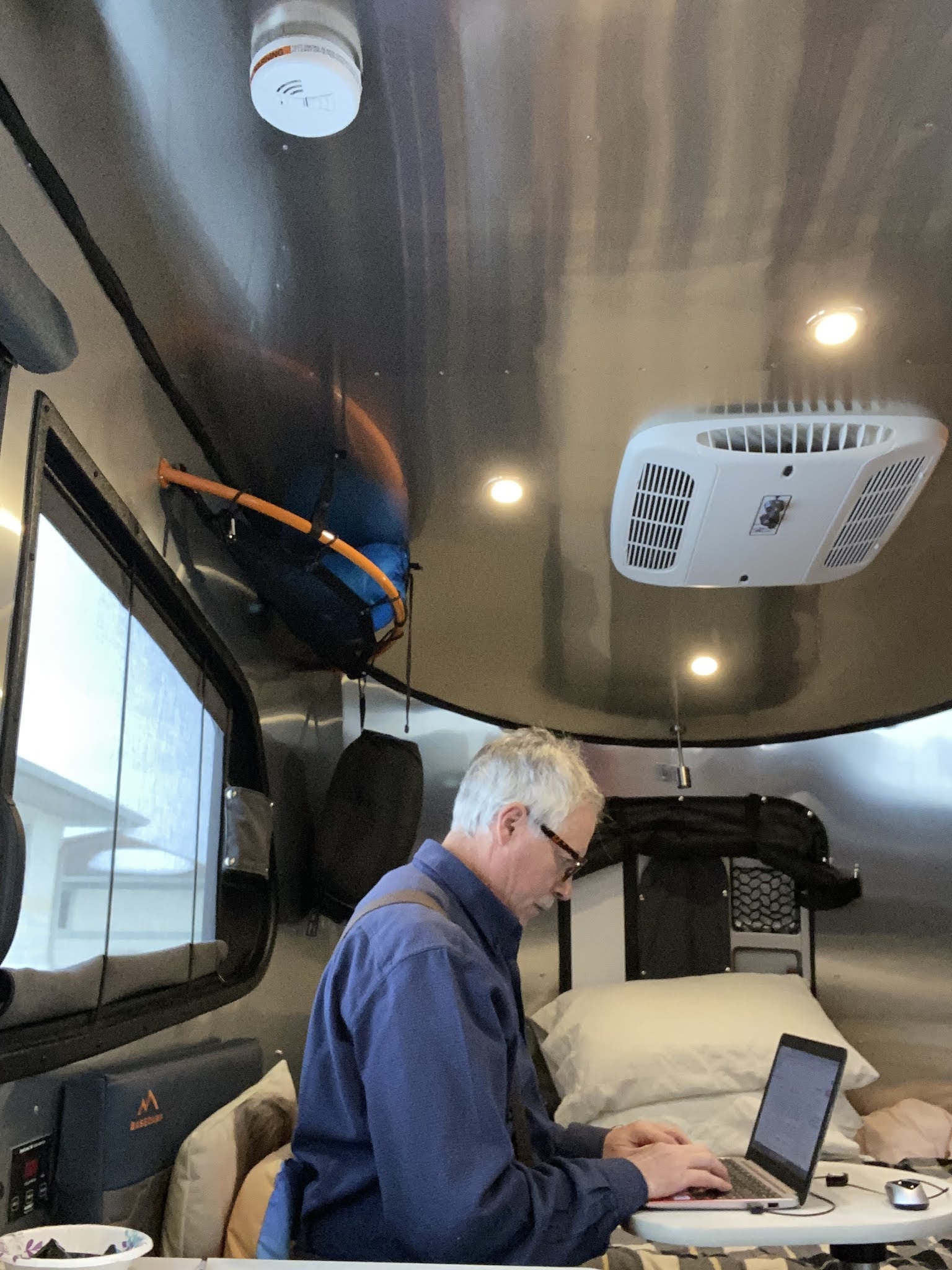
Just because I'm waiting at home, though, and keeping an eye on the weather, doesn't mean I can't have fun in my new camper. My wife and I are still playing with possibilities with the new nooks and crannies of our Basecamp. We're exploring just how we want to set up our bed, where we want to store our clothes and food, and we won't even begin to learn more about the water systems until spring when we de-winterize. Plenty to learn about prior to that, though.
Here are the main considerations we're pursuing while we driveway camp for two or three more weeks.
Efficiently changing the bed/dinette configurations and bedding storage
Storage and access for clothes, toiletries, and towels
Easy access to pots and pans, cooking appliances, and food
computer workstation set-up
Having moved from a tiny trailer (RTTC Polar Bear) to a little trailer (AS Basecamp), what's funny is that I have to keep reminding myself that the old way of doing things is now history. I have to adapt to the new possibilities of our new rig and use our new unit to best advantage. I can start packing less stuff in the SUV or in plastic storage bins. There's space in the trailer. I don't have to throw out all our old ways; however, I do have to to look for ways to determine what is the most efficient way to use our new living space. One consideration is that one person camping, two people camping, or three (think grandchild) each present different possibilities of organization. What fun to explore these possibilities!
Sleep Arrangements / Storage Possibilities
My wife Sandy and I spent some time last weekend hanging out in the Basecamp and discussing different sleeping and storage arrangements for bedding and clothes, trying to figure out the best arrangement for our new space. We think we've come up with an arrangement that will work pretty well.
Sleeping bag for pad, pillows, and down bags hanging from cargo nets
For sleeping we want something that requires a minimal amount of bedding. Right now that means sleeping bags. We're using an old cotton flannel sleeping bag for our bottom sheet/topper pad and lightweight down sleeping bags for our top covers. We plan to also take our heavier down bags just in case we get cold--at least until we become more familiar with the Basecamp's temperature profile.
We are happy that the 2021 Basecamp comes with the split benches so that we can set up the back part of the bed and have a small table with bench seats set up in front of the bed. Sandy and I feel we can sleep on the smaller bed set up without making the entire bed. At least we're going to try that to see if it will work part of the time. The smaller bed with the small dinette will allow us to minimize the time it takes each day to move from table to bed and back. We recognize that longer stays with us both will probably require some time with the bed fully made so that we can really stretch out. Also, for longer stays, Sandy will be working online for her business, which might include a larger table space with both tables up.
Cargo hatch open with storage bags
Rear opening strut
Front opening strut
We plan to use the storage space beneath the curbside bench mostly for clothes. Mounting the struts on the hatch lids has really made a difference. To make the bench storage more useable, three things were required (for us, anyway):
minimize bedding so moving the cushions was quick and easy
mounting the struts so the hatch lids easily stay open
removing the table leg storage mounts to streamline the interior space
Not using the Basecamp as a Toy Hauler allows us to keep the rear trailer space available for our minimal bedding. Having the smaller bed set-up as the normal configuration allows for easy travel preparations because some stuff can just be tossed on the bed when traveling. With the bench storage keeping most of our clothes, the overhead storage nets can be used for day/night clothes storage, which will lessen the need to access the hatch storage. Placing clothes needed soonest or most often in the front hatch storage will make access easier. We also plan to put cube storage bags on top of the canvas storage boxes. (By the way, we are re-purposing the four black canvas bags. They are pannier grocery bags for our bicycles.)
Table legs stored in cargo net zip pouch
The passenger-side overhead cargo rack has a zipper pouch in the bottom netting on our 2021 model. The particle boards used for the bed foundation at the back of the bed were stored there when we picked up the Basecamp. They are heavy, so we realized that this zippered storage area could also hold the tubular table legs. With the bed/table configuration we're working with now, one short table leg will almost always be in place in the back table area. Two legs (one long, one short) can be stored in the zippered cargo net area. The last long table leg we will either have up with the forward table, or we will just slip it beneath the bed area like we did with old old tiny trailer when the bed was made. We're hopping for this to be an easy set up for us but also realize that as we camp more with the trailer, things will probably change.
Typing at the front table; bed set up in back
Kitchen Area Organization: Cooking/Computing
With a beginning organization and plan for the back area of the Basecamp, our driveway explorations will now focus on the front kitchen area. Our basic goals are to make the area as comfortable as home for cooking or for online computer work, recognizing that I do a lot of computer work sitting on the bed with a backjack for back support and a pillow on my lap for a desk. Having an alternative is good for my back, though, so a standing workstation is something I definitely want to explore as an alternative to sitting.
Our cooking goals are really quite simple; we want to be able to cook and eat the same foods while camping that we eat at home. We feel keeping to our usual eating habits will be both less expensive and more healthy for us. One reason we invested in our little trailer--as opposed to the tiny trailer we owned before--is that we wanted our camping experience to simple but still homey, still comfortable. "We're not getting any younger, you know," I mutter in my best (or worst) geezer voice.
Last week and this week have been winter driveway camping prep-time for me, allowing me to get ready for my next trip. Tomorrow I have to drive to my Nissan dealership to have a warranty replacement for a faulty sensor for the Pathfinder. I received last week the Basecamp's registration and license plates. Next week I might head out for a 450-mile trek south to northern Arkansas. There's an Army Corps lake there, Greers Ferry Reservoir, that has open campgrounds yet is still far enough south of Iowa to be more pleasant in February. The temperatures will be around fifteen degrees warmer than here in SE Iowa, with no or little snow. What with us getting 8-12 inches of snow right now--on top of ice--well, temperatures in the 20-50 degree range sound great right now.
They key point is to enjoy the present moment, though, so today I'll be heading out to the camper to try out a few procedures such as the standing computer station. I plan to have fun today . . . and to have fun tomorrow. I'll be able to follow the fence to the driveway where the Basecamp is parked, so I probably won't get lost in the whiteout . . .
A year ago, my wife and I enjoyed a fall weekend camping trip to a local state park. We hiked and even played with our grandkids who visited one afternoon. How the world has changed! Just a quiet weekend: nature walks, family interaction, peace and quiet--and no coronavirus, presidential election, worries and woes out the window. Step back a year in time and experience the ease of the outdoors.
It's Friday afternoon at Lake Darling State Park in southeast Iowa, and my wife and I are the sole campers in the entire park. We are not alone, though, abut are visited by deer, geese, swans, squirrels, and a lone eagle. And, of course, we have each other, as we have arranged for this late fall weekend of camping for ourselves, a chance to be together, to walk together, and to even enjoy an experience more rare nowadays in this modern world--to be out of cellphone receptivity.
It's much easier to get a lakeside campsite during the off-season.
"Solitary" has its etymological roots in the Latin word solus, which means "alone." Mirriam-Webster defines it as "being, living, or going alone or without companions." I see no reason, though, to not apply the term to a couple, such as a camping couple, traveling "alone or without [any other] companions." After all, by marriage or whatever process two individuals declare themselves to be a couple is really a declaration that two have become one.
I think we've all met couples who take out their rigs or tents and camp, enjoying the time alone and together. Maybe these are long-time couples, maybe two people new at this "couple" thing. Maybe they are enjoying the comfort of being together, celebrating a relationship strengthened with time; maybe they are using the camping time to increase the strength of the bond by creating experiences together. In either case, they are a unity, two become one as they sit together before their campfire, the crackling light of the fire illuminating their faces with the same flickering light.
Bundled up, we enjoyed several leisurely walks along the lake.
Four months ago I wrote a piece entitled "Traveling Solo: Being Alone Is Not the Same Thing As Being Lonely," in which I reference a Psychology Todayarticle in which the author says, "Loneliness is marked by a sense of isolation. Solitude, on the other hand, is a state of being alone without being lonely and can lead to self-awareness." It seems to me that couples can certainly travel alone by themselves yet not feel lonely, that they can come to understand and appreciate their relationship better by spending time by themselves. That campfire, after all, is the fire of the gods which symbolizes knowledge and consciousness. It is possible for time alone together to be a special time, a celebration of the reality that beneath the hustle and bustle of everyday activity lies that quiet unity of experience, hands warmed by a cup of coffee or tea, the fire warming faces, the day full of possibilities.
Later that night, the full moon illumined the same view.
Lake Darling State Park provides a spectacular view of the lake right from the campground. My wife and I have camped there together only once before, since the cellphone signal is practically non-existent, which means my wife can't work online from camp. However, we decided this time to spend a weekend together and to not worry about the work. There is a phrase I just ran across that applies: "escaping default life." We have our daily routines, our habitual behavior, yet we don't want to live our lives on "automatic." the hours and days drifting past without our even noticing. My relationship with my wife and my relationship with nature hold special status in my life. The only word I can think to describe that status is "sacred." A true experience of the sacred can never be taken for granted; it cannot become blasé. We put our cellphones away, held hands, and walked along the lake, warmed by the late fall sun and serenaded by trumpeting geese. I don't know if that's romantic, but I do know that it's impossible to sleepwalk through the day while surrounded by garrulous geese!
It's impossible for a couple to camp in a tiny trailer and to not experience a real sense of closeness--be that positive or negative. Tiny trailer camping, practically be definition, is the experience of sharing--or invading--one another's space. Fortunately for my wife and me, our experience with tiny trailer camping has been one of graciously sharing one another's space. Our weekend of sharing began with my backing into our space on the first try with Sandy guiding me. Go, team! . . . because rumor has it that this activity can be a challenge to happy couple relations. Maybe tiny trailer backing is easier, even though the short turning radius makes the backing quick and quirky.
Clear skies at late fall means freezing temperatures
For off-season camping in Iowa state parks, the water and electric remains on, but the shower and flush restroom facilities are closed due to freezing temperatures. (The dump station is available, but we didn't need it, of course.) There are two pit toilets for the campground/cabin area; we also brought our dry portable toilet to see how that works.
We immediately set up by plugging in our oil, electric heater for the camper. Having a great view of the lake, we were looking forward to sharing the campfire together, now that the weather was cold enough to justify a fire. We were essentially off the communication grid, although we could, at times, successfully push through a text or phone call with our signal booster if we were lucky. We hadn't realized how habituated we had become to checking our phones until we lost that option; then we embraced the moment, just enjoying the silence and one another's company. Our weekend boasted temperatures from 20-50, but we had brought clothes for the variety of weather.
Our family comes for a visit.
Our solitary weekend wasn't lonely, though. Certainly not! In addition to our quality time alone, Sandy and I were visited for an hour by grandkids and family. Swings, walking the dogs, climbing, and lots of happy sounds extended our sense of sharing and unity. After the kids left, we were also not alone--two more teardrops increased the campers to three. Imagine, only three campers in the entire park, and they were all tiny trailers! We discussed that with the other teardroppers, and the consensus was that since most tiny trailers don't have plumbing, it wasn't such a big change to camp in the cold weather. We're already used to no indoor facilities, and sleeping with the potatoes so they don't freeze isn't that big an accommodation, is it?
Across the bay, two teardrops arrive, this one a Silver Shadow
A home-built teardrop, both teardrops about a hundred yards from us
Activity arises out of stillness and silence. Physics tell us that the universe arises from the Unified Field, an unmanifest field of pure potentiality from which all existence springs, a field of energy and (I think) intelligence in the most abstract sense in that the order of creation implies intelligence. I think that's why camping can be rejuvenating; both physically and mentally we can refresh and remind ourselves of the order of things. For a couple, a weekend together can be an affirmation of that bond of unity. It's a time to slough off the distractions and to celebrate our common bonds, a time to experience something of the "perfect love and friendship [that reigns] through all eternity," as articulated in the Christian hymn "Blessed Be the Tie That Binds," or Bruce Springsteen's more scarred journey to love in "The Ties That Bind":
It's a long dark highway and a thin white line Connecting, baby, your heart to mine We're running now, but, darling, we will stand in time To face the ties that bind
We don't hook up our campers and drive to nature. We are nature, as much a manifestation as the largest galaxy or the smallest flower. We are sojourners, all of us, and blessed are we who travel in unity, whether we be one, two, or many.
I'm writing from my tiny trailer right now, enjoying the silence and environment, both enriched by memories of other solo camping outings saturated in tiny trailer camping solitude. The difference is that I'm still in my driveway, so the view out my window is not that of oak, hickory, and maple. Rather, it's a garden view of peas, lettuce, and the purple flowers of the chives. Not a bad view, actually.
My wife and I were going to camp some this week, setting up our trailer in the county park just outside of town, four miles from our house. However, the weather grew wetter and wetter, with the "non-raining" days (today being one of them) actually just being days of faint mist. Tomorrow will be the same, followed by a forecast of seven days of possible rain and thundershowers. Not impossible camping weather, since the temperatures are in the 50-60 degree range, but we've decided to stay at home
Another reason for staying at home is that Iowa has not only opened its campgrounds, the governor has also said the showers and restrooms will be fully open--in other words, back to normal. In my opinion, the COVID-19 numbers for the state don't support such a "back to normal" attitude because the numbers are still spiking. My wife and I will still do some camping this year, but we will still camp using the self-contained protocols. Governor Kim Reynolds, with each further opening of the state, says, "Oh, but be sure to be careful and keep your distance," but I believe the result of this experiment in opening early will be that of Sweden--yes, we'll get through it, but with many more deaths than expected.
In the meanwhile, my wife and I, and our children and grandchildren here in town, have established our safe "bubbles" of security as best we can and are living our lives looking to the future. We share some time together, are careful when we go out for food, and expect these practices will continue for some time. The governor yesterday said bars, theaters, and other public venues such as museums and zoos can open, along with some school activities. When asked why further openings were justified, the governor said that the state has the resources for an uptick in coronavirus cases, should a surge happen. She said the state's positivity rate is down, which is an odd thing to say. Locally, a 29-year-old woman had coronavirus symptoms. She sought a test at the local hospital but was denied--too young. She went to Iowa City, was tested positive and put in a room. Test kits have to be used as little as possible locally because so few are available. Of course positive-tested individual numbers are down!
So I sit in my tiny trailer, knowing that my wife and I will be camping in some of the lesser-used campgrounds when the weather is fine and it's the middle of the week (if that makes any difference with the kids out of school). Meanwhile, we have a quiet writing room, a meditation room, a playhouse for the grandkids. We're in pretty good shape. I plan to transplant my zucchini starts tomorrow, along with eggplant and cherry tomato starts.
I'll enjoy the cloudy day today and tomorrow, and keep dodging all those raindrops that I know are coming. Sometimes you just have to look at the sky and make your own decisions, never mind what those people on the TV are saying.
One of my "stock photos" of the field across the way from my home.
First of all, at this time with over a million people infected with COVID-19 and over 60,000 deaths in the United States, characterizing the pandemic as a good event would be the height of insensitivity. Too many people are suffering. On May 3, the Des Moines Register reported the following information about Iowa: "Nearly twice as many people have died in Iowa from COVID-19 versus influenza this season, according to information compiled from the state department of public health. And the COVID-19 deaths occurred in less than a fourth of the time."
Yet even in the reality of these times outside my window, here I am, staying at home as requested, being careful to limit my trips to the store, distancing myself from others, just like other people all over the United States and the rest of the world--and I'm healthy. There's the world event, and then there's the individual event. There's the macrocosm, and then there's the microcosm.
Right now, I'm sitting in my chair next to my woodstove. I've built a small fire to just warm the house a bit . . . and to warm my heart a bit as the sun rises this early morning. The county where I live has a low coronavirus rate at this time . . . at least the verified number of infections is low. My family and my wife and I are well, so on the microscopic value of my individual life, any "suffering" I'm experiencing is either just complaining or an empathetic response to the experience of others.
Apropos to this blog, though, I am home, unable to travel to campgrounds and camp--even local ones--and any camping I do will be from my driveway. As a tiny trailer owner on the first day of May, how can there be a "silver lining" to my camping life? The bottom line is that my camping life has been nipped in the bud this year. I've even got twelve bales of straw stacked in front of my trailer, tarped down, so I can't hook up. How can that be a good thing?
My answer is grounded in my marriage, really, and my lifelong habits of behavior. Henry David Thoreau said it around 150 years ago: "Simplify, simplify" (Walden, Chapter 2, see The Walden Project). That's what my wife and I have been doing since early March, trying to find a lifestyle that fits us and also meets the needs of the times.
This COVID-19 epidemic, then, has become a crucible where we are refining and transforming our personal lives into a more efficient existence, both physically and mentally. (That's an extravagant statement, so I have to add that we've been watching a lot of TV, too, just to keep this discussion real.) Without getting too lofty, we've just been thinking about how we can manage this new time as best we can, and we've found a few key action points.
One point of focus has been food. We've always appreciated foods cooked from fresh and unprocessed, organic ingredients. With our greater time at home, we've expanded even more our self-cooked food selections, making our meals from scratch, baking bread and chapatis, sun tea instead of colas, baking our own deserts, taking the time to make our meals not just nutritious but also beautiful. We've always stocked up with gallon jars of the basics, so we've "topped off" our victuals and are now in a good position to grocery shop once every two weeks.
This leads to the second focus: gardening. I've gardened organically for almost forty years, and this year I've had more time to focus on doing it right. I'm not able to say nowadays, "Yeah, I'll get some stuff in, and then let's go camping!" since I can't hook up and take off. My mini-greenhouse is ahead of my usual schedule, and I've done a make-over of our north garden from a wire-fenced, more traditional garden to raised beds with cedar boxes. It's been a lot of work, but I've had the time, haven't I? It's been a cool spring, so starting the garden this year has been a gradual process, one I've been enjoying, except for a chronic sore lower back from too much lifting, bending, and shovel work.
Two tiny trailers
Although my wife and I have just spent the first Saturday in May with our grandchildren here at our house, we have been spending more time together in isolation as a couple, and that has not been all bad. When the pandemic erupted in early March, our extended family pulled back and created bubbles of isolation, and we managed our extended relationships mostly by Facetime. We did as almost everyone else did and learned how to manage our relationships at a greater distance. At one point after about a month, after we and our extended family had created our bubbles of safety, we began physically interacting again. Then, after home repairs and outside workers coming were required at our children's home, we re-established our iPhone routine for two weeks, which ended last Saturday.
We have some limited "sharing of our bubbles" of safety now, knowing that the current environment is the "new norm" for probably at least the next year. Mostly, though, my wife and I spend our time alone together, and that has not been a bad thing. Rather, we are both more aware of our time alone as we are processing this change in society, which at times seems to be an almost hallucinogenic experience--like Alice in Wonderland who has fallen down the rabbit hole into a bizarre reality. We are wrestling with this new reality, and even though we at times feel emotionally beat up, we are finding a way through to meaning and purpose. We are seeing our new norm as an opportunity to enrich our relationship and to deepen our understanding and appreciation for one another. It shouldn't have been and truly wasn't necessary for a pandemic to occur for us to increase our connectedness, but we are choosing to use the situation as best we can--and have found increasing nurture and unity for ourselves in this time of distancing.
Throughout our navigating these new waters of living and lifestyle, our tiny trailer keeps popping into view--outside our north window as we look each morning at the lush field across the way and enjoy the sunrise to the east; later in the morning as I slowly straighten up to stretch out my back which is sore from garden work, leaning on my shovel and seeing the Green Goddess in the morning sun; in the evening, making sure the garage and trailer are buttoned up for the night, thinking about when I will spend a night in the trailer. I think our tiny trailer is emblematic of our hope that we will negotiate this change in lifestyle from one of naivete to one of more cautious and careful behavior. With continued care, the passage of time, and society's better scientific understanding of this novel coronavirus, we will eventually begin to camp again. We will work it out.
In a Psychology Today online article about the advantages of consciously choosing a more simple life ("Henry David Thoreau: 'Simplify, Simplify"), the author reminds us that happiness is not an object or even a person; it is a state of mind--happiness, contentment, peace. Doing less is a means to accomplishing more if we remove clutter from our lives. As an example, one way to improve the quality of a photograph is to frame the shot to emphasize the most significant detail, thereby removing what is extraneous and distracting. By simplifying, we actually enrich.
For me, I'm working on simplifying my news intake. I do feel it's important to keep current with how things are going in the world, especially with the practicalities of managing our safety. I do feel I especially need to keep current with Iowa's changing management of the virus (or lack of management). However, lately I have been doting on the news, reading too much about the medical situation and the politics of a national election year during a pandemic. "Simplify, simplify," I tell myself. Get off the phone get into the garden. Do not miss the planting time! And that doesn't mean planting gloom, doom, and spin into my consciousness. I know what I need to do and for whom I plan to vote.
The sunrise is much better for my eyes than backlit text on a phone or computer screen. That sun warms the soil for the seeds I plant; it warms my heart. I need to deal with this pandemic and the changes it has wrought in our personal lives and in the world, but I don't need to obsess about it. That's not healthy. It's not 1969, Woodstock, pills and mushrooms, Grace Slick, the Jefferson Airplane, white rabbits, et al. Our current sirens are not nearly so mythic or melodic.
Who really knows what event lies around the bend for ourselves and our families? We can be prepared, but we can also be sure to enjoy the moment, to appreciate the beauty and love in our lives, to help our families and to grow from the experience of giving. We can "simplify, simplify," and find the simple pleasures of life. Wherever we sojourn, we can all make our temporary residence more than just a point on a map. We can make it home, whether our "home" is a traditional one, or whether we are dreaming of our tiny homes on wheels.
Early morning, the Garden Goddess awaits in the driveway
Finally, after two weeks of quarantining for my wife and me and our grandchildren's family, we will begin to interact again, and our tiny trailer will become--at least until circumstances change--not only our garden cottage but also a playhouse.
Hardly anything is up in the garden, although as I write that, we are eating some asparagus, chives, arugula, radishes, and turnip greens from the garden and our mini-greenhouse. This morning there is a north wind, and rain is expected. We seem to be past the frosts, though, and in our main garden, peas and spinach are just peeking out.
The wrens get a tiny house, too!
We've put out two beautiful wren houses that a local friend paints and sells. The one in our blossoming peach tree can be seen from our living room windows while the other birdhouse is in the pear tree, visible from our bedroom window. We hope to soon see busy wrens flitting from the houses to the garden, adding their spirited presence to our home.
We're already planning how to make our house a second safe haven for our children and grandchildren, having cut ourselves off from the world, except for an early-morning trip to the grocery store once every week or two (and we might have our groceries delivered). Some form of distancing in society is going to continue into the indefinite future, it seems to me. With the garden producing now and some food stocked up, we can go a long time with just interaction with our children, leaving the rest of the world to its own hunkering. (Is "hunkering down" redundant? Does anyone hunker up or sideways?)
The garden has been a real bright spot for me. It's a safe place for me to go and interact with nature. The earth is waking up, plants are peeking through the soil, and getting my hands in the soil while feeling the warming of the world is calming and reassuring. I've replaced the forest for my growing bed . . . and I still get to see plenty of rabbits! They've been sniffing around the garden, asking, "Hey, Tom, when are you going to open the store?" I left the door open to my greenhouse, and one rabbit momma started digging a nest in the turnip greens. I shooed her out, but she didn't want to go. It was, after all, a great place for a nest--except that I locked it up every night. Maybe she was counting on that, though. What safer way to spend the night, not having to keep an eye out for our local bobcat.
From snow to spring
Two and a half weeks brings a big change for spring here in SE Iowa. We had snow on the ground then. Although I haven't slept overnight in our camper recently, I plan to, and this morning when I chopped wood for our house's woodstove, I saved some back in the garage for a fire in our metal firepit out in front of the trailer. Next week should be warmer spring weather! With the big field across the way and my quiet little neighborhood, I plan to enjoy my world with a magnifying glass this season, rather than with a telephoto lens. Sometimes the small joys are the most rewarding. Sometimes the small joys are not so small after all.
I can't find my tiny trailer anywhere, but I have found this small garden hut in my driveway, beside my garden. It has wheels and is rigged to tow, but it's blocked in front by bales of straw. It could be a tiny trailer if I could travel and camp. It could be my tiny home away from home if Iowa's campgrounds were open. Right now our tiny trailer is our meditation retreat, our mobile office, and our dacha beside the garden (which I've written about before).
A second snowfall today, April 17
We have very close family interactions here in town, and we've been trying to understand and to redefine how those connections work and will work in the next year or two. Can two households establish safe measures to interact? Can even one household establish safe measures? Do we need to have food delivered? I think these questions are being asked by many when long-term lifestyle changes are reckoned for our future as individuals, families, and communities.
We are working to create a safe environment--one self-contained family living at two locations, food eventually delivered. Right now I am going to the store about once a week, early in the morning, wearing a face mask and packing alcohol hand-sanitizer. We may cut that out or lengthen the time between grocery runs soon because my greenhouse will begin delivering greens in about a week. We have always kept a supply of food on hand since we cook mostly with bulk, unprocessed natural ingredients. Sandy and I can pretty much hole up here at home and pull the hole in and disappear. If we can create that same situation for our daughter and family, then can we carefully interact--being ready to invoke a two-week quarantine if the protocols are compromised?
It's a day-by-day situation with a recognition that the worst is yet to come in Iowa, expected in May. Right now our county has had four confirmed cases of COVID-19, with no deaths. Other places in the state have higher infection rates. Today the governor just announced the K-12 schools would be closed for the rest of this school year. Several meat-packing plants in the state have had major virus outbreaks among the employees. Meanwhile, I'm focusing on staying at home and tending my garden.
There's this sense of loss, though, a sense of discomfort and sadness, even though sickness and death from the coronavirus have not struck our community yet with a heavy hand. One article I read that provided perspective for me was from the Harvard Business Review, "That Discomfort You're Feeling Is Grief." The article introduced some new perspectives for me, one being that we are experiencing loss of our normal lifestyle, economic loss, and loss of connection--several kinds of grief. One concept that I hadn't heard of before was that of "anticipatory grief," that unpleasant feeling we get when we are anxious about the future.
It's especially difficult for my wife, who feels an obligation to help out with the children and grandchildren. My years as a school teacher have helped me, I feel, deal with the separation. Teaching is a career-long process of giving everything you have to the children before you, of completely dedicating yourself to their inner and outer wellbeing--and then letting go and allowing them to go on with their lives without you. It's tougher with family, but the same principle applies: they grow up and leave the nest. Sure, I'm grieving, but the pain is worse for my wife.
I've written a long introduction to finally arrive at discussing my tiny trailer. Sandy and I have just taken probably the shortest drive to a camping site ever. I hooked up the trailer and moved about ten feet forward so that I'll have space to put up the awning without having the guy wires block the walkway. Our camping will take place in our driveway in front of our garage and next to the garden. For my nature inspiration authors this season, I'll take less inspiration from Thoreau and Muir and more from my gardening books. Rather than oak, maple, sycamore, and juniper, I'll be communing with kale, lettuce, peas, and green beans. And lettuce, arugula, cilantro, chives and onions, okra, tomatoes, carrots, potatoes (red and yukon), asparagus, chard, spinach, squash, and a few other vegetables, I'm sure. I shouldn't forget the flowers either, the day lilies, peonies, irises--and the annuals, the cosmos, zinnias, and marigolds. And, of course, our peach, cherry, and pear trees . . . and raspberries. Hmmm . . . sounds like I'll be busy this year!
A photo from the kitchen window, after the first (and lesser) snowfall
I'll be able to set up our mobile office so that Sandy can work outside while I putter and plant in the garden. Not today, though, because we got about 5-6 inches of snow last night, our second snow in a week. It will melt soon; it was thirty-two degrees at dawn, but wow! The ups and downs of spring! I'm writing right now in the early morning, the sun up but the day gray with a canopy of cloud and white with a blanket of snow. In the next couple of days, it will warm up enough so that I can plant peas outside and possibly even transplant some of my kale starts that are up in my mini-greenhouse.
COVID-19 Iowa
We'll start living more outside. And with our family situation? It's a time of hard assessment. We may decide for our households to continue our quarantine of households with groceries delivered and no other interactions before (or if) we interact again. Increased pressure from the environment may determine that we continue our quarantine. Or we may decide that we have created two safe "bubbles" in this COVID-19 polluted sea. The entire world is working this out, trying to determine long-term liveable solutions. We all know the short-term protocols.
What is odd is how integral to our plans our tiny trailer has become. It's there in our driveway, just waiting for some time inside or a chair or two out front. We can build a fire. We can watch the sun go down. It's a world apart, even on a journey of only ten feet.