Showing posts with label Art and Craft Activities. Show all posts

Friday, February 18, 2022

One Warm Day for Camping Is All (or the Least) You Need

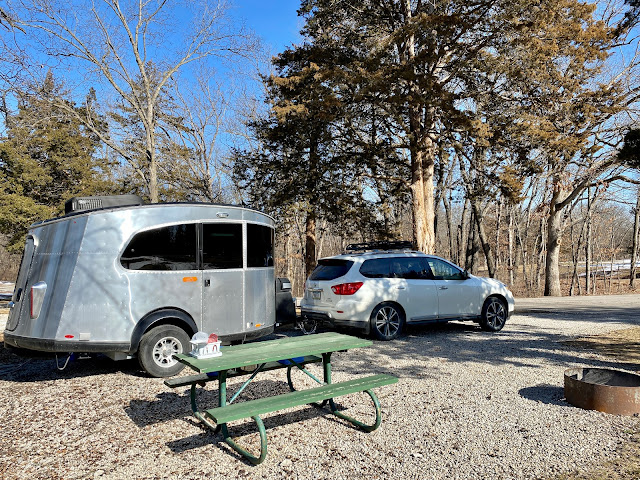
Airstream Basecamp at Lacey Keosauqua State Park
Using the word "warm-up" in February in Iowa is probably the most scandalous word choice one can make as winter continues to dump its frigid bounty upon the Midwest. However, there was one day this week when the temperatures rose to near fifty degrees, and there was one afternoon when the sun was shining and the wind had not yet begun to howl. I chose to hitch up and make my way to Lacey Keosauqua State Park, arriving at about noon on a Monday and leaving at around noon the next day--thereby missing wind, rain, freezing rain, sleet, and snow. I'm pretty proud of my timing and also glad for another chance to check out the rig and get everything ready for when better weather arrives. This trip continues my plan to take advantage of winter getaways and to also use them as shakedown excursions, providing an opportunity for both some recreation and also gearing up.

Lacey Keosauqua State Park is the second-oldest state park in Iowa. It's twenty-five miles from my home, and it's also located right next to the little town of Keosauqua, the Van Buren County seat and also where I was a junior-senior high school teacher for twenty-one years. Van Buren County is rural, known for its villages, rolling hills, and the Des Moines River. Keosauqua is the county's largest town with a population of around a thousand. I have many good memories of this area and its families, and with the recent years, I also have many good memories of camping and hiking in the region. Twenty-four hours of hiking the area pushed away the winter doldrums and provided a glimpse of better weather that will eventually arrive--even if it arrives in fits of wind, freezing rain, and mud. 

Lacey Keosauqua State Park
Although there were several campsites available with the warmer weather, I chose one near the front of the campground that was snow-free and level, allowing me to hook up to electricity, to be near the central water faucet, and to not have to level and unhook my Airstream Basecamp from my Nissan Pathfinder. Because little camp set-up was required, I was able to take a couple of hikes that afternoon, a quick one prior to lunch and then a longer hike after lunch. For this trip, I continued my overnighter practice of not using the 12-volt refrigerator but just using a small ice chest cooled by a couple of reuseable freezer blocks. My main meals? Leftover lasagna!

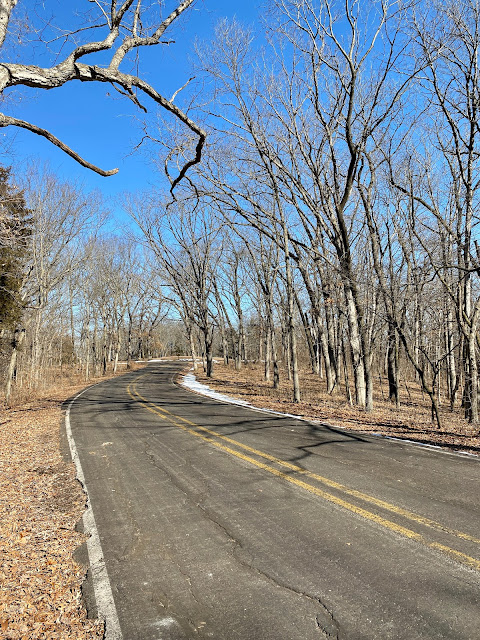
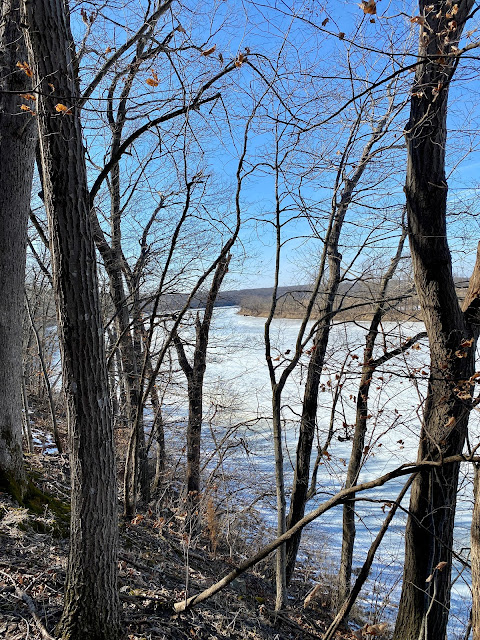
Hiking mostly on paved roads was okay for this trip, allowing me to avoid mud. About a quarter mile down the main road through the park is a paved road to one of the park's shelters. Since it's not a through road, I was able to walk down the center of the roadway, at times my face turned upward to the sun and my eyes closed. I was able to sit on a limestone wall at the shelter's loop-around and enjoy the silence of the still-sleeping forest trees. I did wander down one trail, though, that was covered with fallen leaves and not muddy, walking a couple of hundred yards to a bluff where I could see the frozen Des Moines River below, a sheet of unmoving ice not anywhere near the spring thaw. A bit of silence, a bit of exercise, and a bit of sunshine without much wind were my rewards for the day and this overnight camp trip. Well worth the effort!

Lacey Keosauqua State Park, Des Moines River
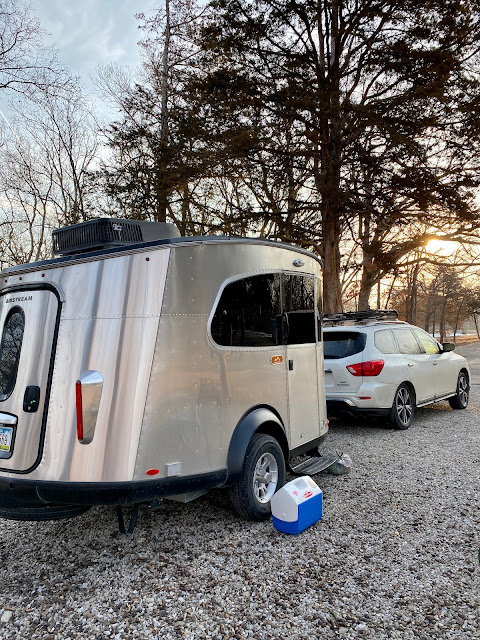
The night's temperatures dropped down to twelve degrees Fahrenheit, but the Basecamp's Truma heating system worked well. I slept warm, enjoying the luxury of the camping trailer and looking forward to another hike the next day. Since the weather was still somewhat uncertain and the wind was picking up, even though it would be a warm day--up to 50 degrees--I decided to head home instead of dealing with wind and with the possible early arrival of rain. I did take a morning hike, though, checking out the other spots in the campground that I could have claimed if I'd been willing to deal with a bit more snow and ice. I was happy with the spot I'd chosen, though, because the site allowed me south and east sunlight for the camper. In cold weather, I like to be able to exit the camper to sunlight, not freezing shadow. 

I enjoyed the drive home on Highway 1, the state highway that I had commuted for twenty-one years as a teacher. A few views have changed with buildings new or buildings demolished; however, for the most part the unfolding vistas were the same, evoking memories and also providing ever-present perspectives of rural beauty--sleeping fields awaiting the spring and strings of trees that followed the creeks. My greatest joy was in getting out even for a short while to enjoy the beauty of the natural world and to engage in those eternal rhythms governed by the laws of nature, the hand of humankind less heavy upon the land. One warm day was all I needed for camping, and I'm glad I took advantage of the opportunity to head out. We should all enjoy those moments of joy that come our way, and we shouldn't feel shy to contrive them when necessary. Being the only camper in the campground and seeing the sun rise in the eastern sky, the bare limbs of dormant trees silhouetted by the pristine light, that was an experience worth the effort--another small excursion in this new camping season, another joyful moment to commune with the great outdoors.

Subscribe--Follow by Email

* indicates required

Tuesday, September 21, 2021

Is Earth Art a Part of Camping or an Abuse of Camping?

Earth art or vandalism?
Called "rock stacking" or the more alliterative "stone stacking," the idea of forming a human-made artifact is a more common sight in my camping experience. Even though I understand the need to build or create--the need to leave our mark on the world, an "I was here" statement--after experiencing for some time different human testaments of existence in various natural settings, I think we need stop our little moments of building in what natural settings are left in the world. Places should exist that do not exhibit the hand of man. "Leave no trace" should be our mantra when we enter the wilderness--or even parks that are human-made reproductions of nature.

"Rock-stacking denies people the experience of wildness" states the title of an article on the Blue Planet Society website. In addition to taking away a hiker's chance to experience what the world looks like without human intervention, there are also environmental concerns about what I'm calling "earth art." Water flow and habitat are changed by rock stacking, and if you can imagine, some earth art has even been created on archaeological sites, where not only are stacks added to the landscape but also those stone stacks are created using stone that may be significant to the archaeology of the area. In a New Yorker article a Blue Planet Society spokesperson said, “Rock stacking is a way of quickly making your mark and having an image of it. People are posting pictures of them on Instagram, saying, ‘I’ve been here and I made this.’” 

The New Yorker article goes on to say that stone stacking is a hot potato of discussion online. I can see that; creative activities are very fulfilling, and stacking rocks checks not only the "creative" box but also the "self-acknowledging." Online social sites have driven this phenomenon recently, even though stacking stones has been around for a long time as a spiritual action, a travel marker or ownership marker. “Social media has kind of popularized rock stacking as a meditative activity, and you used to have a handful of people doing it, but it has really escalated over the past few years on public lands,” Wesley Trimble, the program-outreach and communications manager for the American Hiking Society, said in the New Yorker article. 

Oh, the irony of this message painted on a rock in a state park!
The stacking fad is likened to the rock painting fad, which I also saw evidence of in my recent walk along Rathbun Lake's shores within the boundaries of Honey Creek State Park. Rathbun Lake is a man-made lake, but it is possible to walk the shores and have one's experience center on the lapping of the waves against the shore, the smell of water shore vegetation, the wind off the lake and a sense of distance from the hubbub of life. Earth art such as rock stacking or rock painting attracts the attention, leading it away from the bigger perspective. It's the visual equivalent of my sitting on a boulder on the beach, eyes closed and listening to the waves splash onto the sandy shore, feeling the sun warm on my face and the wind gusting off the water--and then having someone who has snuck up behind me say, "I'm right behind you!" It's an intrusion, even if the stack of rocks is quite artistic.

Primitive, beautiful child's art--but do it at home!
I have nothing against stone stacking or rock painting. In fact, I have written an article about the art of rock painting for this blog! What I propose is that we leave our parks and wild areas alone and engage in earth art in our own homes and backyards. Paint rocks with your kids at home. Most garden nurseries keep a supply of stones to sell. Buy a box of smaller water-worn stones and when friends come over, have a rock-stacking party! Create rock sculptures in your front or back yards (or both), and post those creations on Instagram. Create something beautiful and then live with it. 

Driftwood on a Rathbun Lake beach
One interaction with nature that leaves no trace is photography. Although you don't leave your photographs at the location where they were taken, you can post them online for the social media community to appreciate. "I was here," your photos can declare, "and isn't this place beautiful! And didn't I do a creative job of capturing the beauty!" The evidence of your travels and creative artistry end up just where they belong, in a medium designed and which expressly exists for sharing--and at no clutter to the environment. There might be those who say, "But rock stacking is beautiful; it's art!" I respond by saying, in character as a retired English teacher, "Look up the definition of the word Antropocene." Good old Merriam-Webster defines it as "the period of time during which human activities have had an environmental impact on the Earth regarded as constituting a distinct geological age." Most of us experience nature in small pockets of natural environment, enclaves of nature surrounded by landscapes already sculpted by human beings into towns, roads, highly cultivated and chemically-treated agricultural land, and even parks that have been to some degree manipulated or manicured. 

Do we really need as guests to these parks to be adding to the Antropocene, adding yet another layer of human engineering to the land, even if creative and artful? I prefer photography or the other, older arts of painting or sketching. In an article the other day, I quoted British Romantic poet William Wordsworth, who said, "The world is too much with us." His sentiment also applies here. The National Park Service has recently labeled rock stacking as "rock graffiti" and "vandalism." The online article "The New Graffiti: National Parks Fight Stone Stackers" does a good job of explaining the why and how of leaving stones unturned. Volunteers, cited in the earlier mentioned New Yorker article, have been organized to remove stone stacks, a group in Acadia National park recently leveling nearly 3,500 rock stacks. The article "Rock Cairns," posted by the National Park Service, also is interesting as it details the history and function of rock cairns (or stacked stones) in the national parks and trails.

When you enter the wilderness, though--even the "kinda wilderness" of many city, county, and state parks--consider yourself a guest. Just as you wouldn't mark up the walls of a friend's house if you were invited over or throw your trash on the floor, in that same way you shouldn't change the natural beauty of any parkland. This is something you can easily do . . . just by not doing, just by leaving behind no trace of your ever having been there. This is the highest art of camping, taking away good memories (and maybe some photos), leaving nothing behind.

Subscribe--Follow by Email

* indicates required

Friday, November 20, 2020

Almost Heaven: a Tiny Trailer 4-Day Fall Photography Trek in West Virginia

High Falls of Cheat, West Virginia

Luckily for us, a "very enjoyable four-day 'Fall Color' trip" for retired commercial photographer Ron Snow captures his scenic tour of the mountains of West Virginia . . . with camera gear and home-built tiny trailer. And now we can all sit back and enjoy some gorgeous shots of nature and a great introduction to this area.


Ron built his teardrop on a frame from an old Coleman Popup camper. The build took him eight months and about 800-900 hours. The cabinets were constructed from recycled barnwood that Ron tore down himself. The wood is oak with wormy chestnut door panels. The galley countertop is made from a piece of pre-blight chestnut that was weathered about a quarter inch deep. It is mounted on a piece of dense particle board and edged with pieces cut from an oak barn rafter. 


"I did an epoxy pour over the countertop," says Ron. "I built tambour doors on my upper galley cabinets. This process involved cutting about seventy 3/8" wide strips of oak, routing each piece four times, assembling them in a jig, and then gluing on a canvas backing. I built the door and drawer pulls (twenty of them) by tracing my computer mouse to get the teardrop shape for a pattern. I then used the pattern to cut, shape, and polish pieces of 1/8" thick aluminum. The cabin ceiling is made from pallets--oak, cherry, maple, poplar, and pine--which I disassembled, planed, routed, sanded, and finished with urethane."


"The wheels on the teardrop are from a 1977 BMW. I used rock wall climbing handholds for pull handles on the front sides of the teardrop. The top drawer panel on the cabin cabinets lifts up, and a TV slides out and drops down. The front of the cabin has two cushioned panels that are tilted back about twenty degrees for a comfortable seating angle. The panels open for storage behind. Between the cushions are storage areas and a table that folds out. The rear bumper on the teardrop is made from a pair of springs from an old utility trailer."

Loading up the rig, Ron headed out on his four-day odyssey, stopping first in the Stuart Recreation Area in Monongahela National Forest, hiking the Red Creek Trail at Dolly Sods and overnighting at Seneca Shadows National Forest Campground.

Stuart Recreation Area, Monongahela National Forest

Red Creek, Dolly Sods Wilderness Area

Still spending Tuesday night at Seneca Shadows, Ron had another full day of hiking and photographing. The hike to the High Falls of Cheat in the Monongahela National Forest is an eight and a half mile round trip. "The elevation gain on the trip out and back was nearly 1,400 feet," Ron said. "My goal on my watch for climbing stairs was ten flights. After that hike my watch said that I had hit sixty-three times my goal--the equivalent of 630 flights of stairs. Well worth the trip! I got back in time that evening to photograph the golden glow of the setting sun on Seneca Rocks." That night at Bear Rocks at Dolly Sods, he photographed the Milky Way.

High Falls of Cheat

Seneca Rocks at Sunset

Milky Way over Bear Rocks, Dolly Sods

The third day of West Virginia in its full fall glory focused on the George Washington National Forest area. Enjoying a four and a half round trip hike in the Wolf Gap Recreation Area provided Ron with many photographic opportunities. He spent the night at Trout Pond National Forest Campground, near Lost River, in George Washington National Forest. 

Big Schloss Overlook, Wolf Gap Recreation Area, George Washington National Forest

The objective of Ron's day hike was the Big Schloss Overlook. "My legs were still rubbery from Tuesday's hike, but I had to give it a shot. Not quite as bad. Only about four and a half miles with a vertical climb of about 1,050 feet. At least this time I would only be climbing one way. The views were spectacular.  This climb only netted me 510 flights of stairs. For those keeping score, that is 1,140 flights of stairs in two days. I'm getting too old for this!"

Big Schloss Overlook, Wolf Gap Recreation Area, George Washington National Forest

Since rain was expected to roll in on Friday, Ron decided to cut his trip short and head for home on a Thursday, completing his four-day excursion. He made stops at Valley Falls State Park and Arden Falls on the Tygart River before heading home. Ron said, "I was able to pack quite a bit into a brief, four-day trip. I'm anxious to get out again soon!"

Valley Falls of the Tygart River, Valley Falls State Park

Arden Falls, Tygart River near Arden, West Virginia

Between his tiny trailer and his truck, Ron was able to pack all his gear for staying comfortable and for producing some wonderful photographs. Below is a list of the photography gear he used, which is primarily Canon equipment.
  • 6D Canon body for most of his work with an assortment of Canon lenses: 17-40mm L, 24-105mm L, 100 - 400mm L, etc. 
  • For his panoramas, a 70D body with a Sigma 8mm fisheye lens and an Acratech panorama rotator.
  • A Benro tripod with a Manfrotto ball head. 
  • A Promote Controller to bracket his HDR images. 
  • Photoshop is used to edit. 
  • Ron also uses a variety of other software programs, including PT Gui and Photomatix, and other Photoshop plugins, filters, extensions, and actions depending on what he's editing.


Thank you so much, Ron Snow, for showcasing for us the beauty of West Virginia in the fall--and for sharing with us the beautiful tiny trailer that so clearly reveals your craftsmanship. When times make it easier, I'm certainly up for a trip to West Virginia!


Subscribe--Follow by Email

* indicates required

Saturday, April 25, 2020

Tiny Trailer Rock Painting . . . Because Tiny Trailers Rock!

Beauty is where you find . . . or create it.

I confess I spend too much time reading the news and getting updates on the novel coronavirus, COVID-19. What is needed is a more positive activity, and tiny trailer owner Kelly McGinnis found the perfect at-home activity with his wife and daughter--painting rocks. I haven't written an article for the Arts and Crafts category for my blog in a while, so it was with great appreciation that Kelly responded to my query and provided the following story and information. I hope inspiration hits and that we all find time for quality activities wherever we are--in addition to whatever essential routines we maintain.

New Wave Teardrop

Kelly is a tiny trailer owner, having bought a New Wave Teardrop trailer back in November. "I love it," he says. "I did buy it with the intention of using it for my kayaking/rafting trips year round. I have been a hammock camper for years."

A high school teacher/coach, Kelly lives in Mississippi, "but for the past seventeen years, I have spent my summers in Ocoee, Tennessee, as a river guide on the Ocoee River. It was the Whitewater venue for the '96 Olympics."

Kelly McGinnis, expertly negotiating white water.
"I work for Nantahala Outdoor Center and am a Master Guide and Head Guide on the Ocoee River, one of seven rivers the NOC operates on. I do train new guides, and I am a certified EMT and Wilderness EMT along with being a Swiftwater Rescue Professional. Summers I live in staff housing but my weekends (Tuesdays and Wednesdays) I am planning on paddling other southeastern rivers and staying in my camper. The Ocoee River is dam controlled and runs Thursday through Monday. I compete in whitewater events along with flatwater racing year round."
Glass, tile, and Quikcrete

Working for the Mississippi Department of Environmental Quality as an environmental scientist, Kelly's daughter Sarah-Kelly had been a river guide also until graduating from college two years ago. His wife and daughter are both very "crafty" and have made stepping stones and mosaics before.  "The rocks we painted were not gathered in 'the wild.' We get them from a landscaper so as to follow the 'Leave No Trace' philosophy."

The paint for the stones was acrylic art paint, and then the pieces were clear-coated when finished. The McGinnises use whatever they can find for molds for the stepping stones, such as tupperware, fastfood go containers and the like. They use Quikcrete for the stepping stones and use broken glass or tiles for the designs.
"We have done this a few times during quarantine for a few hours each session.  Just get outside and let your imagination run as far as designs and what to paint.  It really is fun and relaxing. We have spent more quality time together on the front porch talking, playing cornhole, sitting around the firepit in the backyard and cooking outside. It really has been much better than I would have imagined."
Backyard artwork has not been their only activity, though. Their other quarantine projects have mostly been landscape updates, house repair projects, and organizing their "overflowing" outdoor gear collection. Kelly's wife Leslie also has been nailing Crocs to their fence and planting in them. "At first we were paddling every day until the shelter-at-home decree statewide. I had just returned from teaching Raft Guide School on the Nantahala River in North Carolina during our spring break when they closed school. During spring break I had stayed seven days riverside in my squaredrop."

Creative recycling of Crocs

As soon as the quarantine lifts, Kelly plans on returning to Tennessee to guide, and he'll be taking his camper. "My wife says my ten weeks on the river each year make me much more easy to live with the other forty-two weeks!"

We all have camping plans for when it's safe enough to camp again. I'm hoping to attend a Rustic Trail Teardrop Campers gathering in early October in Tennessee at Harrison Bay State Park, which, funnily enough, is only thirty-one miles away from the Nantahala Outdoor Center on the Ocoee River. Small world!

Subscribe--Follow by Email

* indicates required

Tuesday, March 10, 2020

A Humorous Look at the Beauty of Our National Parks

My son and his dog Emmet, 2003
In 2003 my son and I went on a road trip out West, and I remember when we stopped at the Pacific Ocean in Northern California. My son was sixteen years old, and we walked along a beach close to Eureka with our Snoodle (Schnauzer and poodle mix) dog Emmet. After twenty minutes or so, my son said, "What's the next thing to see?"

We were heading east next for Pullman, Washington, but I said, "Let's just stay here for a while and enjoy." We tented in a private campground, spending time in the redwoods and on the ocean. It was quite a change for my son from the prairies of Iowa. I remember the long drive back home, and when we hit the Iowa northern border, we stopped to camp for the night. Getting out of the car, my son took a deep breath of the humid air filled with the scent of ragweed (a plant that aggravates the allergies of many) and said, "Ah! It smells like home!"

From the comments: "Had the commentator Never left their house in their entire life??"

I suppose the familiar is reassuring, and I'm also sure that the unfamiliar can be somewhat intimidating or at least disconcerting. As a writer, I'm also aware that sometimes people say or write things without really considering all the possible interpretations of those words. Sometimes those thoughtless expressions can be funny, and sometimes the best reaction to odd or unexpected expressions can only be a "Hmmmmm."

From the comments: "Ummm, it does too look like the license plate.
But you need to get out of your car to see Delicate Arch."

Illustrator Amber Share found a perfect subject for her craft in reviews of national parks, where the reviewer gave a "one star" designation--without, perhaps, thinking too deeply on the subject. Here's the idea below.
"I'm an illustrator and I have always had a personal goal to draw all 62 US National Parks, but I wanted to find a unique twist for the project. When I found that there are one-star reviews for every single park, the idea for Subpar Parks was born. For each park, I hand-letter a line from the one-star reviews alongside my illustration of each park as my way of putting a fun and beautiful twist on the negativity."
The website Bored Panda's staff writer Aelita SenvaitytÄ— helped Amber create an article that highlights sixteen park "posters" that include a one-star comment. ("I Illustrated National Parks In America Based On Their Worst Review And I Hope They Will Make You Laugh--16 Pics") The result? Humor! Or at least I think so. As the writer for a tiny trailer travel blog, I've covered quite a few campers who have traveled to-and-through our national parks and provincial parks. Whether we've visited many parks or just aspire to, I think you'll enjoy Amber Share's wry twist to the "out in nature" experience of some.

North Cascades National Park. From the "West Coast Camping Extravaganza" travelogue.

The article includes not only the one-star comment but also for some illustrations insights from the illustrator on the creative process, or a contrasting description from the National Park Service on the beauty of the particular park. Yosemite National Park is one example. Below is the National Park Service's description. Then we have the poster of the one-star review.
"Not just a great valley, but a shrine to human foresight, the strength of granite, the power of glaciers, the persistence of life, and the tranquility of the High Sierra. First protected in 1864, Yosemite National Park is best known for its waterfalls, but within its nearly 1,200 square miles, you can find deep valleys, grand meadows, ancient giant sequoias, a vast wilderness area, and much more." (National Park Service)
Two comments from the article:
"Trees block view of what? What did they want to see?"
"Easy. The forest, but without any trees to block the view of it."

One aspect of camping is that we can experience the world without technology . . . or can we? According to the National Park Service, if we were to travel to Isle Royale National Park, we could experience a variety of island wonders. "Explore a rugged, isolated island, far from the sights and sounds of civilization. Surrounded by Lake Superior, Isle Royale offers unparalleled solitude and adventures for backpackers, hikers, boaters, kayakers, canoeists and scuba divers. Here, amid stunning scenic beauty, you'll find opportunities for reflection and discovery, and make memories that last a lifetime." (National Park Service) However, is an experience bonafide if not shared on social media platforms? Some travelers must cherish the Instagram moment.

From the comments:
"That's a feature, not a bug!"
"That's good because from what I read above, the bugs will bite you on the face . . ."

I want to add something about the Great Smoky Mountains National Park because I traveled through that area last summer. The comments for Amber Share's poster contain quite a few suggestions for enjoying the area, not only the park but also the communities. "This is one of my favorite places on earth," one commenter says. "If, for some mind boggling reason, you really can't find anything to do, there's a cute little British pub outside Pigeon Forge where you can park your grumpy butt and drink an impressive assortment of beer." The one-star reviewer, however, seemed to be lacking a clear purpose for the visit.

From the comments:
"I went to the general store, and they couldn't sell me anything specific."

For those of you who are considering a visit to a national park or provincial park, the sixteen posters that Amber Share created offer a wry reminder of why we camp. We just have to remember not to be intimidated because the great outdoors is . . . well, so big! Maybe a little humor can help us keep a balanced perspective.

Mount Rushmore National Memorial. From "Tiny Trailer Travels West" travelogue.

I've shared five of the sixteen posters in this article. To enjoy all the illustrations, go to the Bored Panda article, or connect with the posters on the Instagram site Subpar Parks. I try in my own way to have a creative response to my time in nature, such as I wrote about in the article "It's Not Just How Many Miles or Places." To read more articles I've written about arts and crafts in connection with camping, go to this aggregated link: Arts and Crafts Activities.

Subscribe--Follow by Email

* indicates required

Thursday, June 13, 2019

Fine Art, the Computer, and Nature: Lynn Wollstadt Paints in Pixels

On the Wisconsin River, 2018

Get in your canoe . . . drift down the Current River in Missouri . . . camp on the river . . . and then get our your iPad and paint some digital art on your computer canvas. This is how computer artist Lynn Wollstadt finds and expresses her muse.

April, Current River and Canoe

Lynn creating computer art "en plein air" on the Current River

Last January Lynn bought a new iPad, a "fancy Apple pencil," and now draws all the time using AdobeSketch software. "It's so convenient!" she says. Although there are many apps for drawing, she picked AdobeSketch because it seemed so simple and would let her do what she wanted, which was to just draw realistically in different media, "the same ones I would use in real life but never get around to because of the hassle of supplies, set-up, and needing a dedicated work space." The iPad solution allowed Lynn to integrate her art easily into her busy professional teaching schedule. With her computer art, she was able to return to the artistic passion that she had when she was younger and "drew constantly for a few years, winning a prize or two in high school, but never taking an art class in college."

The Turtle-Flambeau flowage on the Wisconsin River
"As far as the process goes, when I feel like drawing (which is pretty much every day, especially now that it’s summer I have have more time), I just reach for my iPad, open a project, and draw! As I’ve gotten more proficient at learning the features of the app (at first I didn’t know how to make the watercolor stop spreading—it acts like real watercolor on wet paper), I’ve changed my methods some. I’ll often do a first layer with a pencil sketch, then open a new layer and start in colors. You can show or hide layers, rearrange them, make them more or less opaque, and I’m sure there are still lots of things I don’t know about." 
 When Lynn works with AdobeSketch and the Apple Pencil, she never overlays a photo--"that seems like cheating to me (but you can totally do that)." She usually has a photo up on her phone and her iPad on her lap when she draws. "The cool thing about using AdobeSketch (or one of the other art apps) is that I can choose pencil, watercolor, acrylics, or any other kind of media. It's really amazing. I took a photo of a friend at the dog park a couple weeks ago and then did a 'pencil' sketch at home; it looks just like pencil. I tend to do landscapes in watercolor, with maybe pen when I need finer lines."

The first camping trip on which Lynn computer painted was on the canoe trip on Missouri's Current River in April. "We canoed and camped on gravel bars for three nights. I drew every day, but not everything was a keeper. The only one I finished on the spot was the moonrise pic, which was so satisfying because it was so beautiful and COMPLETELY didn’t show up when I tried to take a picture."

Moonrise on the Current River

"I love drawing in nature!" Lynn says. "Sometimes it was too sunny and even with my no-glare screen covering it was too bright to really see what I was doing, but I spent quite a bit of time drawing on that trip....often lying in my hammock drawing the trees above me. The picture of the Current River I started drawing there and then finished at home, looking at different photos. I am finding nature scenes are my favorite to draw just now because I work from photos from previous trips, and it helps me remember!"

The Current River, Missouri

Lynn and her family always tent camp. They do like the idea of a tiny camp trailer for sometime in the future, but for now, their main goal for camping is to not be near other people. "That’s why we love canoe camping so much!" They are not backpackers, and took up camping again by car camping nine years ago.  They had not camped for decades. "I did have some old camping equipment, so our first couple of trips were car camping at small Michigan state forest campgrounds. Then over the next couple of years we discovered canoe camping on rivers in Wisconsin and realized it was ideal for us. Camping in completely isolated places, accessible only by water, but we were still able to bring plenty of gear, a cooler, and our dogs!"

Evening camp on the Current River

Portraits are a challenge Lynn enjoys. "Drawing any kind of portrait is a very intimate experience, really staring at a face and figuring out how that person is put together." She likes to draw the people she cares about, and she always draws from photos that "reveal the personality of the subject."

Lynn Wollstadt, self-portrait

However, landscape painting is Lynn's favorite right now, "hands down, because I'm so desperate to go camping and won't be able to for another couple of weeks at least." When she camps and takes her own photographs, while painting those places from the photos, "the scene takes me back there . . . feeling the air, hearing the sounds." How can we blame her? That's why we all like camping. It's easy to understand Lynn's enthusiasm for canoe camping, right? It's kind of like aquatic tiny trailer camping!

Below is a painting by Lynn of a sandbar on the Wisconsin River, composed from a photo she took last year while camping. Following the painting is a time-lapse video that shows the step-by-step process by which the above painting was created.

Wisconsin River


For those of us tiny trailer campers who like Lynn's digital art, when asked if she'd draw any tiny trailer "portraits" as commission work, she said, "I'd love to!" Her art webpage is Drawings by Design, which includes images of her art and FAQs. She also has photos of her work posted on her Facebook page, Lynn Wollstadt, Artist

However, we here at Green Goddess Glamping hope that you won't be able to contact Lynn for a time--a few days or weeks or maybe a month, that she'll be off into the wild, camping and painting "in completely isolated places, accessible only by water." Sounds just plain wonderful!

(To read all the Green Goddess Glamping art and craft articles, check out the Art and Craft Activities label link, which aggregates all similar posts.)

Enter your email address:


Delivered by FeedBurner
(Note: As the content for Green Goddess Glamping evolves, sometimes content focus will dictate that articles will be posted on some Facebook groups and not others. For instance, a specialized utilitent article may not be posted on a campfire cooking page. The best way to ensure that you are receiving all articles is to subscribe to follow this blog by email notifications.)