Showing posts with label Glamping. Show all posts

Sunday, September 21, 2025

Sleeping on the Airstream Bambi 16 front Dinette Bed Conversion


My wife and I decided to spend our last eight-night camping trip using the front dinette as our second bed. A couple of years ago, we decided after 18 years of marriage to sleep in two bedrooms because of getting up more at night, snoring, and just sometimes having a night of light sleep.

My first experience of sleeping in the front of our Bambi was in our driveway, just spending one night on the dinette bed to see what the experience would be like. I set up the bed, covered it with a folded quilt, and used a sheet and thermal blanket for my covers. The next morning I analyzed my experience and realized that using the front bed was very doable. The cushions were hard, though, so my wife ordered a two-inch covered latex foam pad for the bed. This helped immensely.


After eight nights of camping, using the front dinette as a bed, what we found was that it took about five minutes to either break the dinette down to the bed or to convert the bed back to the dinette. The various components of the bed: the 2-inch latex mattress, the folded quilt used as the bottom sheet, the top sheet and blankets, and the pillows were stored in the back or rear bed area when the front area was being used as a table and not a sleeping area.


Our first experiences of sleeping in the rear bed area together were that sharing the rear bed area was definitely possible, but there were definitely some space issues and some concerns by both of us of not disturbing our partner during the night. By having me sleep in the front area and having my wife sleep in the back area, the small space of the little Bambi 16-foot trailer seemed to be expanded greatly.


By the two of us sleeping front and back of our Bambi 16, we were both able to read a bit before going to bed, yet also do it according to our personal physical readiness for sleep. I could read later than my wife, or I could choose to go to sleep earlier while she was still reading, and there was no conflict on whether the light was on or whether she was active and I was not. And if we woke up during the night, we could read without disturbing one another.


In terms of space, by each of us having an individual bed, we were able to stretch out more and roll over more easily, to change position during the night without worrying about disturbing our partner. We could also add or remove blankets, fluff our pillows, or generally just be more relaxed and natural with the sleep process.


Our experiment with using both beds in our Bambi 16 was a success. Our sleeping habits at home are now more natural naturally mirrored when we are camping. Taking the extra five minutes to make the bed in front and then in the morning to return it to the dinette is time well spent. Ironically, by bringing the extra sleeping items needed for the front bed—the extra latex mattress and the extra blankets—we were able to expand the Bambi‘s living space, if not actually then at least subjectively. By taking five minutes in the morning and five in the late afternoon, we were able to both have an extra bed yet still keep our kitchen table/office space. We use Starlink for our internet connection, so now my wife has a mobile office wherever we travel.

Our nighttime experience was not one of close quarters and elbows and knees, even with our cordial intentions, but one of expanded sleeping space. Especially for longer periods of living together in the Bambi, which we intend to do, providing for ourselves the best environment for a good night's sleep is essential. The classic little trailer design of a rear bedroom, front dinette, and everything else in between we have found to be a very livable space. We intend to continue sleeping by utilizing both rear and front space. It’s a viable option for us, and we recommend for others, too.


Subscribe--Follow by Email

* indicates required

Friday, May 13, 2022

RV Parks *Exist* -- What Does That Mean for Camping Travelers? A Personal Experiennce Narrative

Airstream Basecamp at Oasis RV Park at Aztec Hills
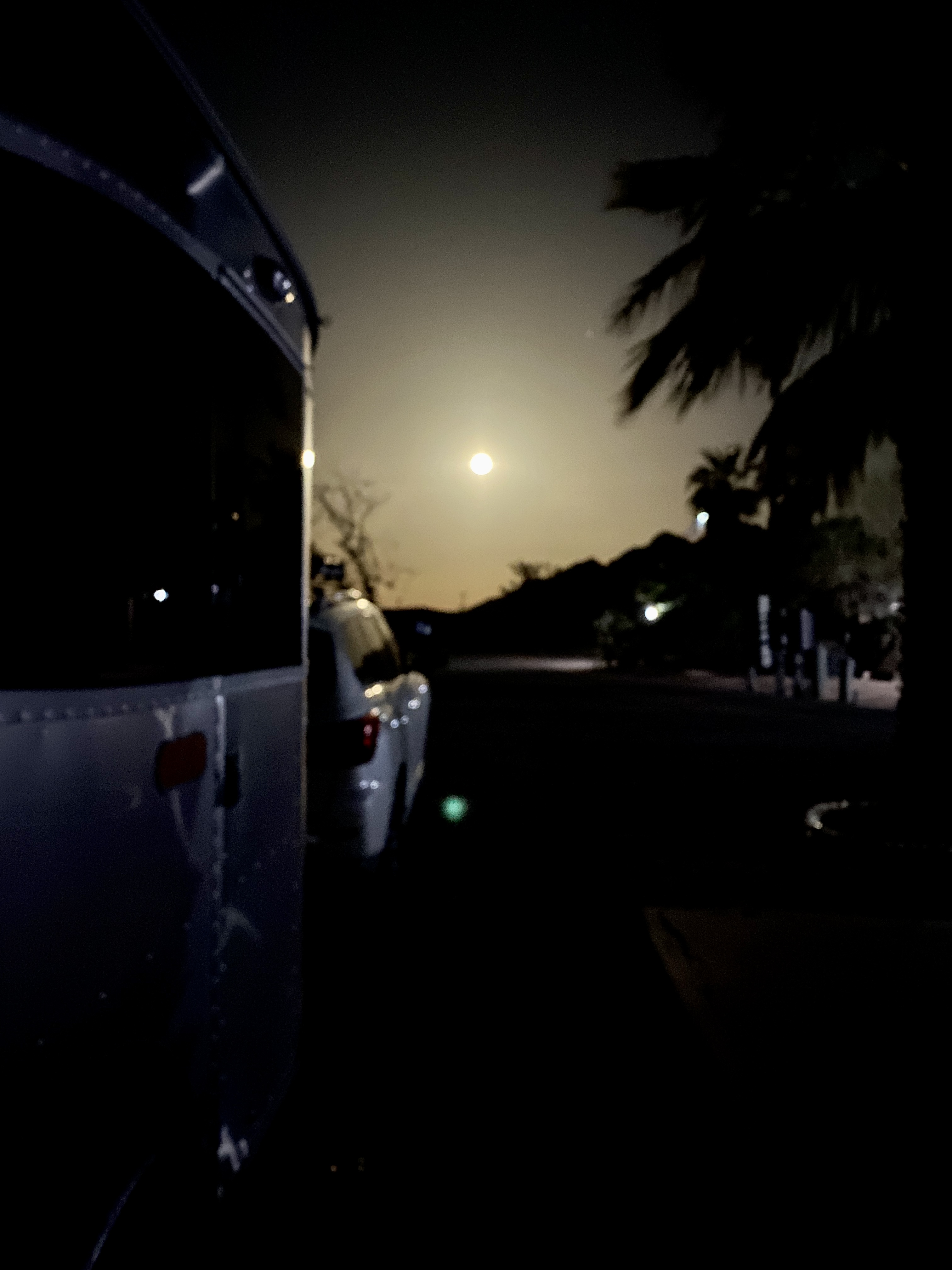
Full Moon at Oasis RV Park at Aztec Hills, Arizona, the Sonoran Desert
I enter the restroom-shower building in a small RV park. It's a blue building, the paint not new but still solid, unpeeling even if a bit faded. The roadways in the park are a reddish gravel and sand mixture, the edgings a countrified uneven scraggle of grass and weeds, mown at least once this spring yet now sporting a few leggy yellow spring flowers. A young boy about nine years old with a newly trimmed blond mohawk haircut is looping the park on his bicycle. A mother with an infant in a baby chest carrier is at the swing set with her lanky early-teenage daughter, pushing while her daughter pumps, both of them chatting and laughing. 

Inside the restroom-shower facility, the continuous sound of trickling water attracts my attention. One cracked toilet commode has a leaky trap; however, the toilet even though cracked is not leaking onto the floor. The next commode is uncracked and silent, but the seat is bandaged with white duct tape. The room is clean, worn, and waiting. The RV park likewise--worn, casually lived in, and friendly--as is the manager (and perhaps owner), a later-middle aged, gray-haired, energetic woman whom I had to telephone when we arrived because the office was closed. "I live in town," the manager's voice had said. "I'll be there in seven minutes."

Arriving in no more than seven minutes, my wife and I were efficiently processed, the lady pointing out several sites available and asking us which one we wanted. "Are you leaving early tomorrow, and which way will you be heading?" she asked. When we said we'd be driving east to Iowa, she provided directions and then said the accommodations building was always open. Guiding me to the pull-through, she gestured me to stop when the trailer was properly aligned with the hookups. Registration was completed from a clipboard, outside and covid-safe, and a quick run-through of hookup procedures were provided as she pointed out the specifics of the space we chose. We were home for the night.

On my wife and my recent trip from southeastern Iowa to the city of Carlsbad in southern California's San Diego County, we spent five overnighters each way in our sixteen-foot Airstream Basecamp. Out of those ten overnighters, one was in an Iowa state park, one in a federal national forest campground, two in Kampgrounds of America facilities, and six stays were in private RV parks. Only one camping spot was used both out and back. Our routes out and back shared some of the same roads but also were each unique in both stops and travel, especially in our Midwest and High Plains sections. The states we crossed were Iowa, Missouri, Kansas, Oklahoma, Texas, New Mexico, Arizona, and California. Some of the states, such as Missouri, Oklahoma, and Texas, we just nipped a corner. My favorite joke of the trip was my wife's as we passed through Texhoma, Oklahoma, which is right on the border of Texas and Oklahoma. "Because they're right of the border, they took half of each state's name to make their town's name--TEXas and OklaHOMA," I said. "That's better than OKLA-ASS," my wife said. That gave us a good laugh as we traversed the city both on the trip out and back. We spent thirteen days driveway mooching at my wife's parents' house, plugged into their home 110 system to keep our 12v refrigerator running and our batteries charged.
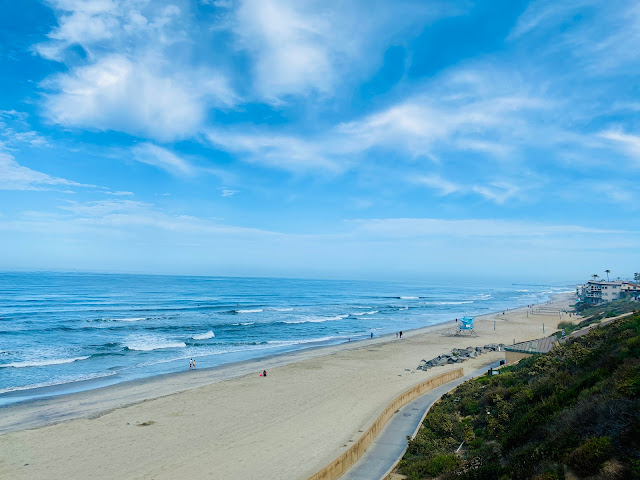
Pacific Ocean, Carlsbad, California
The view from Ocean St., Carlsbad, California
Pacific Ocean, Carlsbad State Park, California, CampInn
A CampInn at Carlsbad State Park Campground (with a 6-month in advance reservation)
With the recent upswing in camper sales, due in large part to the desire for people to travel safely during the pandemic, there has also been an increase in the move to create more RV parks. (Quickly, what is the difference between a campground and an RV park? A campground is primarily for recreational use for up to two weeks. An RV park, almost always privately owned, caters to both travelers and to permanent residents. Often permanent residents will build decks or porches next to their RVs. Skirting or small flower gardens may trick out the RV, making the "mobile" recreational vehicle facility appear much more like the mobile home parks that have become so common in the last seventy years or so. Even though RV parks are being built, there is opposition and fear expressed from many communities. "Opponents to new RV parks roll out the traditional boogeyman fears of higher crime, increased road traffic, and the large numbers of “undesirable” transients in their rolling ghetto-mobiles invading their peaceful streets," was one articulation. It's okay to build more RV parks, just not in our backyard is another sentiment. Some RV parks enforce the "ten-year rule" to try to maintain a more upbeat look--not renting spaces to RVs that are over ten years old. (There is some controversy regarding this "resort RV park" policy. Follow this link to read more.) One full-time RVing couple with a blog wrote an article about RV parks: "5 Reasons We Avoid RV Parks (And Where To Camp Instead!)." Reasons for avoiding RV parks, according to the article, include crowding, distractions, expense, noise, and "consumerist culture." 
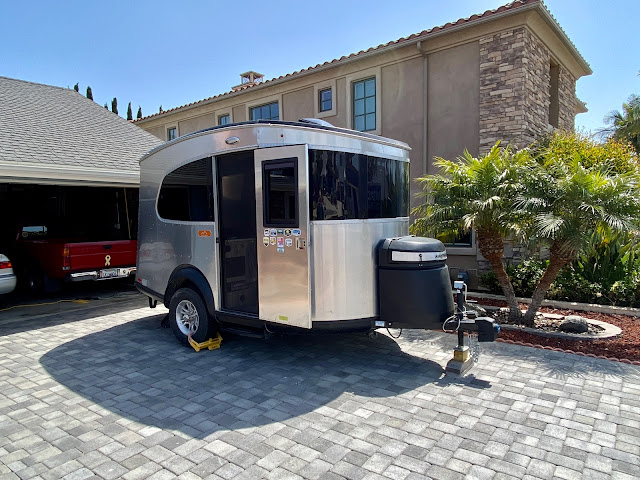
Driveway mooching; Airstream Basecamp
Driveway mooching for thirteen nights in Carlsbad, California
Although in general I agree with the "avoidance" article because my main reason for camping is to get out in nature and relax, I have to say that for our trip to the Pacific Ocean and back, RV parks provided a safe and quick option for a good night's sleep and a chance to shower, cook a meal, and stretch the legs. We even met and chatted with a few people and discovered some interesting facts. There are a lot of "mom and pop" RV parks. They may be a bit run down, but they are friendly spaces that provide a wayside stop for travelers or a longer, more permanent stay for workers, families, or retirees who live full-time in their RVs, vans, or travel trailers. My wife and I liked some of our camping spots more than others, but for all of them we appreciated the opportunity to roll in, hook up, and to use the showers. In order to save time, we used shower-toilet facilities when easy, minimizing our hookups to just the 30 amp plug-in. This saved us time when leaving and also allowed us to only use dump stations twice during the trip--one the night before arriving at our Carlsbad location and once the night before getting back home to Iowa. (When staying in Carlsbad, except for two nights, for most nights we stayed in our parents' house.) 

I researched our routes out and back, using Google Maps. First I found the quickest route, and then I began modifying that route; for instance, I didn't want to drive through Kansas City, Missouri, and re-routed north and west through the Topeka and Wichita, Kansas, area. We decided in Arizona to skip the elevation climb through Flagstaff and to take the Phoenix route. That ended up taking in some 6,000-foot elevations on the Mongollon Rim anyway, but on the route out we weren't sure how our Nissan Pathfinder would pull the trailer. (We are happy to report that the rig worked quite well.) On the way back, we kept to our lower Arizona route to avoid wildfires. We also routed a Phoenix pathway to avoid construction shutdowns on Interstate Highway 10. What we discovered is that there are many small, older RV parks around, many of them near small, rural towns, and that these small RV parks are friendly places that meet a variety of patron needs. They may not be the best locations to commune with the great outdoors, they may not be the poshest spots to camp, and some may be more cramped than you like. However, we were able to enjoy our cruise across America, having a specific destination each day after driving usually six to eight hours each day. 

When finalizing our destinations, I'd look carefully at the Google Map photos and read reviews. Our daily distance traveled was between two hundred and four hundred miles, the usual being closer to three hundred. Using the three hundred mile gauge, I'd find a town on or near the quickest route and then search for "RV parks near" and then type in the town. I also would google "campgrounds near" a town but sometimes the campgrounds would be further off the travel route, more in the boonies. These sites, I'm sure, were probably more scenic, but our main focus was getting down the road. RV parks seemed to be nearer the main roads. 

Below is a list and brief description of the campgrounds and RV parks we stayed at during our there-and-back-again journey. For travelers wondering about travel opportunities, these descriptions may provide a sampling of the possibilities out there.

Nine Eagles State Park, Lamoni, Iowa


Leaving on a Tuesday afternoon, we decided for a short first day of travel. We chose to camp our first night at Nine Eagles State Park, a bit over 125 miles from home. The shower/toilet facility was still closed, but we easily got through the night, even though it was windy and rainy. This was our first time at Nine Eagles, and we found the lake not accessible from the campground--we couldn't find it anyway. We also discovered in this first stop that if we're interested in putting in the miles, not to choose a campground too far from the route. Nine Eagles was about ten miles of narrow country road from our main route, which lost us time. RV Parks are usually closer to main routes of travel. However, we were on the road!

All Seasons RV Park, Wichita (Goddard), Kansas


A little over a mile from our route, All Seasons RV Park consisted of primarily permanent residents, and by that I mean folks who have built wooden decks and porches for their RVs. A couple of empty spaces for overnighters were kept open, however, right next to the shower house. We were quickly checked in, given the shower house combinations for the door locks, and left alone. The RV park set our expectations and general experience of RV parks for the trip--a clean, older facility with no picnic table and little space between rigs. It was a quick and easy pull-through, though, with a nearby gas station, and we were quickly on the road the next morning.
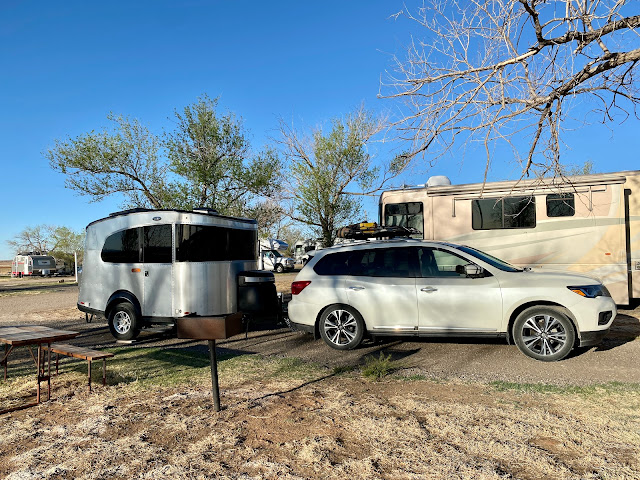
Kampgrounds of America, Tucumcari, New Mexico, Airstream Basecamp
Tucumcari KOA, New Mexico

Tucumcari KOA Journey, NM; Holbrook/Petrified Forest KOA Journey, AZ


I've written about Kampgrounds of America before ("First Impressions"), and my Southwest experience with KOAs remains the same--consistently predictable with upkeep and cleanliness . . . and predictably not a "woodsy" experience. For the trip out, we stayed in two, and I had to look at my phone's photos to remember their distinguishing features. They were pleasant, though, and the pull-throughs were flat and accessible. We did get to see our first Airstream Basecamp in Holbrook, even though we didn't get an opportunity to chat. On our trip back to Iowa, we didn't stay in any KOAs, yet that wasn't intentional. For a roadside park that keeps its standards consistent, KOAs are a good bet. We hit a couple two nights in a road, and they put us up for the night and got us down the road.
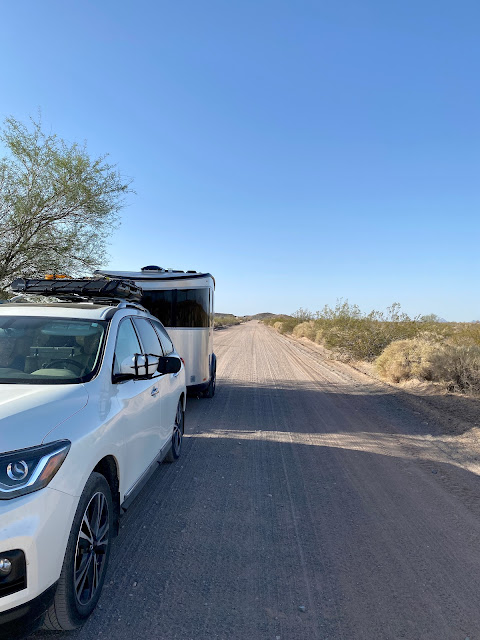
Airstream Basecamp, Sonoran Desert, Nissan Pathfinder
Oasis RV Park at Aztec Hills

Oasis RV Park at Aztec Hills, Dateland, Arizona


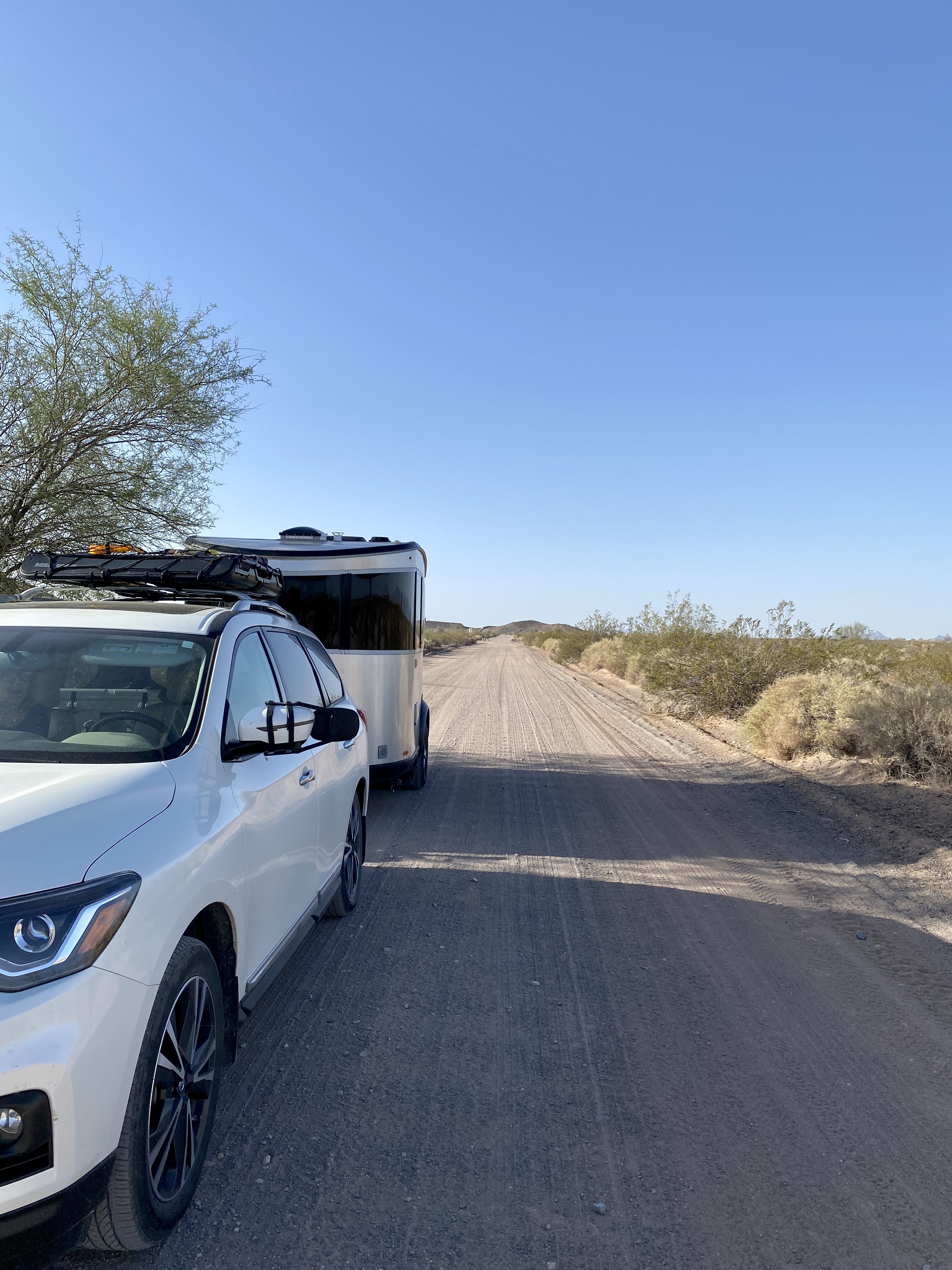
Oasis RV Park was our last stop before arriving at Carlsbad, California, and our first overnight stay after leaving Carlsbad. It's in the middle of the desert, and I wrote an article about our first stay upon reaching Carlsbad. ("Arizona Desert Basecamp Overnighter") This RV park certainly is in the desert in the middle of nowhere, yet there were a surprising number of folks staying there long term. Our first arrival was quite an unexpected event, as chronicled in the first article, linked above. Our return stay was hotter, yet at least we knew this little oasis really did exist as we headed down that gravel and dirt road into the desert. The owner and his wife kept the park clean, and it was interesting to see how their work routine began at dawn, when the day was coolest. 
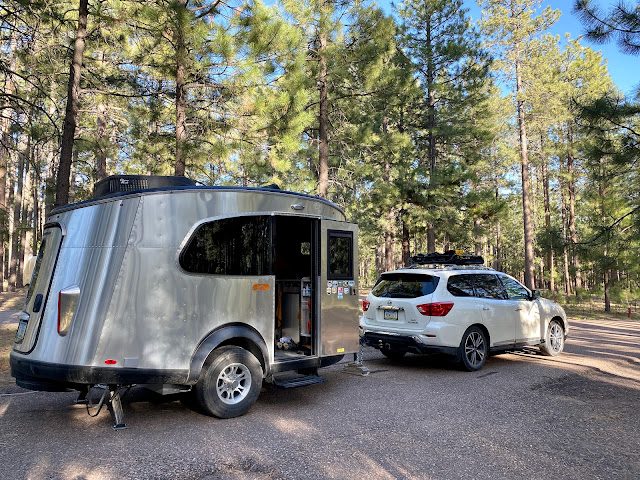
Mongollon Rim, Arizona, Canyon Point Campground, Airstream Basecamp
Safely nestled in for the night at Canyon Point
Mongollon Rim, Canyon Point Campground
Canyon Point Campground

Canyon Point Campground, Forest Lakes Estates, Arizona


After our first night on our return trip at Oasis RV Park, we decided to camp in the forest on the Mongollon Rim in Arizona at six thousand feet in elevation--a big change from the desert sojourn the night before! Canyon Point Campground is a federal campground in the Apache-Sitgreaves National Forest. The campground was closed on our way out but opened its season on May 1. We arrived on May 2, so there were a few minor glitches in our registration, but nothing noteworthy. (Believe it or not, we had trouble giving our camp fee to the staff. I finally told my wife Sandy, "I'm tired and don't want to wait around to pay. I'll just take a nap in the road, and they can wake me up when they want their money!" Luckily, someone showed up to collect.) It was windy, but we enjoyed the Ponderosa pines and the cool air after the desert. We could see that if we had more time on our trip how we could locate more scenic campgrounds. We were lucky Canyon Point was just off the road.

Hidden Valley Mountain Park, Tijeras, New Mexico


In several ways this was our least favorite park on the trip. It met the basic requirements of close to our route and clean, with an easy pull-through. However, the park didn't tell us when we registered that the nearby shower house was out of commission because of sewage repairs. We had to hike a long distance to an upper shower house, which they didn't even tell us about. We learned that the park had just been sold to a larger company. The park is laid out with the chevron pattern for RVs, so this park had many of the disadvantages of tight spacing and little landscaping without the amenities or sense of personal commitment that other small RV parks had. My main memory of this park (other than a friendly cat) was seeing in the hills above large, expensive homes with decks overlooking the valley below . . . which was stacked with RVs, ours among them. The irony of that contrast made me a bit sad--beautiful hilltop homes, a beautiful valley below, and a sardine scrunch of RVs "nestled" among the junipers growing in the dry, red soil. We were off early the next morning, though, no harm done.

Seven Winds RV Park, Liberal, Kansas


This is the RV park that I described at the beginning of this article, the one with the duct-taped toilet seat. Liberal, Kansas, is in southwest Kansas, where Kansas, Texas, Oklahoma, New Mexico, and Colorado are all in close proximity. In many ways Seven Winds was the most worn of the RV parks we stayed at on this trip, but in many ways it was also the sweetest experience. The manager was efficient, friendly, and helpful; the park was clean and peaceful; and with this park and the next night's (also in Kansas), we were given a look at how many Americans have found a home with "Mom and Pop" in these little, rural RV parks. The woman who checked us in was both professional and personal in her interactions. The southwest Kansas spring weather was hospitable, although the manager did tell us that we had "just missed some wind," which reminds me that the local town did have some tourist stop about Dorothy and Oz. Hmmmm. It was heartening, though, to see that some folks have found an economical way to live--most likely out of necessity--that includes a full-time residence in recreational vehicles (including 5th-wheelers and travel trailers) that are built more for shorter-term use. 

Mill Creek Campground, Paxico, Kansas


Our last stop on our trip home, Mill Creek Campground is about ninety miles west of Kansas City (either one, Kansas or Missouri). It reminded us of Seven Winds, perhaps a bit more renovated but both still next to the railroad tracks. Perhaps it was because of all those miles of driving, but we were never bothered by passing trains in any of the parks we stayed at. Railroad noises and road traffic noises are not uncommon in RV parks. Mill Creek and Seven Winds were both rural parks in rural communities. We found them quieter because they weren't near the interstate highways. Like most of the parks we stayed in, the pull-through was a composite of gravel, sand, and dirt--not bad except when it rained (as it did here), and then the it was easy to track in reddish footprints. Here at Mill Creek, we met a nice young maintenance man who asked us if we needed any help.  "We've got on-demand hot water," he said, "so don't worry about running out when you shower." The owner, who lived on his farm on the hill above the park, said to call if there were any problems. We cooked dinner and then went to bed early, since it had begun to rain. Up early the next morning to try to beat the rain, we still spent much of the trip home with light fog and misting rain. 
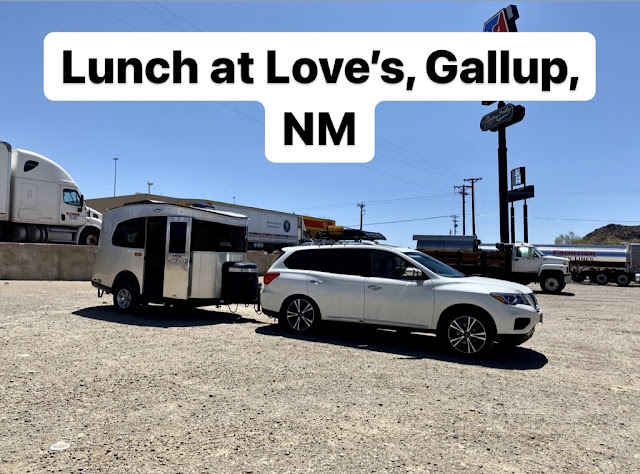
Love's Travel Stops, Gallup, New Mexico, Airstream Basecamp
A convenient gravel overspill truck lot on the other side of Love's
RV parks definitely have a place in the camping world, both for travelers and for full-time camping. If my wife didn't have her consulting business, we could have taken more time for the trip across the country. We wouldn't have had to pay so much attention to cellphone signal strength and internet receptivity. We could have set our destinations for scenic camping spots and traveled with the 2-2-2 travel model in mind (two hours of driving, arrive by 2 P.M., and stay two days). Because our destination travel was solely our final destination in Carlsbad, California, we spent longer hours traveling (but not very long hours), and it was a delight to discover little privately owned RV parks all across our nation. That made our trip easier, and we didn't have to spend our nights in Walmart parking lots or Love's Travel Stops with the big rigs. No, I didn't get a photo of every place we stopped--in part because arrival at some of the Mom and Pops gave us a chance to just let go, to drop our on-the-road vigilance. If kids are playing on the swings and dogs are lying in the middle of the street, it's okay to relax, right?

After this trip, we feel more comfortable with our traveling routine and with our new Airstream Basecamp 16, which we bought in 2021. We now know that the larger campgrounds, such as KOAs or "resort RV parks" have spaces for overnight travelers. We also know that there is a bit of adventure in discovering small, private RV parks to stay in for the night. We might expand our travel options by trying out some overnighters at truck stops or other parking lot options. It's nice to have opportunities and options when traveling down the road. Those worn yet clean RV parks tucked away across America? Perhaps that's what tried and true service experience looks like. Sometimes it's just plain nice to be mollycoddled.

Subscribe--Follow by Email

* indicates required

Monday, March 7, 2022

Hiking a Familiar Trail Is Spending Time with a Friend

Swimming area
We have to be careful walking a trail when a late-winter thaw is upon us. Soil transforms to a sticky gumbo, and what is packed sandstone gravel in the dry season becomes a semi-gelatinous jambalaya of chert and dirt. With my hiking stick, though, and a more careful consideration of where to put my feet, hiking the two-mile path that circles Indian Lake in southeast Iowa was my most recent outdoor adventure. Paying close attention to the weather forecast, I was delighted to see that mid-week during the first week of March was predicted to have warm, clear weather with temperature highs from the forties to the sixties. Off to Indian Lake Park, near Farmington, Iowa!

Marshy section prior to meadows
Spending three nights at the lake's city-owned campground, I was looking forward to my first full day there to include a walk around the lake. It's a great walk and also an easy walk, much of it a wide sedimentary stone path that maintains a beautiful perspective of the placid lake. The trail includes three main presentations: the front area of campground, lodge, and swimming hole; the backside of the lake which includes lake view and woods; and then the lower end of the lake with marsh and meadow, where the graveled trail becomes a mowed grass pathway. The trail also includes enough change in elevation to provide variety with some steep but short hills and some low areas with running water at the right time of season.

Crossing the dam
My wife and I bought our first pair of collapsible trekking poles this last December, and this was my first chance to hike with them--or actually just one, since I didn't feel that I needed two. Having one pole would provide some extra support and steadiness if I slipped on the thawing trail, yet I wouldn't have to manage both poles and have both hands full. Since the trail was so malleable, the stick did come in handy, providing an anchor for ascents or descents when what appeared to be solid ground just slipped sideways. There were times, though when I just carried the pole, not using it for walking, and I was happy to discover that the next day while bike riding, I was able to collapse the pole about a third and then have the pole function as a dog stick if I needed to keep off some territorial canine.

Forward campground--gravel and drier
For whatever reason, I usually walk the lake in a clockwise direction, which allows me to move through the developed area first, then to enjoy the woods and lake, and finally to walk the easier path along the lower end of the lake, ending with the upper-meadow experience of several ancient white oaks that are over two hundred years old. Depending on where I'm camping, then I reach the campground area and walk to my trailer. This trip, I parked in the campground closest to the entrance because it was the driest and least muddy. Even though there is no view of the lake from the front campground, I really enjoyed keeping myself and the camper out of the mud. 

White Oak in the upper meadow
The trail around the lake is a stroll with an long-time friend. There's a lot that is familiar and comfortable--a bench and vista, the hike up a steep hill from a creek crossing, a pocket of meadow on the saddle of a hill, the drop back down to another ravine bottom with its rivulet of snow-melt. I also always sit on a bench at the end of the hike and commune for a time with the ancient, gnarled white oaks, stark and gray at this time of year, sentinels of the passing years that have witnessed so much silence and birdsong. The trail also provides something new each trek, whether it's a bluejay flashing color among the bare limbs of maple, oak, and sycamore, or whether it's the silent gaze of a doe, wary yet curious, on the hillside. During the right time of year, such as this hike, the background melody of running water splashing over stone downhill to the lake also adds to the uniqueness of the hike, always changing its pitch and timbre, and sometimes not even there, the moisture sleeping in the soil.

What a wonderful late-morning hike! I could feel the sun on my face giving me a bit of color, a welcome warmth after the drear cold of winter. I could feel I was out of shape but still fully capable of this easy hike. I was inspired to get out more, hopeful of better weather to come, and nourished by the natural world that always invites one to be a part of the unity, the web of life and existence. It's like seeing someone you know well, someone you've known your entire life, and then realizing it's your reflection on the still waters of the lake. Hello, old friend, walk with me a while. I've forgotten what good company you are, but now I remember; and that sigh I hear from you is the wind crossing the lake, stirring the juniper trees, wind as much my breath as yours, for we are one, now and forever.

Subscribe--Follow by Email

* indicates required

Saturday, January 29, 2022

Boondocking in Iowa--Sorta . . .

Practicing off the grid at Bellevue State Park, Iowa
Speaking of "sorta," I sorta have a goal to camp at least once a month for all twelve of the months of 2022. January has almost run its course, and I haven't yet camped. I'm not obsessing, though; however, there is a chance I can still camp this January. The weather is better here in SE Iowa these last few days, even though the snow on the ground may stop me from camping because the snow will be too deep in campgrounds to set up. Our local state park has one site cleared, though--a pull-through right next to the campground entrance, a primitive site without hook-ups. That means I could camp there by using my batteries and propane, off the grid. And this is for Iowa and probably much of the Midwest, about as close as one gets to boondocking--camping in primitive sites in a campground. I might head out and "boondock" for one or two nights here at the last of January--if the weather holds and I'm up for it. 

I see the practice of "boondocking" as having several levels of engagement with being off the grid. The lightest engagement is camping at a campground site that has all the hook-ups . . . but just not using them. From there increasing levels of camping off the grid would be to camp at a campground with full amenities but choosing a primitive site (sometimes called "tent sites"). Next would be camping at a campground that has all primitive sites with perhaps a water faucet and vault toilets. A further progression would be a campsite that has a fire ring and nothing else. These are pretty much the sites for boondocking available in Iowa. A few are even for free, but I've found those to be few and far between.

I am excited, though, to experience more primitive camping while using my 16-foot Airstream Basecamp trailer. It's built to travel over terrain that's less flat because of its height above the ground and its rear angle, good enough to find a spot in many primitive sites at designated campgrounds. Being able to set up camp with more elbow room than the more developed campground sites is a real motivator for trying boondocking here in Iowa. This is especially true if I use my solar panels to provide power for evening lights and for the 12-volt refrigerator; then I can stay for longer times than a couple of days. Let me provide some examples of campgrounds I've found that I'm eager to "boondock" at.

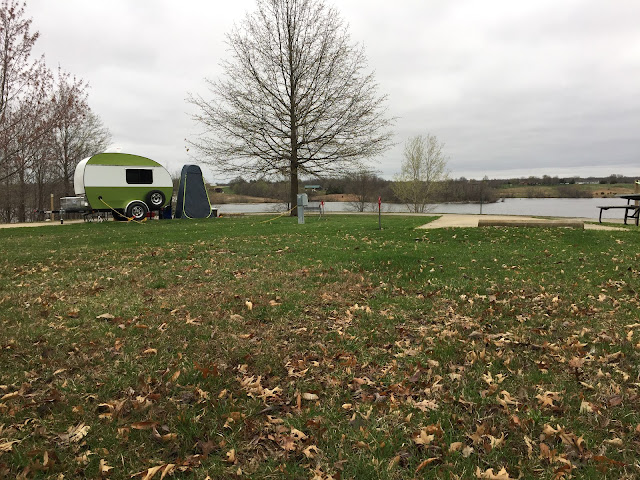
Lake Sugema, main campground, with my first travel trailer, the Green Goddess

Lake Sugema Campground

Lake Sugema is mostly a fishing lake, but it is one of the more modern county campgrounds around. Beyond the modern campground loops, though, is a primitive camping section that is more secluded than the rest of the campground. It has a faucet in a central area and a selection of campsites with sun and shade. 

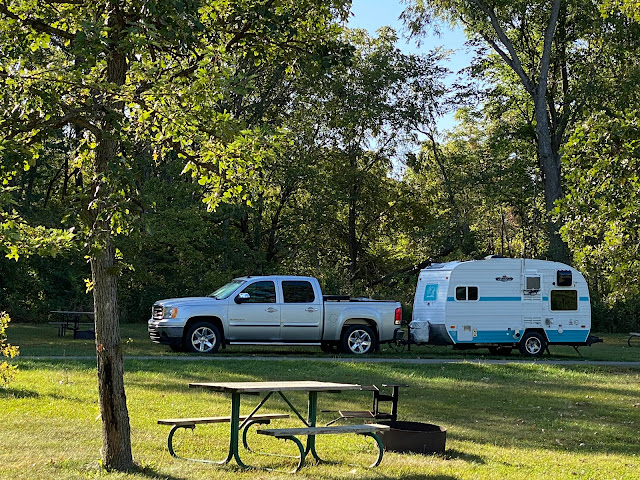
Rock Creek State Park, primitive camping area, an overnight camper
Rock Creek State Park

This state park was hit pretty hard by the derecho winds that swept the state a couple of years ago. I found this out when I mentioned during my state at Rock Creek at how few shade trees the campground had and was told that many broken trees had to be removed. A big surprise was how large the primitive portion of the campground was, with sites having lots of space and with even sites close to the lake. Camping at these primitive sites would provide a whole new experience of the lake and park. 

Geode State Park primitive camping area

Geode State Park

As with the two above campgrounds, Geode also has a primitive camping section that has a separate area. The campsites run along a ridge, away from the rest of the modern campground, providing more quiet and less traffic. Campsites offer either shade or more of a meadow experience, which provide different opportunities for both warm and cold camping seasons.

I've listed these three campgrounds because they are representative of the primitive camping experience available in many traditional county and state parks in Iowa. These three have certain qualities in common.
  • The price for the primitive sites is less than for modern sites.
  • If you don't mind a walk, modern toilet and shower facilities are available.
  • These three primitive campgrounds have fairly level and accessible campsites for trailers. It's not uncommon for "tent sites" to be on sloping and sub-optimal ground. Not so with these campgrounds.
  • Dump stations are available.
  • In an emergency, I could most likely move to an electric site to charge trailer batteries. 
Wildcat Den State Park, off the grid
Perhaps with time, I'll find some Iowa sites for camping that are for free. I know of a couple that are in small woodland plots or near river access--county land. I also have heard of one free camping area along a trout stream in NE Iowa. However, I've never camped in these areas, so I won't recommend them. I'm sure I'll find more campsites as I continue to explore. For right now, I'm enjoying the process of interacting with my year-old Airstream and all its gadgets that allow me to live at ease in more primitive facilities. My main off the grid camping experience this year was at Wildcat Den State Park, which is an Iowa state park that has only primitive camping facilities. These facilities consist of a meadow with a ring of campgrounds, a couple of central faucets, and a vault toilet. Interestingly, my two camping experiences there were during hot weather, and with the last trip also including a stink bug invasion. Air conditioning and zipping closed the trailer have their advantages, I discovered.

In Iowa, weather extremes, especially heat and humidity, will affect my boondocking rambles. Also, the more I primitive camp, the more I'll learn about the capabilities of my unit and the more confident I'll be off the grid. I see no need to go too far or too fast, though--not all at once, anyway. Let me increase my experience as I go, happily setting up camp and then reporting about my experiences. As for a January camping trip--off the grid--we'll see what the weather has to bring for the next few days.

Subscribe--Follow by Email

* indicates required

Friday, September 3, 2021

Camping for Health and Wholeness--Finding Your Inner Basecamp

Basecamp, tiny trailer style. Lacey-Keosauqua State Park.
My intellect bypasses the beauty of this hike I'm taking and provides a lesson on natural history. Go figure, but I am a naturally curious person. This long ridge of land was once an inland sea. When the sea receded, over time the sandstone eroded, and out of this shoulder of earth was carved this curving ravine, this green hollow of diverse life that finds this ecological niche most hospitable--ferns and mosses, succulent plants needing more water and shade, trees that grow tall and spindly because they reach to the sky for sufficient light. 

Beauty discovered at Wildcat Den State Park.
Not to be outdone, my heart whispers that I've entered the womb of the earth, that down in this cupped, curved hollow the world holds its secrets close, and that they are not secrets or mysteries; rather, they are joys and wonders that any child can explain, unexpected beauty surrounding us that can be discovered merely if we take the time to look. The sky opens above us, and thin beams of light reach down, lambent and tender, and this natural beauty awakes within me correspondences I have forgotten. The fall of light quickens something inside of me, stitching together the fragments of myself, making me once again whole.

Children experiencing the wonder of the Maquoketa Caves.
When our world grows chaotic and we feel somehow separated, lessened or weakened by the constant, busy, impersonal cacophony of the day, we need a reminder of the greater world, that the world is greater than just humanity. William Wordsworth wrote about this in around 1802, saying that the Industrial Revolution took as much as it gave ("The World Is Too Much with Us").

The world is too much with us; late and soon, 
Getting and spending, we lay waste our powers;—
Little we see in Nature that is ours;
We have given our hearts away, a sordid boon!

Have we given our hearts away? Have we lost--or better, forgotten--our capacity to interact with the world? When we spend less time in nature, then do "little we see in Nature that is ours"? What a shame that is! The beauty and power of nature is that same beauty and power within ourselves. That is what we need to remember--that is what we need to reawaken when our spirits are depleted.

Basecamp in an urban campground. Illiniwek Forest Preserve.
Finding our place and ourselves in nature is "humanity's oldest endeavor," according to an essay, "Our Deepest Affinity," by Thomas Lowe Fleischner. "No wonder--our survival has wholly depended on our capacity to pay attention to the encompassing living world, full of threats, foods, and delights." Fleischner explains that "we live in a very odd historical moment" in which people are so surrounded by human-made things that we have little around us to remind us of the natural world. That is why the experience of walking out of the office and into the freshness of an approaching thunderstorm is so powerful. The untamed winds of the approaching storm give us a reminder of the greater world, a natural world sweet and rich with the promise of approaching rain, of moist, green earth. We breathe in a deep breath and feel suddenly more awake, invigorated and connected. Fleischner's conclusion is that we need nature. "The current gush of social dysfunctions--violence, depression, anxiety, alienation, lack of health in so many ways--coincides with the mass sacrifice of human interaction with nature."

We expand our vision to a greater world. Maquoketa Caves State Park.
Camping is humanity's "oldest endeavor"; it is a means for us to integrate ourselves into the integration of the world--that we, either individually or as a species, are where the fragmentation and purposelessness resides. It is not that we are tone deaf to birdsong; it's more that we have taken ourselves to places where there are no birds! As Wordsworth says in his sonnet: "For this, for everything, we are out of tune." We can find wholeness in nature (and wholeness and health share the same word root). 

My wife calls me to the window, and a brilliant goldfinch is eating hyssop seed, the plant bobbing with the bird's weight as it eats. It is the early morning, just past dawn, and a thunderstorm has passed. After a hot, dry week, the air is cool and moist. The earth has received a rejuvenating sip of rain, and I am rejuvenated by what my senses tell me: we can heal ourselves by healing the earth. The hyssop, the black-eyed Susans, the cosmos blossoms, the zinnias, cucumbers and okra, honey bees and bumblebees, the wrens and goldfinches--this late summer haven we have created with our vegetable and flower garden is a haven not just for the natural world we have invited but also for nature within us. Sitting by the campfire should be just an extension of how we live our natural lives--a garden at home, a plant in the office, taking our lunch outside or commuting with a bicycle. The world is our home; we shouldn't keep ourselves locked away in a closet . . . no matter how nicely we have furnished that little space.

Some basecamps are more permanent than others.
I open the door and walk outside, barefoot. The sidewalk is a wet and cool; the grass is lush. I admire the peach tree that grows at the corner of the fence. It gave its crop of juicy peaches to us this year--peach pie and peach cobbler, fresh peaches for breakfast--and now it drinks the early morning rain, its aged limbs propped with lumber for support and protection from heavy winds, a painted wren house swinging from a limb. Yes, I live in a home on property I own, but I mean to share that property. My wife and I mean to share our land because it isn't really just "ours," if we consider all the other lives that also live with us, from the singing birds and pesky rabbits to the worms and microbes in the soil. 

Solo camping at Rathbun Lake. Honey Creek State Park.
In his essay, Fleischner shares the results of medical studies, concluding "it's stunning how remarkably healthy time outdoors turns out to be," that finding nature, whether walking by the ocean or in the forest, or simply going outside to cloud-gaze or to feed the pigeons, is healthy for both body and mind, a medical reality leading to "prescriptions" for wellness that include being in nature. Call it "nature therapy" or "forest therapy," we are healthier when we spend time in nature. That's why once the heat spell breaks, my wife and I will camp for two weeks by Rathbun Lake at Honey Creek State Park, spending time walking the beach or hiking the woods. If it's cool enough, we will start a fire in the morning and sit beside it sipping tea and waking up with the world. My wifes works online sometimes while we've camped and has had the opportunity to tell a client during a phone call, "I'm talking to you, and as I speak a doe and her fawn are lying down in the shade of a maple tree thirty yards away." 

A safe haven.
We camp in our Airstream Basecamp, but I am beginning to realize all the nuances of that word, basecamp. A basecamp is a safe, stable place from which we venture forth on our explorations. It is the foundation for activity. Camping is a means for affirming our place in the natural world; it's also a means for affirming who we are, a way to reconcile and integrate our quick, frenetic lives to the eternal rhythms of nature, to widen our perspective, just as our view expands when we reach a mountaintop and scan the panorama around us or when we turn away from the ocean shore and look out across the ocean to the horizon, where sky and water are one. Camping can help us find our "inner basecamp," that perspective and strategy of life that includes the healing qualities of the natural world. Perhaps this is the true meaning of the current buzzword, glamping. "Glamorous camping" is in its essence, at least for me, not the pretty and expensive accouterments of camping; I think it's more the beautiful and priceless gifts the natural world freely provides. 

It is our obligation to "camp," whether it be sitting by a campfire, watering the begonia at our desk, or standing at our window, watching the goldfinch outside eat its fill of hyssop seed. Nature is not our toy. In this human-centric world in which we now live, we need to mother our Mother Earth, to be good stewards to the land. "Always leave the camp cleaner than when you came," my dad always said. This planet is our basecamp. In order for it to take care of us, we must take care of it. For our health and wholeness, we must keep nature in our lives; we must nurture and be nurtured by the natural world. Sitting by a small campfire is not a little thing: it is the light of the sun contained by a ring of stones. It is the beginning point of that adventure we call life.

Subscribe--Follow by Email

* indicates required

Thursday, July 29, 2021

Camping in the Not-so-deep Woods, an Urban Experience

Illiniwek Forest Preserve, Illinois
I awake on the eighth morning of my Mississippi River camping trip to birds singing and rich river smells drifting into my camper from my open side and back doors. The light is soft, the sun not yet having breached the horizon. Out my window, I see the muted, rippling reflections of the Mississippi's current as it flows downstream from the locks and dam just up the river. Night still puddles within the leaves of the trees. I am not camping in the deep woods, though, perhaps not even in the not-so-deep woods, although there is a pocket of deeper woods across the road--or highway, I should say. This is my first experience of urban camping, and you know what? It's surprisingly enjoyable.

The trilling morning song of the birds is punctuated by a steady orchestra of traffic sounds: the brash bray of a motorcycle, the deep growl of trucks, the whine of car tires on pavement. After a while the traffic noise ceases to intrude; after a while the urban sounds are just a cacophony that drifts to background chatter. A new and recognizable sound emerges in this urban orchestration--a Canadian Pacific locomotive pulling its train past the campground, the brass of its horn and the tympani of its wheels on the tracks. The deeper bass of a barge horn floats across the river, and now that I am listening for the urban-morning sounds, the steady drone of RV air conditioners add to the morning's urban symphony. Yes, indeed, welcome to camping in the not-so-deep woods!

To pinpoint my experience, I am camping at the Illiniwek Forest Preserve on the Illinois side of the Mississippi River, near Moline in the Quad Cities area, across the river from Iowa. This forest preserve consists of 174 acres of woods and river frontage, including a campground. With hiking and biking trails, being linked to the Great River Trail, having both modern and primitive camping, and picnicking and a boat ramp, the preserve has something for pretty much anyone wanting some outdoor experience. This morning my wife and I watched a pleasure yacht leave the river's lock and head downstream. Yesterday evening we walked the shoreline road and saw a half dozen anglers happily fishing. One guy with a grin held up a sack o' catfish when we asked him how the fishing had been. A steady flow of bicyclists on the river trail require us to keep an eye out for riders so focused on keeping their pace that they get a little crazy. It's a hot summer July day, and this urban forest preserve is definitely fulfilling its mission: "to connect the community to nature through land preservation and recreation as well as administering educational opportunities."

Finishing up my third day here at the preserve campground, I ask myself, "How enjoyable is this urban camping experience?" I mean, last night before going to sleep, I looked out the window and saw a police car stopped on the campground road, talking to somebody. On the other hand, yesterday we also saw three children blissfully riding their bikes around and around the loop, just as happy as wrens flitting from branch to branch. I think this is one of those "Is the glass half empty or half full?" moments. The wooded forest preserve is just across the road, and the hilly woods are deep and lush and beautiful--once you get across the road, dodging 55 mph traffic. The traffic on the trails is regulated, one-way travel--one direction three days a week, the opposite four days a week, this probably mostly due to bicycle traffic and the attempt to lessen collisions. 

A pocket of wild at Illiniwek Forest Preserve
With 2.6 million monthly users, the website Treehugger emphasizes "Sustainability for all." The website's article on urban camping mentions a variety of forms of urban camping, from protest "camp-ins" to stealth camping to sanctioned events and spaces. Urban "camping" could include both the homeless and the houseless--those who are living on the streets or those who are living along the streets (in camping rigs). I'm focusing on two other aspects the article mentions: camping to connect with nature, and "urban campers look[ing] for a place to get away even when they don't have the time to travel to get away." Urban camping, really, is an extension of the philosophy that green zones should be a part of cities. Urban campgrounds provide the opportunity for some to interact with nature for more than an afternoon or a day. In a sense, urban campers are like those opossum, coyotes, squirrels, deer, and raccoons that live in fringe zones of wilderness in cities. The animals move back and forth between two environments, living in the transition zone. Urban campers don't experience the best (or most extreme) of both environments, primeval nature or posh hotels; they do, however, have a blended taste of both worlds, and that is a unique experience. Is it a form of glamping to be camping and to have a museum or theater or a fine restaurant nearby? The urban camping experience is a unique opportunity . . . or a great incentive to move on to more wild climes. You could very well see eagles fishing the Mississippi here at Illiniwek Forest Preserve, but you won't see wild bison grazing, unless the Buffalo Bridge Foundation has its way about the life of an I-80 bridge.

Here in Iowa, and I believe this to be true for much of the United States, the land has been "civilized" by human beings. Some scientists suggest that our modern era be named the Anthropocene Epoch, which a Britannica entry describes as "characterized as the time in which the collective activities of human beings (Homo sapiens) began to substantially alter Earth’s surface, atmosphere, oceans, and systems of nutrient cycling," the last meaning how biological life (matter) cycles and recycles in a sustainable manner. I think our "pockets" of nature, even if they are tiny pockets like here in the Midwest, are important reminders of how the world must be to maintain its sustainability, how the earth should be so it doesn't erode away, how the water should be so it is drinkable, how the air should be so it can be breathed healthily. People need--and the planet needs--the deep woods to be healthy, but the not-so-deep woods are also needed in this Anthropocene Epoch, both as reminders and as sustainers of life, as reminders of the "default" setting of the laws of nature. And it's also important to remember that when we consider nature's default settings in terms of geological time, it's not essential (to the laws of nature) that human beings be included in that resetting to reestablish balance and sustainability. Just ask the dinosaurs. 

Trying out solar panels as an Iowa state park
To experience the laws of nature swinging along on their own without the cosmetics of humankind--that's one reason why I bought a solar package option for my Airstream Basecamp. With the solar option, I can still use my trailer and many of its options of convenience, yet get a bit deeper into the woods . . . or maybe that's not accurate. I won't get any deeper into the woods; I'll still be in a small pocket of nature unadorned by humanity. However, that pocket will be a bit deeper, a bit more wild, a bit more reminiscent of the primeval. Why not just go backpacking? Why not just take off into the Alaskan or Canadian wild? I don't have a completely satisfactory answer for those questions, just an honest one. I have a "getting-older" physiology, I have a family and responsibilities, and having bicycle camped a bit, I've discovered that I'm not extremely motivated to experience "roughing it," or at least not much or not for long. My blog isn't called Green Goddess Glamping for nothing. The name isn't just about a camper we once owned. The name also refers to the comfortable, stress-free integration of camping with nature, of recognizing nature within us by experiencing and celebrating nature outside of ourselves. For me, camping in Midwest primitive campgrounds is an opportunity to intensify my contact with nature, as the Treehugger article referenced earlier observed, but not having to travel far away for the experience. Right now for me it would seem unnatural to leave behind wife, kids, and grandkids so that I could have a grand experience of untrammeled nature, even though my wife and I have invested in a fine piece of equipment for doing so (pause while I glance out my window at my camper in the driveway). My wife has also recently affirmed that the time is coming, but in the meantime, thanks to the foresightful people who have established these pockets of nature within the fabric of our society, pockets of nature that allow me to get away from it all . . . sorta.

My wife is working today online, outside this morning and inside this humid afternoon, and she expressed exactly what I'm feeling: "Hey, I can look up from my work and see the river." For many people, that's what urban camping is, an opportunity to look up from the workaday experience and see the sky, the water, to stand upon earth in the shade of a sycamore. It's a chance to connect with nature. Is it Denali National Park or the Pacific Crest Trail? No, and it's not even Iowa's Pikes Peak State Park, where I was camping a little over a week ago and had the chance to see the beautiful Bridal Veil waterfall, which was only a quarter-mile hike from camp. I'm camping in this little pocket of nature-left-alone, surrounded by the Quad Cities with a population of almost 400,000 people. My glass is half full, though. My little travel trailer is comfortable, the views are interesting and varied, and my wife Sandy has driven up to spend three days with me, an added treat on my seventeen-night Mississippi River camping tour. If I were alone, I'd be spending every morning on my bicycle, exploring the Great River Trail. Yesterday Sandy and I hiked some on the preserve trails, and once again I was impressed at how little distance one must travel from the landscaping of humankind in order to feel the over-arching, quiet yet powerful omnipresence of natural law. Green zones are good for the environment and good for our souls. 

Would I prefer camping in the deep woods rather than the not-so-deep woods? Yes, indeed! Just the other day I shared with Sandy some images of the Grand Tetons. Wouldn't it be great to go there? And one day we will. The deep woods are infused with the deep silence of nature--and are, of course, never completely silent or still on the surface, thanks to blue jays squawking or the scrabbling climb of a squirrel up a tree. Even with its casual noises, though, the deep woods exude that deep, abiding being of existence, the sense that nature is singing and dancing to its own song, and that it is our song, too, and would we please join the dance, our dance? The answer is yes. Even in an urban campground, we can hear the song of existence. If we cannot hear it, it's because we have forgotten how to listen, or because we've become distracted. Even the urban woods help remind us of our legacy, of our birthright, of our true nature. My glass is half full, and the nectar is sweet.

Subscribe--Follow by Email

* indicates required
Click to learn more